The short answer
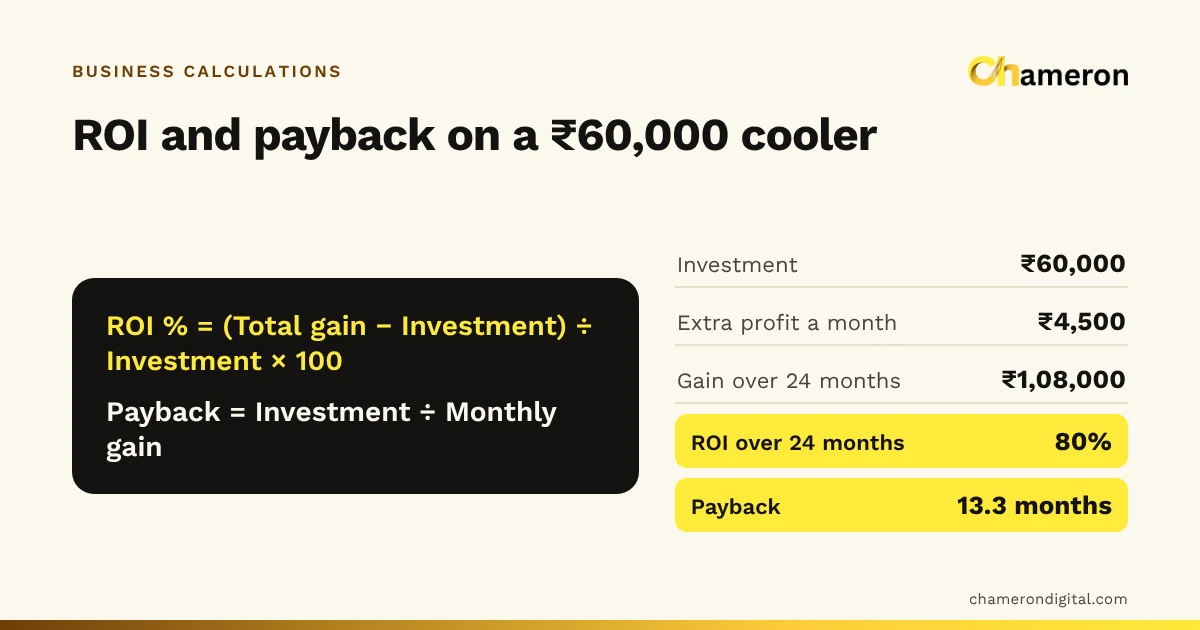
Return on investment (ROI) measures how much an investment earned compared with what it cost. Subtract the amount invested from the total extra profit it brought over a period, divide by the amount invested and multiply by 100. Pair it with the payback period: the investment divided by the extra profit it brings each month. An example ₹60,000 cooler that adds ₹4,500 of profit a month returns 80% over two years and pays for itself in about 13 months.
The ROI and payback formulas
ROI answers "was it worth it?"; payback answers "how soon do I get my money back?". Both depend on getting two inputs right: the full investment and the true extra profit. The next two steps cover each.
Step 1: Count the whole investment
The investment is everything you spend to get the benefit, not just the price on the quotation:
- the purchase price, after any discount, without GST you can claim back;
- delivery, installation, electrical work and fittings;
- training time and any setup charges;
- the first stock needed to use it, such as cold drinks to fill a new cooler;
- interest, if you borrow to pay for it (see time, loans and risk below).
Leaving out installation or initial stock makes ROI look better than it will be. Write the full list down before you decide.
Step 2: Measure the return as extra profit
This is where most ROI figures go wrong. The return is the extra profit the investment causes, after its own running costs. It is not extra sales.
Use the gross margin on the extra sales (the difference between gross and net profit matters here: running costs come off separately). Then ask two questions about every rupee of "extra" profit. Would it have happened anyway? And did it come at the expense of something else you sell? A cooler that sells chilled drinks partly replaces warm drinks you were already selling from the shelf; only the difference is extra.
Worked example: a beverage cooler
An invented general store is deciding whether to buy a beverage cooler.
| Input | Amount |
|---|---|
| Cooler, delivery and installation | ₹60,000 |
| Extra cold-drink sales per month | ₹30,000 |
| Gross margin on those sales | 20% |
| Extra gross profit per month | ₹6,000 |
| Extra electricity per month | ₹1,500 |
| Extra profit per month | ₹4,500 |
Now see what happens if the owner makes the most common mistake and counts sales instead of profit: ₹30,000 × 24 = ₹7,20,000 of "return", which gives an ROI of 1,100%. That figure would justify almost any purchase, and it is meaningless. The ROI calculator asks for extra profit per month for exactly this reason.
If the cooler can be sold for something at the end of the period, you can add a cautious resale value to the total gain. Leaving it out keeps the estimate conservative.
Compare investments on ROI and payback
ROI becomes most useful when you have to choose. Suppose the same store has two other ideas for its money, both measured over 24 months.
| Shop renovation | Delivery two-wheeler | |
|---|---|---|
| Investment | ₹2,00,000 | ₹1,00,000 |
| Extra profit per month (after running costs) | ₹10,000 | ₹6,000 |
| Total gain over 24 months | ₹2,40,000 | ₹1,44,000 |
| Net gain | ₹40,000 | ₹44,000 |
| ROI over 24 months | 20% | 44% |
| Payback | 20 months | 16.7 months |
The renovation brings more extra profit each month, but it ties up twice the money for a similar net gain. The two-wheeler has the higher ROI and the faster payback, and it leaves ₹1,00,000 free for other uses. The renovation's benefits may also last much longer than two years, so the owner might measure it over a longer period. Comparisons are only fair when the periods and assumptions match.
When the extra profit depends on extra sales, check whether the break-even point of the new setup is realistic: an investment that adds fixed costs raises the sales you need every month. The break-even calculator shows by how much.
Time, loans and risk
Always state the period
ROI without a period is incomplete. 80% over two years is roughly 40% a year on a simple basis (80% ÷ 2). When comparing investments of different lengths, convert to a yearly figure, or compare them over the same number of months. This simple method ignores the time value of money; for large, long-term decisions, ask your accountant or adviser about discounted methods.
Include the cost of borrowing
If the store buys the cooler with a loan and pays ₹6,000 of interest over the two years, the true cost is ₹66,000:
ROI = (₹1,08,000 − ₹66,000) ÷ ₹66,000 × 100 = 63.6%
Check the interest on any loan with the loan EMI calculator before you decide, and make sure the monthly gain comfortably covers the EMI, or the investment will strain your cash even if its ROI is positive.
Test a cautious case
The ₹4,500 a month is an estimate. Work out what happens if it comes in lower or higher.
| Case | Extra profit per month | Gain over 24 months | ROI | Payback |
|---|---|---|---|---|
| Cautious | ₹3,000 | ₹72,000 | 20% | 20 months |
| Expected | ₹4,500 | ₹1,08,000 | 80% | 13.3 months |
| Strong | ₹6,000 | ₹1,44,000 | 140% | 10 months |
If even the cautious case is acceptable, the decision is a safe one. If the investment only works in the strong case, think again or find a cheaper way to test the idea first.
Measure ROI after the fact
An ROI estimate is a forecast. Six months later, check what really happened by comparing like-for-like periods before and after: the same months, similar days, and the same categories.
Marketing is where this matters most, because it is hard to trace. Say the store spends ₹15,000 on pamphlets with a printed offer code, and 120 bills carrying the code come in, averaging ₹500 at a 25% gross margin. The gross profit from those first visits is 120 × ₹500 × 25% = ₹15,000: an ROI of exactly 0% on the first purchase. But if 30 of those new shoppers return every month for six months, spending ₹500 each time, they add another 30 × 6 × ₹500 × 25% = ₹22,500. The total gain becomes ₹37,500 and the ROI (₹37,500 − ₹15,000) ÷ ₹15,000 = 150%.
The lesson: measure what you can trace (codes, new customer numbers, sales of the promoted line), and give repeat business time to show up. Reports that show sales by day, category and customer make before-and-after checks far easier. Our guide on calculating business profit shows how to make sure the gross margin you use is real.
Pitfalls that inflate ROI
- Counting sales instead of profit. The single biggest error, as the cooler example shows.
- Forgetting running costs. Electricity, maintenance, fuel, subscriptions and extra staff time all come out of the gain.
- Leaving out part of the investment. Installation, training, initial stock and interest are part of the cost.
- Not stating the period. "200% ROI" means nothing until you know over how long.
- Claiming sales that would have happened anyway. Compare with a fair "before" period, not with your quietest month.
- Valuing time savings that never become money. Saving 2 staff hours a day is worth about ₹5,000 a month at ₹100 an hour over 25 days, but only if overtime falls or the time is used to sell more.
- Ignoring risk. A high expected ROI with a fragile assumption can be worse than a modest, reliable one.
The bottom line
Measure ROI as extra profit, not extra sales, against the full cost of the investment, over a stated period. Look at payback alongside it, include interest if you borrow, and test a cautious case before you commit. Then check the real result after a few months and learn from it for the next decision. For quick estimates, the ROI calculator works out the return and payback from three numbers.
Questions people ask
What is a good ROI for a small business investment?
There is no fixed number. Compare the ROI with what else you could do with the same money, such as repaying a loan or buying more fast-selling stock, and with the risk involved. When cash is tight, a short payback period often matters more than a high ROI.
What is the difference between ROI and payback period?
ROI measures how much an investment earns relative to its cost over a chosen period. Payback measures how long it takes to earn its cost back. A long-lived investment can have a high ROI but a slow payback, so look at both.
Should I include loan interest in ROI?
Yes, if you borrowed for the investment. Add the interest paid over the period to the cost, or subtract it from the gain. The business loan EMI calculator shows the total interest for a loan.
Can ROI be negative?
Yes. If the total gain over the period is less than the amount invested, ROI is negative and the investment lost money over that period. It may still turn positive later if it keeps earning.
How do I measure ROI on software or other time-saving tools?
Count the extra profit or money saved each month after subscription and running costs. Value time saved only if it turns into money, such as less overtime or staff time moved to selling. Our guide on choosing business software covers what else to weigh.