The short answer
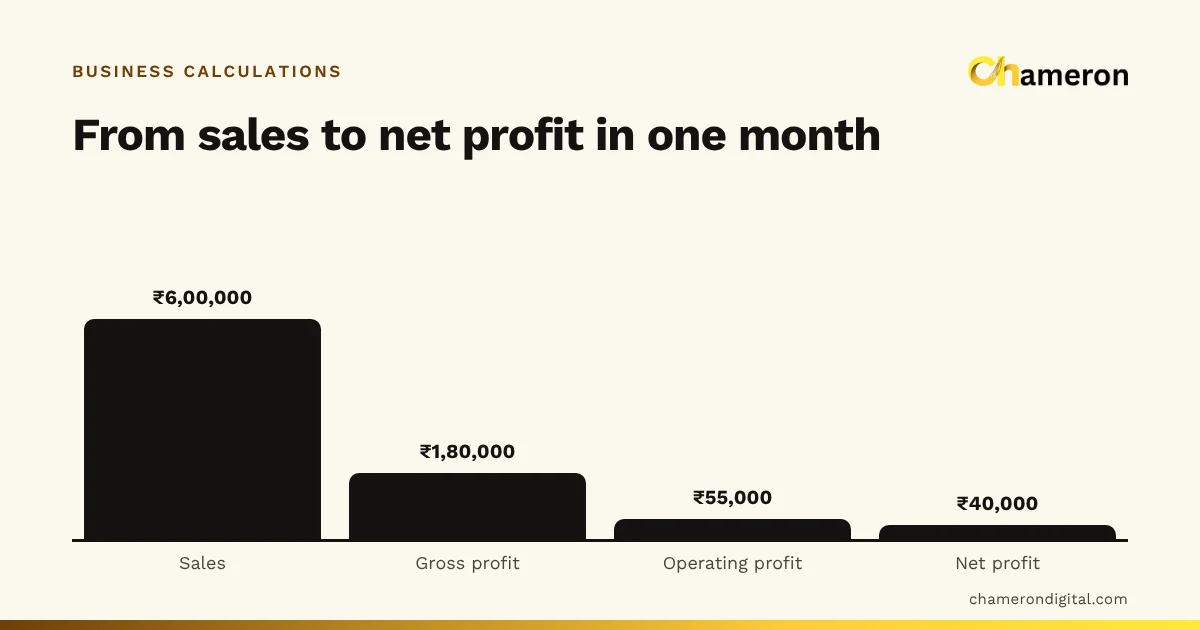
Business profit is worked out in three layers. Gross profit is sales minus the cost of the goods you sold. Operating profit is gross profit minus the costs of running the business, such as rent, salaries and electricity. Net profit is what remains after interest and tax. An example shop with ₹6,00,000 of sales in a month makes ₹1,80,000 gross profit, ₹55,000 operating profit and ₹40,000 net profit, and each figure tells the owner something different.
The three layers of profit
Each layer removes one kind of cost, so each answers a different question about the business.
| Layer | Question it answers | What it ignores |
|---|---|---|
| Gross profit | Are my prices and purchase costs right? | Rent, wages and every other running cost |
| Operating profit | Does the shop itself make money from its day-to-day work? | How the business is financed, and tax |
| Net profit | What do I actually keep for the period? | Nothing: it is the bottom line |
Gross profit is about buying and pricing. Operating profit is about running costs. Net profit is about everything, including the loan you took to fit out the shop. A business can be strong on one layer and weak on another, which is why it pays to calculate all three rather than only the last.
Get the four inputs right first
Most profit figures go wrong before the arithmetic starts. Collect these four numbers for the same period, usually a calendar month.
- Sales, without GST. Take total sales, subtract returns and discounts given, and remove the GST you charged. GST collected belongs to the government; it was never your income. If your prices include GST, our guide to GST-inclusive and exclusive prices shows how to take it out.
- Cost of goods sold (COGS). The purchase cost of the goods that actually left the shop this month, not the bills you paid to suppliers. The formula is below.
- Operating expenses. Rent, salaries, electricity, phone and internet, software, card machine charges, packaging, repairs and a share of the cost of equipment.
- Interest and tax. Interest on business loans, and income tax on the profit. Your accountant can tell you how tax applies to your business.
The closing stock figure needs a count or a reliable stock record. Our guide on how to calculate stock value explains how to value it at cost, and the short answer on cost of goods sold covers the idea in more detail.
Worked example: one month at a general store
An invented general store closes its books for a month. All figures exclude GST.
Step 1: Cost of goods sold
The store bought ₹4,40,000 of goods but only ₹4,20,000 worth were sold; the other ₹20,000 went onto the shelves, which is why closing stock rose.
Step 2: Gross profit
Sales were ₹6,00,000, so gross profit is ₹6,00,000 − ₹4,20,000 = ₹1,80,000.
Step 3: Operating expenses and operating profit
| Expense | Amount |
|---|---|
| Rent | ₹40,000 |
| Salaries (including a fair salary for the owner) | ₹60,000 |
| Electricity | ₹8,000 |
| Software, phone and internet | ₹4,000 |
| Card machine charges | ₹3,000 |
| Carry bags and packaging | ₹5,000 |
| Depreciation on fittings and equipment | ₹5,000 |
| Total operating expenses | ₹1,25,000 |
Operating profit is ₹1,80,000 − ₹1,25,000 = ₹55,000.
Depreciation is the cost of shelving, a computer or a fridge spread over the years you use it, rather than counted all at once in the month you bought it. Without it, the month you buy equipment looks terrible and every later month looks better than it really is.
Step 4: Interest, tax and net profit
The store pays ₹7,000 of interest on a business loan, leaving a profit before tax of ₹48,000. Suppose the owner's accountant suggests setting aside ₹8,000 for income tax on this month's profit (an invented figure for the example; the right amount depends on your business and should come from your accountant). Net profit is ₹48,000 − ₹8,000 = ₹40,000.
| Line | Amount |
|---|---|
| Sales | ₹6,00,000 |
| − Cost of goods sold | ₹4,20,000 |
| Gross profit | ₹1,80,000 |
| − Operating expenses | ₹1,25,000 |
| Operating profit | ₹55,000 |
| − Interest | ₹7,000 |
| − Tax set aside | ₹8,000 |
| Net profit | ₹40,000 |
This table is a simple profit and loss statement. Kept every month, it becomes the most useful page in your business records.
Turn each profit into a margin
Rupee figures are hard to compare between a busy month and a quiet one. Dividing each profit by sales turns it into a margin you can track.
For the example store: gross margin is ₹1,80,000 ÷ ₹6,00,000 = 30%, operating margin is ₹55,000 ÷ ₹6,00,000 = 9.2%, and net margin is ₹40,000 ÷ ₹6,00,000 = 6.7%.
Read them as a chain. Of every ₹100 the store takes (before GST), ₹70 pays for the goods, about ₹20.83 pays for running the shop, ₹2.50 goes on interest and tax, and about ₹6.67 is kept. If next month's gross margin slips to 28%, the owner knows to look at purchase prices and discounts. If gross margin holds but operating margin falls, the cause is a running cost. Our guide to profit margin vs markup explains why margin, not markup, is the right measure here, and the margin calculator works out single-item margins.
What counts against profit, and what does not
Several large payments leave your bank account without being expenses, and some real costs never pass through it. This table settles the usual doubts.
| Item | Counts against profit? | Why |
|---|---|---|
| Stock bought this month | Only the part sold | Unsold stock is still an asset; COGS picks up what was sold |
| GST collected on sales | No | It is owed to the government, not earned |
| GST paid on purchases you can claim back | No | It is recovered as input tax credit |
| Loan instalment: interest part | Yes | Interest is the cost of borrowing |
| Loan instalment: principal part | No | It repays a debt; it is not a cost of the month |
| Money the owner takes out | No | It is a withdrawal of profit, not an expense |
| A fair salary for the owner's work | Yes, when judging the business | Otherwise profit hides the cost of your own time |
| New equipment | Gradually, as depreciation | It is used over several years |
| Expired, damaged or stolen stock | Yes | It lowers closing stock, which raises COGS |
The last row matters in retail. Stock that disappears shows up only when you count, through a lower closing stock and therefore a higher cost of goods sold. A shop that never counts is usually overstating its profit. Accounting treatment can vary, so check unusual items with your accountant.
Profit is not cash
The example store made ₹40,000 net profit, yet its bank balance could easily fall during the month. Here is why, using simplified figures.
| Step | Amount |
|---|---|
| Net profit | ₹40,000 |
| + Depreciation added back (a cost, but no cash left this month) | ₹5,000 |
| − Extra stock now on the shelves | ₹20,000 |
| − Loan principal repaid | ₹15,000 |
| − Extra credit given to customers | ₹12,000 |
| Change in cash | −₹2,000 |
Nothing is wrong with the business: it is profitable and its stock has grown. But the owner who looks only at the bank balance would think the month lost money, and the owner who looks only at profit might spend money that is not there. Track both. Our guide on tracking sales and expenses covers the daily records that feed both numbers.
Common mistakes
- Using purchases instead of cost of goods sold. In a month you stock up for a festival, profit looks terrible; in the month you sell that stock, it looks wonderful. Neither is true.
- Leaving GST inside sales. Profit and margins are inflated, and they shift whenever a rate changes.
- Forgetting the owner's own work. If the owner works full time for nothing, the business is subsidised, not profitable. Put in a fair salary when judging it.
- Counting the whole loan instalment as an expense. Only the interest is a cost; the principal repays debt. (It still matters for cash, as shown above.)
- Skipping depreciation. Equipment costs money over its life. Ignoring it overstates profit every month after the purchase.
- Mixing periods. Rent for two months paid in one month, or an annual software fee counted in a single month, distorts both months. Spread such costs over the months they cover.
- Never counting stock. Losses from breakage, expiry and theft stay hidden until a stock count brings them into COGS.
Make it a monthly habit
The calculation takes an hour once the inputs are ready, and the inputs come from records you should already keep: sales by day, purchases by supplier bill, expenses by receipt and a month-end stock figure. Set a fixed day, such as the third of each month, to close the previous month.
Software shortens this. When every sale and purchase is recorded with its cost, reports can show sales, profit and margins without manual adding up. BILL OS, for example, has profit and margin reports that download as Excel for your accountant. You still need to add running expenses, interest and tax for the full net figure, so keep those records tidy too.
Once you know your monthly operating expenses, the next useful step is your break-even point: the sales you need just to cover them. The break-even calculator does the arithmetic.
The bottom line
Calculate profit in layers. Gross profit tells you whether your buying and pricing work, operating profit tells you whether the shop covers its running costs, and net profit tells you what you keep. Use cost of goods sold rather than purchases, keep GST out, and treat loan principal and owner's withdrawals as money movements rather than costs. Do it every month, turn each figure into a margin, and compare the margins over time. For questions about tax and how your accounts should be prepared, speak to your accountant.
Questions people ask
Is profit the same as the money left in the till at the end of the day?
No. The till shows cash taken, which includes GST you owe and leaves out credit sales, stock you bought and bills you have not yet paid. Profit is worked out from sales and costs for a period, as shown in this guide.
Should I count stock I bought this month as an expense?
Only the part you sold. Stock still on the shelf is an asset, not a cost. That is why profit uses cost of goods sold, which adjusts purchases for the change in stock.
How often should a small business calculate profit?
Monthly is a good rhythm. It is frequent enough to catch problems while there is time to act, and a month is long enough to smooth out busy and quiet days. Do a stock count or a reliable stock valuation at each month end.
Do I include my own salary as an expense?
For judging the business, yes: put in a fair monthly figure for your own work, even if you take money out irregularly. Otherwise a business that cannot pay its owner can look profitable. For tax purposes, ask your accountant how owner's pay should be treated for your type of business.
What is a good net profit margin?
It depends on the trade, your rent, your staffing and how fast stock moves, so there is no single target. Track your own margin month by month, and make sure it covers loan repayments and the reserves you want to build.