The short answer
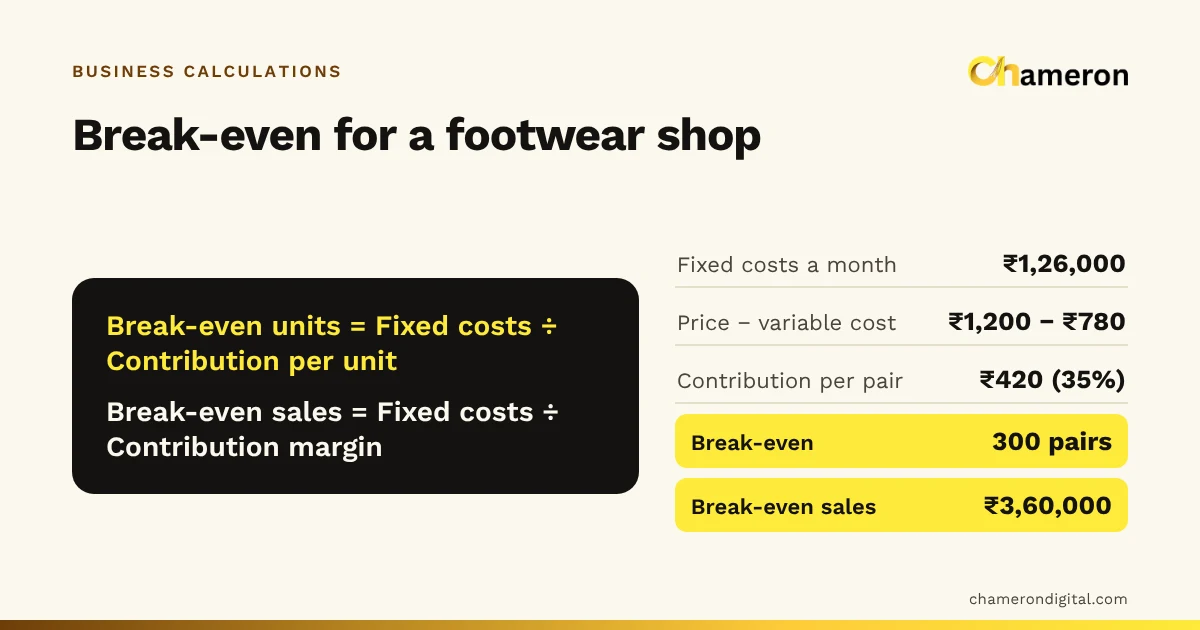
Your break-even point is the level of sales at which total contribution exactly covers your fixed costs, so profit is zero. Divide your monthly fixed costs by the contribution each unit makes (selling price minus variable cost) to get break-even units; divide them by your contribution margin to get break-even sales in rupees. An example footwear shop with ₹1,26,000 of fixed costs and ₹420 of contribution per pair breaks even at 300 pairs, or ₹3,60,000 of sales, a month.
The break-even formulas
Break-even rests on one idea: contribution. Each sale brings in its price, pays for its own variable cost, and the rest contributes towards fixed costs. Once enough sales have covered the fixed costs, the contribution from every further sale is profit.
Use prices and costs without GST, and keep everything to the same period, normally one month. Round break-even units up: you cannot sell 0.4 of a pair of shoes, and rounding down leaves you just short.
Step 1: Sort your costs into fixed and variable
This step decides whether the answer is useful. A fixed cost stays the same whether you sell a lot or a little this month. A variable cost rises with every sale.
| Cost | Usually | Notes |
|---|---|---|
| Rent and maintenance charges | Fixed | Paid even in a month with no sales |
| Salaries of permanent staff | Fixed | Commission paid per sale is variable |
| Software, internet, phone | Fixed | |
| Insurance, licences, accountant's fees | Fixed | Spread annual fees over 12 months |
| Purchase cost of goods sold | Variable | Include freight to your shop |
| Carry bags, boxes, packaging | Variable | |
| Card machine charges on each sale | Variable | |
| Electricity | Mostly fixed | Split it if a large part rises with sales |
| Loan interest | Fixed | Principal repayments: see cash break-even below |
Some costs are partly both. If a part-time helper is added only in busy weeks, or electricity jumps with a production run, split the cost into a fixed part and a variable part. You do not need precision to the rupee; you need each large cost in the right group.
Step 2: Work out contribution per unit
An invented footwear shop sells pairs at an average price of ₹1,200 (without GST). Each pair costs ₹750 to buy, including freight, and the carry bag and card charges add about ₹30 on average.
| Item | Per pair |
|---|---|
| Average selling price | ₹1,200 |
| − Purchase cost | ₹750 |
| − Bag and card charges | ₹30 |
| Contribution per pair | ₹420 |
| Contribution margin | ₹420 ÷ ₹1,200 = 35% |
Contribution margin looks like gross margin, and for many shops the two are close. The difference is that contribution also subtracts selling costs that rise with each sale, such as packaging, card charges and commission. The short answer on contribution margin explains the distinction.
Step 3: Calculate break-even
The shop's fixed costs for a month are rent ₹45,000, salaries ₹60,000, electricity ₹7,000, software, phone and internet ₹4,000, and maintenance and other overheads ₹10,000: a total of ₹1,26,000.
Check it by building the month at exactly 300 pairs:
| At 300 pairs | Amount |
|---|---|
| Sales (300 × ₹1,200) | ₹3,60,000 |
| − Variable costs (300 × ₹780) | ₹2,34,000 |
| = Contribution | ₹1,26,000 |
| − Fixed costs | ₹1,26,000 |
| Profit | ₹0 |
Over 26 trading days, 300 pairs is about 11.5 a day, so the owner knows that 12 pairs a day keeps the shop out of loss. That daily figure is far more useful at the counter than a monthly total.
Break-even when you sell many products
Few shops sell one item at one price. When products have different prices, work in rupees using a weighted average contribution margin based on your sales mix.
Suppose the footwear shop's sales are 80% footwear at a 35% contribution margin and 20% socks, polish and accessories at a 50% contribution margin.
| Category | Share of sales | Contribution margin | Weighted |
|---|---|---|---|
| Footwear | 80% | 35% | 28% |
| Accessories | 20% | 50% | 10% |
| Whole shop | 100% | 38% |
Break-even sales = ₹1,26,000 ÷ 0.38 = ₹3,31,579 a month. Selling more accessories lowers the break-even point; a month dominated by low-margin lines raises it. If your mix changes with the season, recalculate for each season rather than using one annual figure.
Your gross margin from last month's profit statement is a reasonable starting point for the weighted margin, as long as you also take off variable selling costs.
Use break-even to make decisions
The real value of break-even is testing a change before you make it. Here is the same shop under five scenarios. The base case is ₹1,26,000 of fixed costs, a ₹1,200 price and ₹780 of variable cost.
| Scenario | Contribution per pair | Fixed costs | Break-even pairs |
|---|---|---|---|
| Base case | ₹420 | ₹1,26,000 | 300 |
| 10% discount on every pair (price ₹1,080) | ₹300 | ₹1,26,000 | 420 |
| Rent rises by ₹9,000 a month | ₹420 | ₹1,35,000 | 322 |
| Better buying: variable cost down ₹30 | ₹450 | ₹1,26,000 | 280 |
| Profit target of ₹42,000 added | ₹420 | ₹1,26,000 + ₹42,000 | 400 |
Three lessons stand out:
- Discounts are expensive. A 10% discount cuts contribution per pair by 29% (from ₹420 to ₹300), so the shop needs 40% more pairs just to stand still. Before running a sale, check whether it will really lift volume that much. The discount calculator shows the effect on a single item.
- Small buying gains go a long way. Saving ₹30 a pair with a supplier lowers break-even by 20 pairs a month.
- A profit target is just another fixed cost. Add the profit you want to the fixed costs: (₹1,26,000 + ₹42,000) ÷ ₹420 = 400 pairs, or ₹4,80,000 of sales. Turning that into daily and per-bill goals is covered in how to set a monthly sales target.
Margin of safety
Once you know break-even, compare it with actual sales. The margin of safety is how far sales could fall before you start losing money.
If the shop sells ₹4,50,000 in a month (375 pairs), its margin of safety is (₹4,50,000 − ₹3,60,000) ÷ ₹4,50,000 = 20%, and its profit is 375 × ₹420 − ₹1,26,000 = ₹31,500. A thin margin of safety is a warning to keep cash in reserve and avoid adding fixed costs.
Cash break-even
The break-even point above is a profit measure. Loan principal repayments are not a cost in profit terms, but they still leave your bank account. If the shop repays ₹14,000 of principal each month, the sales needed to cover all cash going out are:
(₹1,26,000 + ₹14,000) ÷ ₹420 = 333.3, so 334 pairs a month.
If the fixed costs include depreciation, which is a cost but not a cash payment, you can take it out for the cash version. When cash is tight, the cash break-even is the number to watch.
Common mistakes
- Using gross margin when large selling costs exist. Card charges, delivery and commission are variable. Leaving them out understates break-even.
- Forgetting the owner's salary. If you work in the business, include a fair salary in fixed costs, or break-even will look lower than it really is.
- Including GST in the price. It inflates contribution and makes break-even look easier than it is.
- Treating break-even as a target. It is the floor. Plan to sell well above it.
- Assuming costs stay fixed at any volume. Doubling sales may need another staff member or more space. Break-even holds only within your current setup.
- Calculating once and forgetting. A new lease, a salary increase or a change in mix all move the point.
Keep the inputs current
Break-even is only as good as the cost and margin figures behind it. Recording the purchase cost of every product makes contribution margins far easier to keep up to date. In BILL OS, for instance, cost prices recorded with stock feed the margin and profit reports, which you can compare month by month. Fixed costs come from your expense records, so review them at each month end.
The bottom line
Break-even tells you the sales that keep the lights on. Sort costs into fixed and variable, work out contribution per unit or contribution margin, and divide. Then use it: test discounts, rent rises and buying improvements before committing, keep an eye on your margin of safety, and watch the cash version when you are repaying loans. To try your own figures, use the break-even calculator, and once you know the floor, use the sales target calculator to plan for profit above it.
Questions people ask
What is the difference between break-even point and profit?
At the break-even point profit is exactly zero: contribution from sales just covers fixed costs. Every unit sold above it adds its full contribution to profit. Our guide on calculating business profit covers the layers of profit beyond that point.
Should I calculate break-even monthly or yearly?
Monthly suits most small businesses, because rent and salaries are paid monthly and you can compare it with each month's sales. Use the same period for fixed costs and sales.
Is break-even the same as a sales target?
No. Break-even is the floor: the sales that only cover costs. A sales target adds the profit you want on top. See how to set a monthly sales target.
Do I include GST in the selling price?
No. Use prices and costs without GST. GST collected is passed on to the government, so it does not help cover your rent or salaries.
What if my selling price is lower than my variable cost?
Then there is no break-even point: every sale loses money, and selling more makes the loss bigger. Raise the price, cut the variable cost or stop selling that item.