The short answer
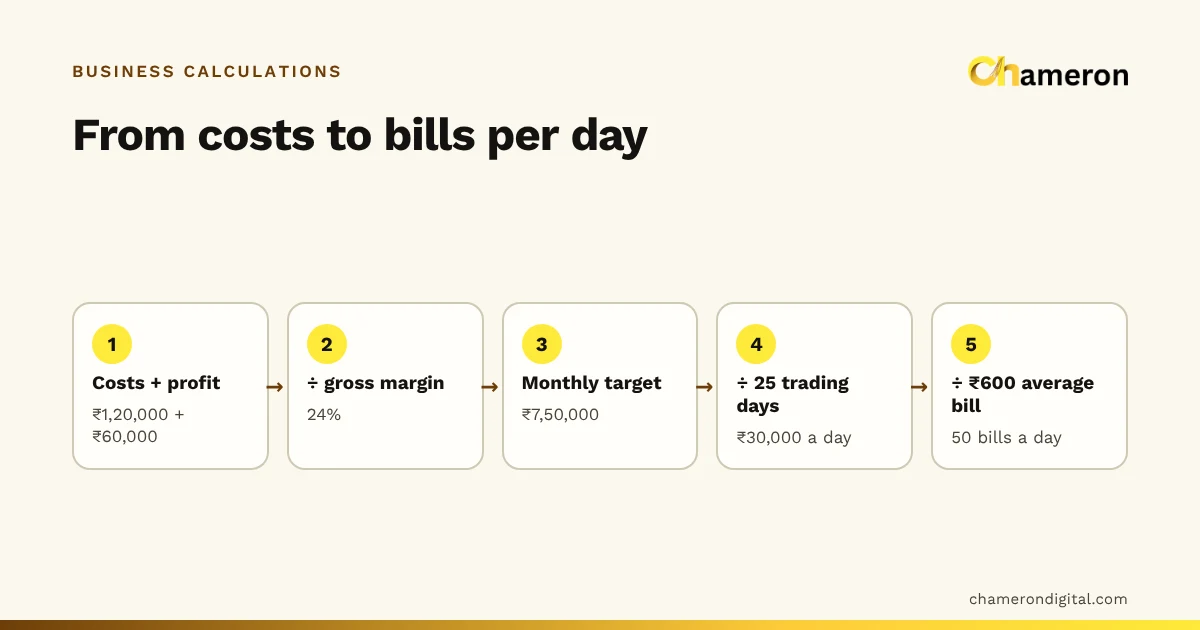
A sales target you can hit is worked out from your costs, not picked from the air. Add your monthly fixed costs to the profit you want, divide by your gross margin, then check the result against what you have actually been selling. Finally, break it into a daily figure and a number of bills. An example hardware shop with ₹1,20,000 of costs, a ₹60,000 profit goal and a 24% gross margin needs ₹7,50,000 a month: about ₹30,000 a day, or 50 bills of ₹600.
Step 1: Start from what the month must pay for
A target is meaningful only if hitting it pays for the business and leaves a profit. So start with the costs that arrive every month regardless of sales. For an invented hardware and paints shop:
| Monthly fixed cost | Amount |
|---|---|
| Rent | ₹35,000 |
| Salaries, including a fair salary for the owner | ₹62,000 |
| Electricity | ₹6,000 |
| Software, phone and internet | ₹3,000 |
| Loan interest | ₹4,000 |
| Maintenance and other overheads | ₹10,000 |
| Total | ₹1,20,000 |
Then decide the profit you want for the month: what you need to repay loan principal, build a reserve and reward the risk you take. The shop's owner sets ₹60,000. If you are unsure what your costs really are, our guide on calculating business profit shows how to separate running costs from the cost of goods.
Step 2: Convert costs into sales using your margin
Every ₹100 of sales does not pay ₹100 towards rent. Most of it pays for the goods you sold. Only the gross margin is left to cover fixed costs and profit, so divide by it.
Use your gross margin across the whole shop, without GST, from recent months. If you pay card charges, delivery or commission on each sale, subtract those too and use your contribution margin instead.
Margin has a large effect on the target, which is worth seeing before you go any further:
| Gross margin | Monthly target | Daily target (25 days) |
|---|---|---|
| 20% | ₹9,00,000 | ₹36,000 |
| 22% | ₹8,18,182 | ₹32,727 |
| 24% | ₹7,50,000 | ₹30,000 |
| 26% | ₹6,92,308 | ₹27,692 |
| 28% | ₹6,42,857 | ₹25,714 |
Across this range, every two percentage points of margin move the target by about ₹49,000 to ₹82,000 a month. Pricing and purchasing are sales levers too.
Step 3: Check the number against reality
A target built from costs tells you what you need. Your sales history tells you what is likely. Compare the two before announcing anything.
The hardware shop's last three months averaged ₹6,60,000, and the same month last year brought ₹6,40,000. The cost-based target of ₹7,50,000 is ₹90,000, or 13.6%, above the recent average.
At its recent level the shop earns about ₹6,60,000 × 24% − ₹1,20,000 = ₹38,400 a month, so the owner is short of the profit goal but comfortably above break-even. That tells the owner what kind of month this is:
- Gap under about 5%: set the cost-based target and push normally.
- Gap of 5% to 20%: set the target, but plan specific actions to close it (Step 4), or step towards it over two or three months.
- Gap above 20%: the target is unlikely in one month. Look again at costs, prices and margin, not just effort.
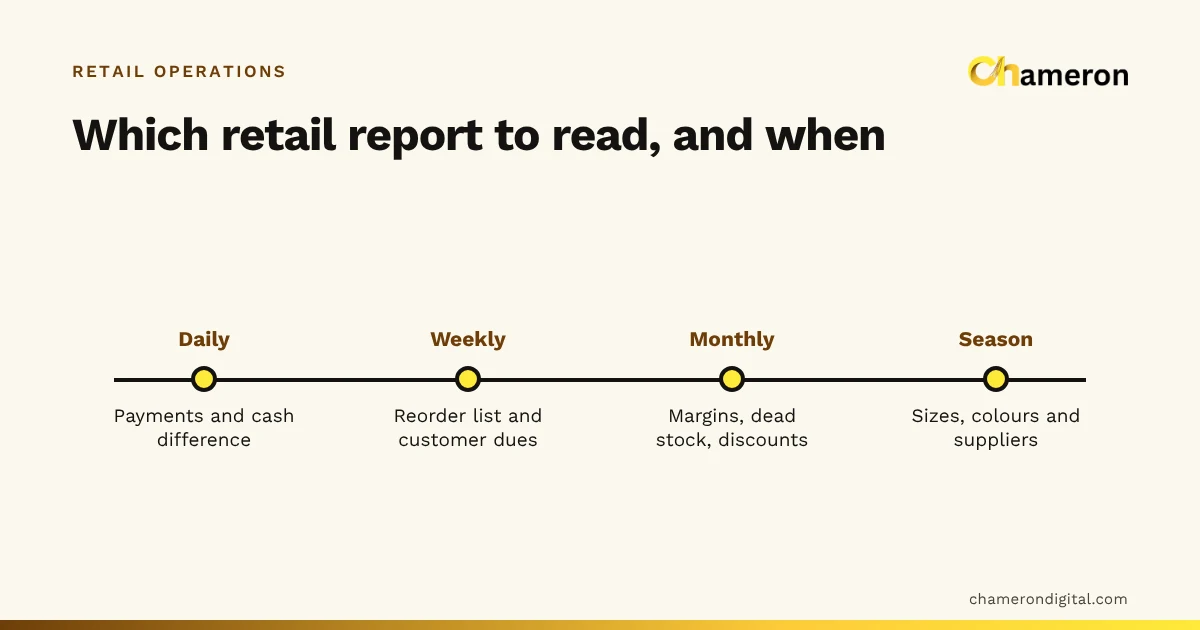
Always compare like with like. A festival month should be judged against last year's festival month, not against a quiet one. Reports showing sales by day and by category make this check quick; our guide to retail reports that matter covers which ones to use.
Step 4: Close the gap with three levers
Daily sales are simply bills multiplied by the average bill value. At ₹6,60,000 over 25 days, the shop takes ₹26,400 a day: about 44 bills of ₹600. To reach ₹30,000 a day it can change either number, or both.
| Plan | Bills a day | Average bill | Monthly sales |
|---|---|---|---|
| Now | 44 | ₹600 | ₹6,60,000 |
| More bills only | 50 | ₹600 | ₹7,50,000 |
| Bigger bills only | 44 | ₹682 | ₹7,50,200 |
| A little of both | 47 | ₹640 | ₹7,52,000 |
The mixed plan is usually the most realistic: three more customers a day, plus about ₹40 more per bill through sensible add-ons such as brushes with paint or fixings with fittings. Our short answer on average bill value lists practical ways to raise it.
The third lever is margin. If better buying lifts the shop's gross margin from 24% to 25%, the target falls to ₹1,80,000 ÷ 0.25 = ₹7,20,000, and the gap shrinks from ₹90,000 to ₹60,000. Pushing volume with discounts does the opposite: it lowers the margin and raises the target.
Step 5: Split the month by your real pattern
An even ₹30,000 every day sets staff up to fail on quiet Tuesdays and coast on busy Saturdays. Give each type of day a weight that reflects your usual pattern.
Say the shop's 25 trading days this month are 21 weekdays and 4 Saturdays, and Saturdays usually sell about one and a half times a weekday.
Add extra weight for paydays, local market days and festivals, and reduce it for days you know are slow. Use last year's daily sales to set the weights, not guesswork.
Step 6: Track the pace every week
A target checked only on the last day of the month is a report, not a target. Check the pace weekly, and recalculate what each remaining day needs.
After 15 trading days (12 weekdays and 3 Saturdays), the plan expected about ₹4,58,333, but the shop has taken ₹4,20,000. With 10 days left it needs (₹7,50,000 − ₹4,20,000) ÷ 10 = ₹33,000 a day, up from the original ₹30,000. Knowing that in the middle of the month leaves time to act: a display change, a call to regular contractors, or a push on slow-moving stock.
If the required figure climbs above anything you have achieved recently, adjust the plan honestly rather than letting the target quietly stop meaning anything.
Targets for staff
If you share the target with staff, share the daily or weekly figure and the levers they control, such as bills served, add-ons offered and accuracy, rather than only the monthly total. Avoid rewarding sales at any price: a salesperson paid on sales value alone has every reason to discount. Reward margin-friendly behaviour, and watch discounts alongside sales.
Billing software helps here by recording who made each sale. In BILL OS, sales can be credited to a salesperson with commission, and the salespeople and sales reports show progress without anyone adding up bill books.
Common mistakes
- Setting the target as "last year plus 10%". It ignores whether your costs have risen. Start from costs and profit, then compare with history.
- Dividing by markup instead of margin. A 32% markup is only a 24.2% margin. Using markup understates the target. See profit margin vs markup.
- Mixing GST-inclusive sales with GST-exclusive costs. The target looks easier to hit than it really is.
- Ignoring the trading pattern. A flat daily figure is too high on slow days and too low on busy ones.
- Chasing the number with discounts. Sales rise, margin falls, and profit can end up lower than before.
- Not adjusting when costs change. A rent increase or a new salary changes the target the same month.
The bottom line
Build the target from the month's fixed costs plus the profit you want, divided by your gross margin. Test it against your recent sales and the same month last year, then close any gap with a concrete plan for bills, bill value and margin. Split it by your real trading pattern and track the pace every week. The sales target calculator does the arithmetic in seconds, and a regular look at the business numbers worth tracking keeps the target honest.
Questions people ask
Should my sales target include GST?
Work it out without GST, because your margin and costs are without GST. If your staff watch GST-inclusive totals at the counter, convert the daily figure so everyone is looking at the same kind of number, and say which one it is.
What if my target is far above what I sell now?
Treat it as a plan over several months rather than a single leap. Set this month's target at a level you can reach with specific actions, and review costs and prices too: a target you cannot hit is usually a cost or margin problem, not a sales problem.
How is a sales target different from break-even?
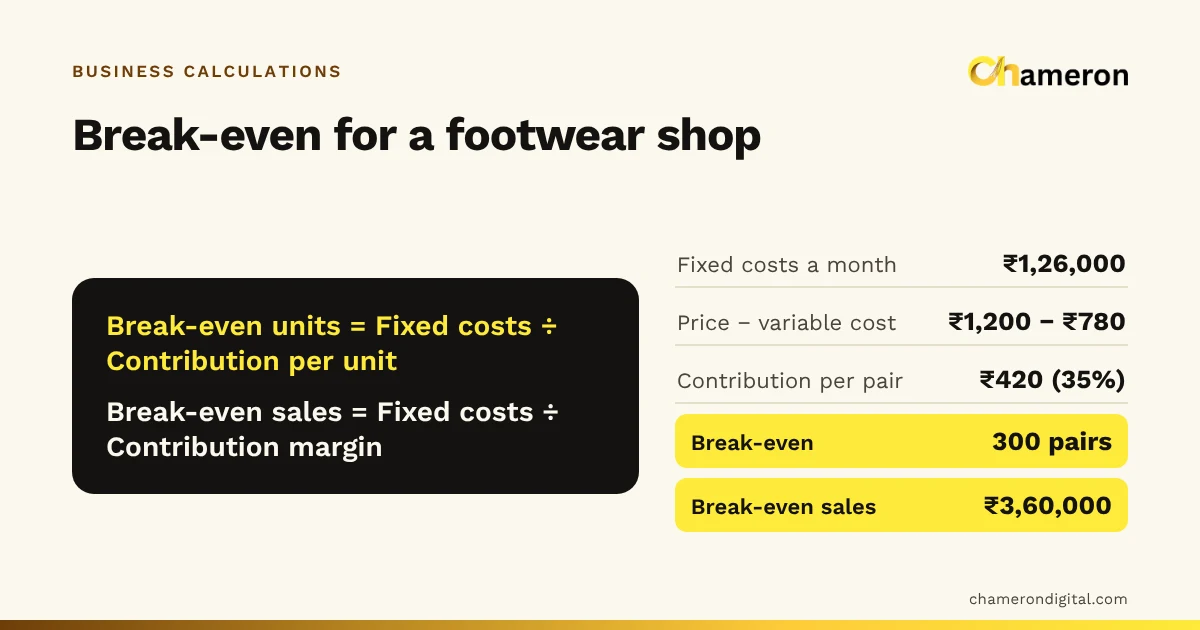
Break-even covers costs only and leaves zero profit. A sales target adds the profit you want on top. Work out your break-even point first; the target sits above it.
Should every month have the same target?
No. Rent and salaries may be similar every month, but demand is not. Use the same method each month, then adjust for festivals, seasons and school terms using last year's pattern.