The short answer
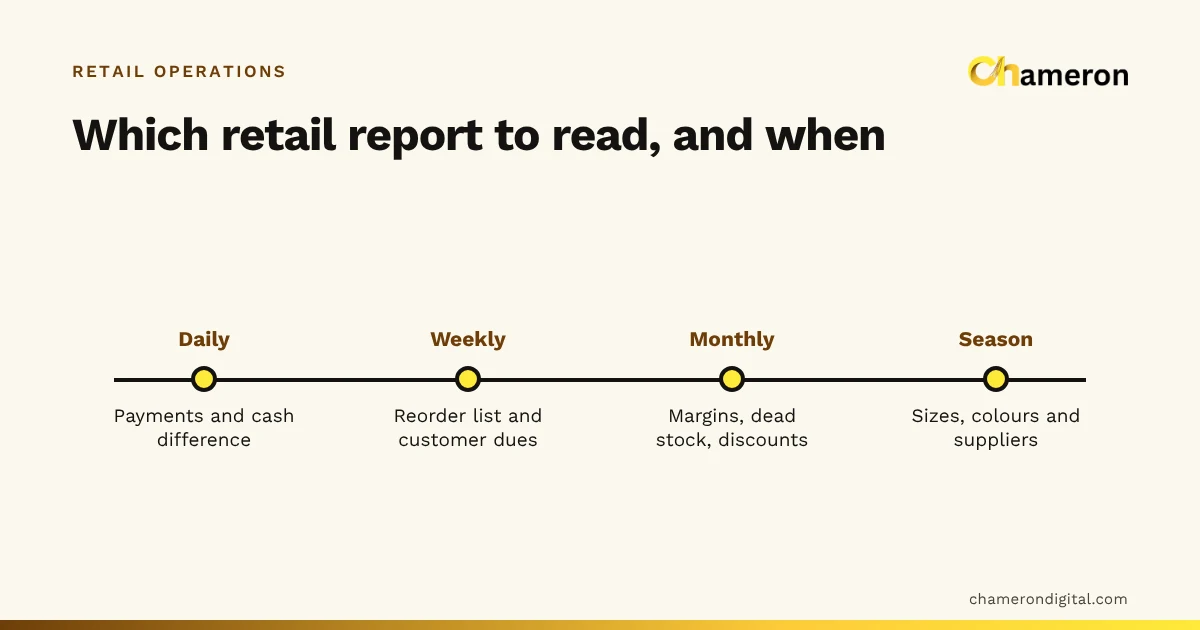
The retail reports that matter are the few that lead to a decision, read at the pace their problem grows. Every day, check sales by payment method against what you collected and the cash drawer difference. Every week, check the reorder list and customer dues. Every month, check margin by category, dead stock, discounts and sales below cost. Each season, check sizes, colours and suppliers before buying. Everything else is optional until it answers a question you actually have.
Why most reports go unread
Billing software makes reports cheap to produce, so shops end up with dozens and read none. The problem is rarely missing information; it is that nobody decided which question each report answers, how often to ask it, and what to do with the answer.
A useful way to sort them is by how fast the problem behind each report grows. A cash shortage gets harder to trace by the hour. A low-stock item becomes a lost sale within days. A pricing error quietly costs margin for weeks. Dead stock ties up money for months. So each report has a natural rhythm, and reading it more often than that wastes time, while reading it less often lets the problem grow.
| Rhythm | Reports | The question they answer |
|---|---|---|
| Daily | Payments by method, cash difference, cancellations and large discounts | Is today's money all here? |
| Weekly | Reorder list, customer dues, salesperson sales | What do I need to buy, chase or coach this week? |
| Monthly | Margin by category, dead stock, discounts, sales below cost, GST summary | Where am I making and losing money? |
| Each season | Sizes and colours, supplier performance | What should I buy next time? |
Daily: is today's money all here?
The daily check should take five to ten minutes at closing, and it answers one question.
Sales by payment method
Compare what the bills say was paid by each method with what you can see was received.
Match UPI and card totals against your bank or payment app statement, not against what staff remember. A UPI payment recorded on a bill but never received, or received but billed as cash, shows up here. Average bill value is worth noting too: a sudden drop on a busy day can mean items are being missed at the counter. The average bill value question explains how to use it.
Cash difference
Expected cash is the opening float plus cash sales, minus any cash paid out. Count the drawer and compare.
A small difference is usually change given wrongly, but a pattern is not. Record every difference against the shift and cashier; one ₹150 short is a mistake, ₹150 short every Saturday is a question. The cash drawer shift and float entries in the glossary explain the terms.
Cancellations and large discounts
Glance at every cancelled bill and every discount above your normal limit. Each should have a reason you recognise. Our guide to common billing mistakes covers what to look for.
Weekly: what to buy, chase and coach
Reorder list
The reorder list shows items whose stock will run out before the next delivery can arrive. The idea behind it is days of cover.
If you hold 90 packs of an item and sell 6 a day, you have 90 ÷ 6 = 15 days of cover. If the supplier takes 10 days to deliver, you have about five days left to place the order before you risk a gap. The reorder point calculator and the guide to reorder points turn this into a trigger level for each item.
Customer dues
List who owes what and for how long. Sort by age, not amount: a small balance that is 90 days old is a bigger risk than a large one from last week. Decide this week's calls and reminders from the list, not from memory.
Sales by salesperson
If you pay commission or set targets, check sales by salesperson weekly. Read it alongside discounts given and returns, because high sales with heavy discounts may not be the result you want.
Monthly: where you make and lose money
Margin by category
Sales tell you what is popular; margin tells you what pays. Calculate gross margin as profit ÷ sales, on prices without GST.
| Category | Sales | Cost of goods | Gross profit | Margin |
|---|---|---|---|---|
| Shirts | ₹3,20,000 | ₹2,08,000 | ₹1,12,000 | 35% |
| Trousers | ₹2,40,000 | ₹1,68,000 | ₹72,000 | 30% |
| Accessories | ₹60,000 | ₹27,000 | ₹33,000 | 55% |
| Total | ₹6,20,000 | ₹4,03,000 | ₹2,17,000 | 35% |
Accessories bring in under a tenth of sales but earn 55% margin; trousers bring in almost two-fifths of sales at the lowest margin. That might mean giving accessories a better spot near the counter, or looking again at trouser buying prices. Remember this is gross profit, before rent, wages and other costs; gross profit vs net profit explains the difference, and profit margin vs markup explains why margin and markup should never be mixed.
Discounts
Total the month's discounts and compare them with sales before discounts. In the example shop, sales before discounts were ₹6,51,000 and discounts ₹31,000, so discounts were ₹31,000 ÷ ₹6,51,000 = about 4.8% of gross sales, leaving the ₹6,20,000 above. Watch the trend, and which staff and which categories account for most of it.
Dead stock
List items that have not sold in 60 to 90 days, valued at cost. If the shop above holds stock worth ₹6,00,000 at cost and ₹84,000 of it has not moved in 90 days, 14% of its stock money is sitting still. Decide item by item: discount, bundle, return to the supplier or write off. The dead stock question explains how to define it for your shop, and inventory turnover shows how fast your stock as a whole is moving.
Sales below cost
Any item sold below its cost price is either a deliberate clearance or a mistake: a wrong price, a cost entered wrongly at receiving, or an over-generous discount. Check every line. It is often the quickest money you will recover all month.
GST summary
Prepare the month's GST summary and sales records for your accountant in the format they ask for. Rates, thresholds and filing dates are set by the government and can change, so rely on your accountant or the official GST portal for those, not on a report's defaults.
Each season: what to buy next time
For clothing, footwear and other seasonal ranges, read sales by size and colour, and sell-through by style, before you place the next season's orders. Our guide to size and colour variants shows how to turn that into a size ratio for buying. Review suppliers at the same time: which delivered on time, which sent short or damaged goods, and whose products sold through.
Common mistakes
- Reading reports nobody acts on. If a report has not changed a decision in three months, drop it.
- Checking only sales. High sales can hide low margins, heavy discounts and growing dues.
- Mixing GST into performance figures. Margins and growth look better than they are.
- Building reports by hand from bill books. It takes so long that it stops happening. Reports should come straight from the billing records.
- Reading monthly what needs daily attention. A cash difference found three weeks later is almost impossible to explain.
- No owner for each action. "We should chase dues" achieves nothing; "Ravi calls these six customers by Friday" does.
How software produces these reports
When every sale, return, delivery and payment goes through one system, these reports cost nothing to produce and are current the moment you open them. In BILL OS, reports cover sales, profit, payment methods, margins, customer outstanding, the reorder list, sizes and colours and dead stock, each downloadable as Excel or CSV, and a review list called Guardian brings up discounts, sales below cost and short drawers worth a second look; see reports and exports.
The bottom line
Good reporting is a routine, not a pile of printouts. Check money daily, stock and dues weekly, margins and leaks monthly, and buying each season, and end every check with a decision and a name next to it. For the wider set of numbers to watch across your whole business, see business numbers to track.
Questions people ask
How much time should an owner spend on reports?
Five to ten minutes at day end, about half an hour a week and an hour or two a month is enough for most single-store shops, if the reports come straight from the billing records rather than being built by hand.
What is the single most important daily report?
Sales by payment method checked against what was actually collected, together with the cash drawer difference. Problems with money get harder to trace every day they are left.
Should reports use prices with or without GST?
Use figures without GST for margin, profit and sales performance, because GST collected is not your income. Use GST-inclusive totals only when matching collections, such as cash and UPI received. See GST-inclusive and exclusive pricing.
What does my accountant need from me each month?
Usually the sales register, purchase records, credit and debit notes and a GST summary, in a format they can use such as Excel. Ask your accountant exactly which reports and layout they want, and keep to it every month.
What is a good average bill value?
There is no standard figure; it depends on what you sell. Track your own over time and compare like with like, such as weekdays with weekdays. The average bill value question explains the calculation.