The short answer
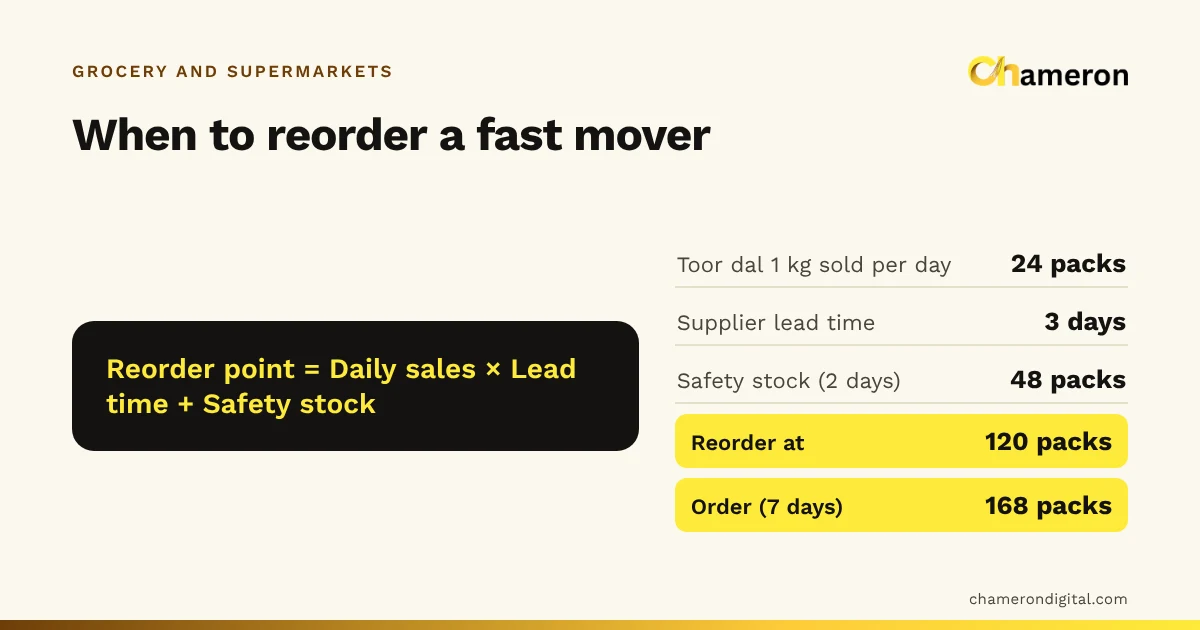
A reorder point is the stock level at which you place a new order, so the delivery arrives before the shelf runs empty. It equals the stock you expect to sell while waiting for the supplier, plus a buffer called safety stock. If a tea pack sells 12 a day, the supplier takes 4 days and you keep 24 packs as a buffer, the reorder point is 12 × 4 + 24 = 72 packs. When stock falls to 72, you order.
The reorder point formula
Each input needs a little care.
Average daily sales. Take units sold over the last four to eight normal weeks and divide by the days the shop was open. Leave out unusual spikes such as a one-off bulk order, or the figure will be too high for the rest of the year.
Lead time. This is the time from placing the order to the stock being on the shelf, ready to sell. It includes the supplier's delivery time, but also the day it takes you to place the order, and the time to check, label and shelve the delivery. A supplier who "delivers in 3 days" plus a day of receiving is a 4-day lead time. See lead time in the glossary.
Safety stock. The buffer for days when sales run faster or the delivery is late. More on choosing it below.
A worked example
A kirana stocks a 250 g tea pack. It sells an average of 12 packs a day. The distributor delivers 3 days after an order, and receiving takes another day, so the lead time is 4 days. The owner wants 2 days of safety stock.
| Step | Calculation | Result |
|---|---|---|
| Safety stock | 12 × 2 | 24 packs |
| Stock needed during lead time | 12 × 4 | 48 packs |
| Reorder point | 48 + 24 | 72 packs |
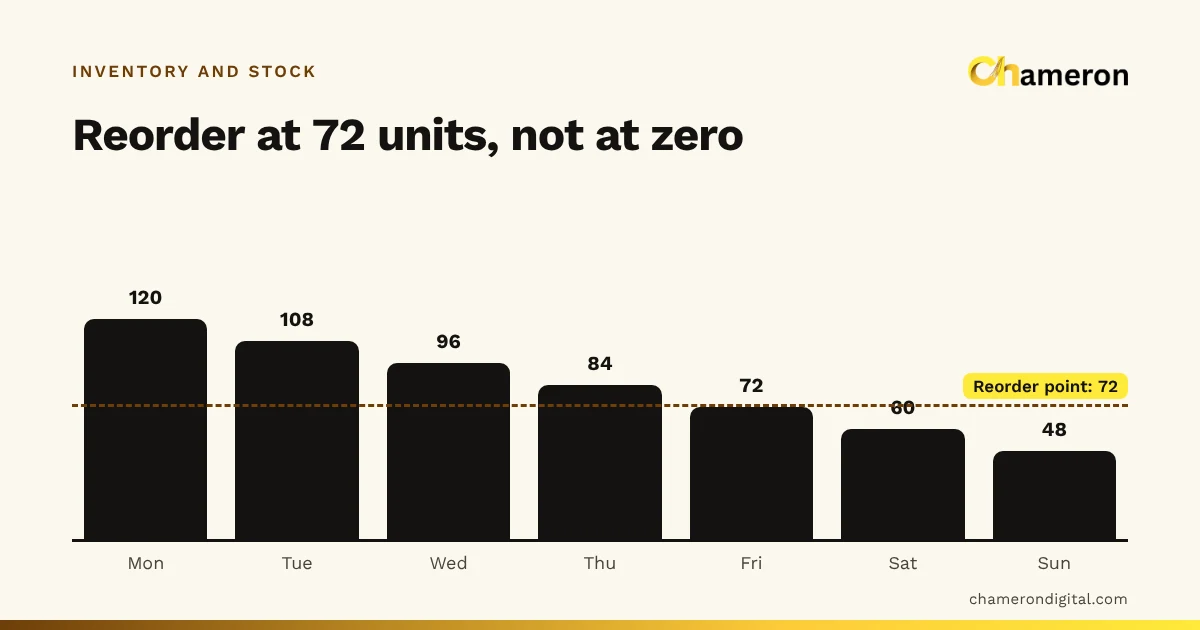
Here is how a week plays out, starting with 120 packs at Monday's close.
| Day | Closing stock |
|---|---|
| Monday | 120 |
| Tuesday | 108 |
| Wednesday | 96 |
| Thursday | 84 |
| Friday | 72: order placed |
| Saturday | 60 |
| Sunday | 48 |
The order goes in on Friday. Four days later, on Tuesday, the delivery is ready to sell and the shelf is down to 72 − 48 = 24 packs, which is exactly the safety stock. If sales ran a little faster, or the delivery was a day late, the buffer absorbs it and the shelf never empties.
You can test your own figures with the reorder point calculator.
Safety stock: three ways to set the buffer
Safety stock is insurance. Too little and you run out on busy days; too much and money sits on the shelf. There are three common ways to set it, from simplest to most data-hungry.
1. Days of cover
Decide how many days of extra sales you want to hold, and multiply by average daily sales. This is the method used above (2 days × 12 = 24). It is easy to explain to staff and works for most shops. Use more days for items with unreliable suppliers or where a stockout would lose a customer.
2. Maximum minus average
If you know your worst recent days, use them:
A detergent averages 8 units a day but has sold up to 14 on busy days. The supplier usually takes 5 days, but has taken 7.
- Worst case during lead time: 14 × 7 = 98 units
- Normal case: 8 × 5 = 40 units
- Safety stock: 98 − 40 = 58 units
- Reorder point: 40 + 58 = 98 units
This method is cautious because it assumes the busiest days and the slowest delivery happen together. It suits items you must never run out of. For everything else it can leave too much stock on the shelf.
3. Based on how much sales vary
If you have daily sales figures, you can size the buffer to how much they swing. A common formula is safety stock = Z × standard deviation of daily sales × √lead time, where Z reflects how often you are willing to run out (about 1.65 for running out in roughly one replenishment cycle in twenty). For an item whose daily sales vary by a standard deviation of 4 units, with a 4-day lead time: 1.65 × 4 × √4 = 1.65 × 4 × 2 = 13.2, so 14 units after rounding up. This is more precise but needs clean daily data, so most small shops start with days of cover.
How much to order when you reach it
The reorder point tells you when to order. You still need to decide how much. A simple rule is to order enough for a set number of days:
For the tea pack, two weeks of cover is 12 × 14 = 168 packs. If the distributor sells in cartons of 24, that is 168 ÷ 24 = exactly 7 cartons. When the numbers do not divide evenly, round up to the pack size for fast sellers and down for slow ones.
Three limits can override the arithmetic:
- Shelf life. Never order more than will sell well before the expiry date.
- Minimum order quantities set by the supplier.
- Cash and space. A larger order may earn a better price, but only helps if you can pay for it and store it.
Many shops write both numbers on the shelf tag or item record: "reorder at 72, order 168". Anyone can then place the order without asking the owner. For a view of how much to hold overall, see how much stock a shop should keep.
When suppliers visit on a fixed day
Many kiranas and general stores do not order whenever they like. A distributor's salesman visits once a week, takes the order and delivers a couple of days later. In that case the question is not "when do I hit the reorder point?" but "how much do I need to last until the delivery after next?"
A biscuit pack sells 20 a day. The salesman visits every Monday and delivers 2 days later. The owner keeps 2 days of safety stock (40 packs).
- Target stock: 20 × (7 + 2) + 40 = 180 + 40 = 220 packs
- Stock on hand on Monday: 85 packs
- Order: 220 − 85 = 135 packs
The extra days matter. If the owner only ordered to cover the 2-day lead time, the shelf would run short well before the next visit.
When the reorder point needs to change
A reorder point is a snapshot of normal trading. Change it when the inputs change.
| Situation | What changes | Example |
|---|---|---|
| Festival season | Daily sales rise | Tea sales rise from 12 to 30 a day before Diwali: 30 × 4 + 30 × 2 = 180 |
| New supplier or route | Lead time changes | 4 days becomes 6: 12 × 6 + 24 = 96 |
| Promotion | Short burst of demand | Raise it for the promotion, then lower it again |
| Item slowing down | Daily sales fall | Lower it, or the item drifts into overstock |
Set a reminder a few weeks before each busy season, and recalculate reorder points for your fast sellers using last year's season as a guide. Our guide to preventing stockouts and overstocking covers the wider planning.
Common mistakes
- Counting only the supplier's delivery days. Ordering delays and receiving time are part of the lead time.
- Using an annual average for a seasonal item. Umbrellas in July and in January are different items for planning purposes.
- Setting it once and forgetting it. Sales and suppliers change; the reorder point should follow.
- Ignoring stock already on order. If an order is on its way, do not reorder just because the shelf is below the level.
- A reorder point for everything. Slow, cheap items rarely justify the effort. Focus on what matters, as in an ABC split described in what inventory management is.
Reorder points in software
On paper, reorder points work only if someone checks every item against its level. Software can do the checking: it compares current stock with each item's level and lists what to order. In BILL OS, the reports include a reorder list, and the Guardian review lists stock that may run out within a week. You still choose the numbers; the system does the watching.
The bottom line
A reorder point turns "I think we are running low" into a rule: when stock falls to the level that covers the lead time plus a buffer, order. Work out daily sales honestly, measure lead time from order to shelf, pick a safety stock method that suits the item, and revisit the numbers before every season. Start with your ten fastest sellers and the reorder point calculator.
Questions people ask
Is the reorder point the same as minimum stock?
They are related but not the same. Minimum stock (or safety stock) is the lowest level you want to fall to; the reorder point is higher, because it also covers sales during the supplier's lead time.
What if my supplier's lead time keeps changing?
Use the longer lead times you actually see, not the promised one, or add the extra days to your safety stock. Keep a note of when each order was placed and when it was ready to sell, so you base the figure on facts.
Does every item need a reorder point?
No. Start with fast sellers, items customers expect you always to have, and items with long lead times. Slow, low-value items can be checked on a schedule instead.
How often should I recalculate reorder points?
Review them at least every quarter, before every festival or season, and whenever a supplier changes its delivery pattern. A reorder point is only as good as the daily sales figure behind it.
What is a good safety stock level?
It depends on how much sales and deliveries vary and how costly a stockout is for that item. Our question page on safety stock walks through how much to keep.