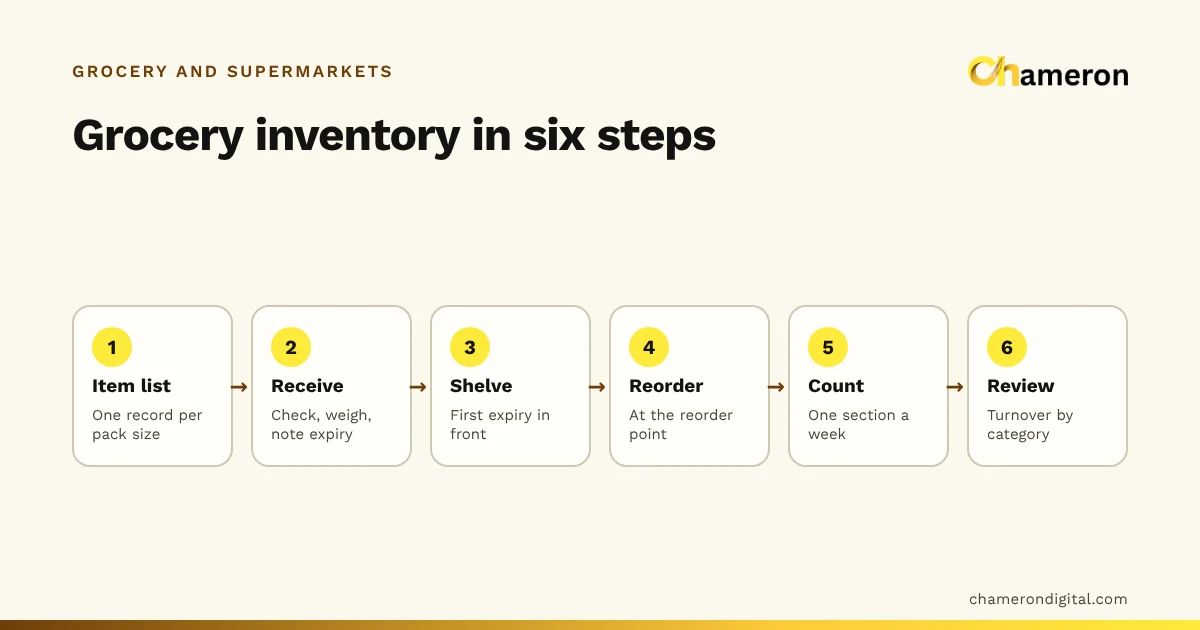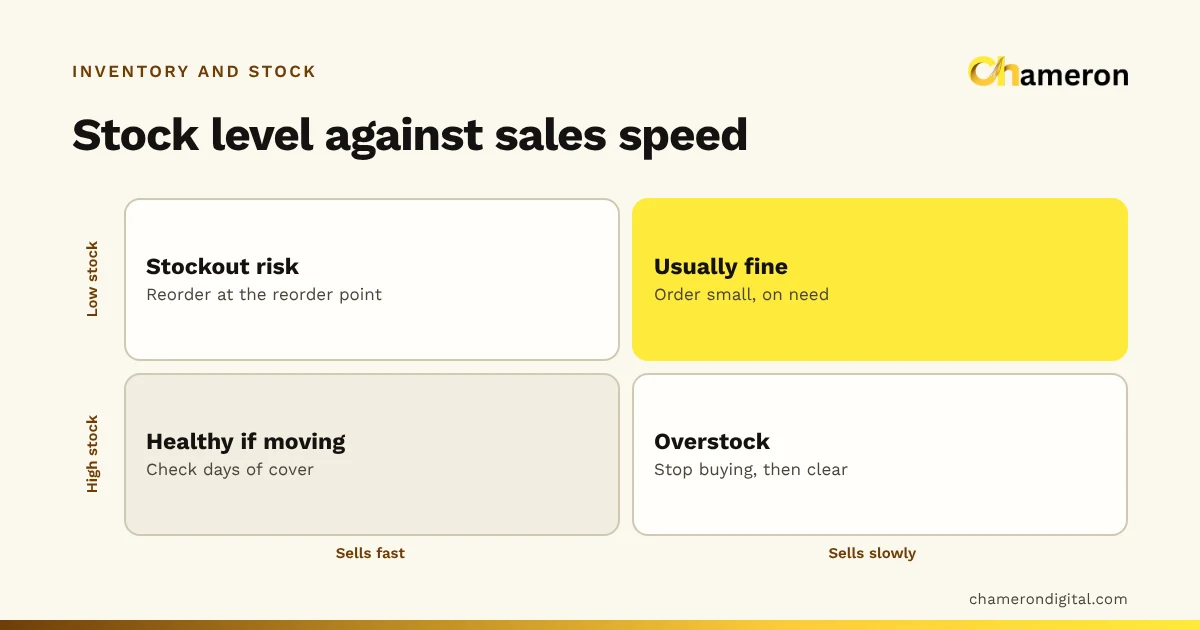
The short answer
Fast-moving inventory is the stock that sells through in days, such as atta, dal, oil, milk, bread and popular biscuits. To manage it, find your fast movers from your own sales figures, give each one a reorder point based on daily sales, the supplier's lead time and a few days of safety stock, order daily perishables from yesterday's sales, and raise levels before festivals. Then count these items every week, because they are the ones whose stock figures drift fastest.
Find your fast movers from your own sales
Every store's list is different, so start from your own figures rather than a list of "usual" fast movers. Take the units sold of each item over the last four weeks, divide by 28 for a daily average, and sort from highest to lowest.
| Item | Units sold in 28 days | Average per day |
|---|---|---|
| Milk 500 ml pouch | 1,680 | 60 |
| Glucose biscuits 200 g | 840 | 30 |
| Toor dal 1 kg | 672 | 24 |
| Bread 400 g | 588 | 21 |
| Sunflower oil 1 L | 504 | 18 |
| Washing powder 1 kg | 196 | 7 |
Keep the top 30 or so as your fast-mover list and review it each month. Two things to watch:
- Fast by units is not the same as important by value. Washing powder sells fewer units than milk, but each one is worth far more. Look at sales value too, and add any high-value item that runs out often.
- Seasonal items join and leave the list. Dry fruits, ghee and sugar rise before festivals; cold drinks rise in summer. Check last year's sales for the same weeks.
Everything else in the store follows the slower routine in our grocery inventory guide.
A reorder point for every fast mover
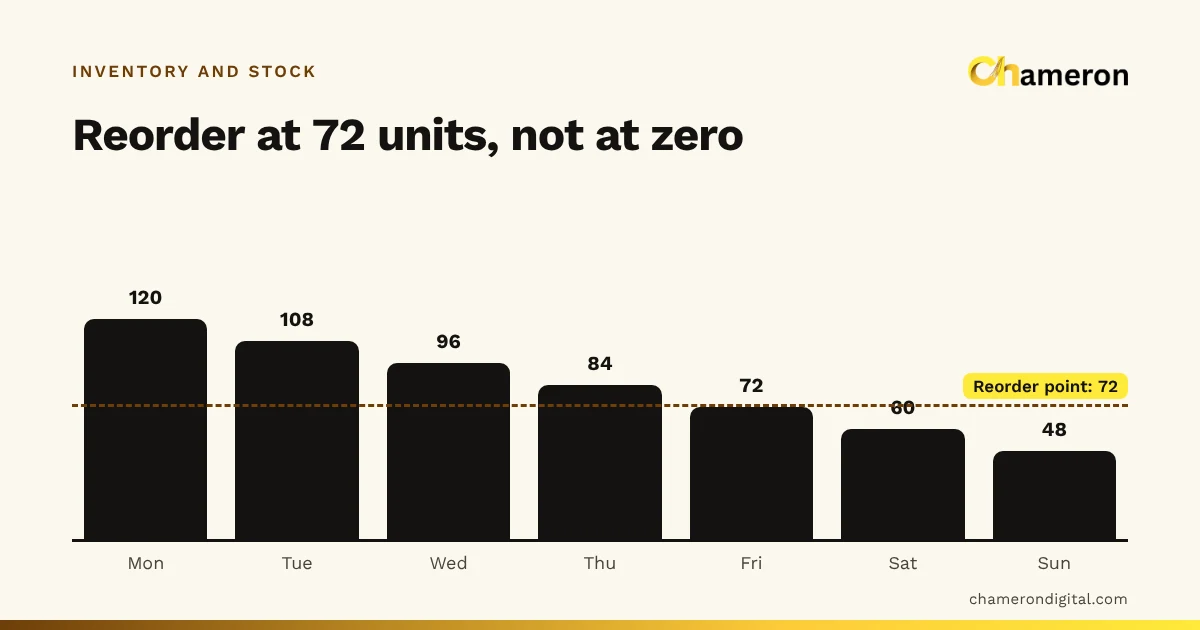
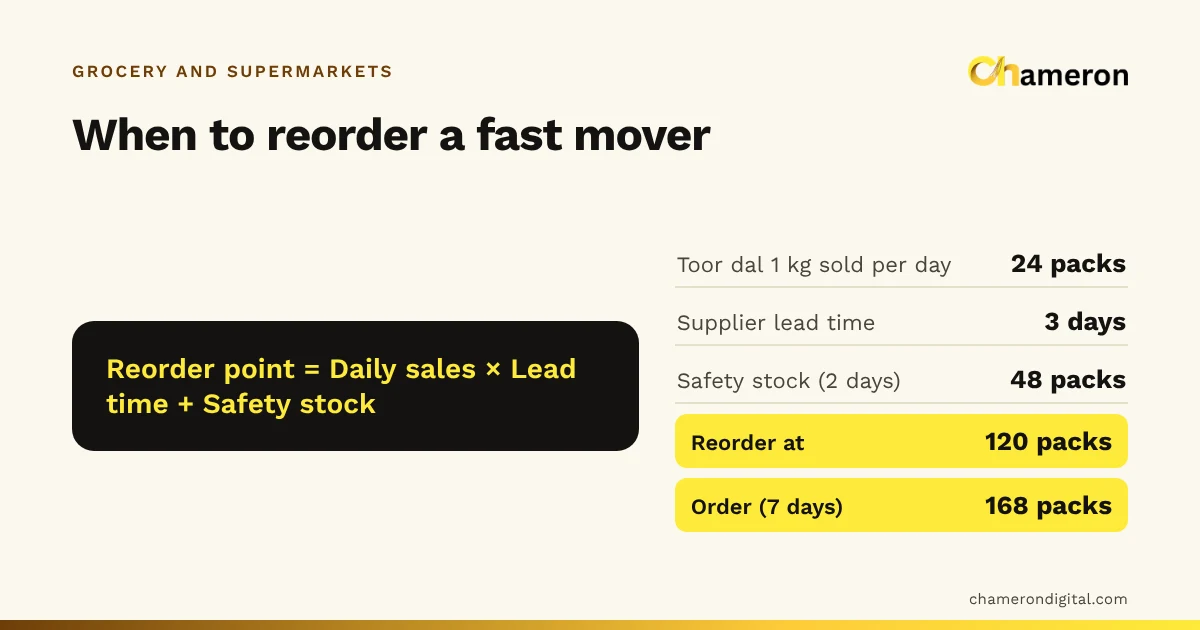
A reorder point is the stock level at which you order again. For a fast mover it must cover sales during the supplier's lead time, plus a buffer for busier-than-usual days.
When stock of toor dal falls to 120 packs, the order goes out. The reorder point calculator does the same arithmetic for any item, and what is a reorder point explains the method in full, including other ways to set safety stock.
When the distributor visits on a fixed day
Many FMCG distributors send a salesman on a fixed day each week, and deliver the next day. You cannot order the moment stock reaches a reorder point; you order on Monday whether you are low or not. In that case, order up to a level that lasts until the delivery after the next visit.
Glucose biscuits sell 30 packs a day. The salesman comes every Monday (7 days apart), delivers on Tuesday (1 day) and the owner keeps 2 safety days:
| Step | Calculation | Result |
|---|---|---|
| Order-up-to level | 30 × (7 + 1 + 2) | 300 packs |
| Stock on Monday | Counted | 110 packs |
| Order | 300 − 110 | 190 packs |
| In cartons of 24 | 190 ÷ 24 = 7.9 | 8 cartons (192 packs) |
Keep a one-page list for each distributor with the order-up-to level of every item they supply. On visit day, count those items, subtract and the order is ready before the salesman arrives.
Daily perishables: milk, bread and eggs
Milk, bread, eggs, curd and paneer sell fast but expire in days, so a reorder point does not fit them. They need a daily order based on what sold yesterday, what is left today and the day of the week.
Bread sells about 21 loaves a day on weekdays and more on Sundays. On Thursday evening 4 loaves are left that can still be sold on Friday. With a buffer of 2:
Friday's order = 21 − 4 + 2 = 19 loaves
Note what was left unsold each day for two weeks. If the same item is left over most days, the buffer is too big; if it runs out before evening most days, it is too small. Agree a return or exchange arrangement for unsold bread and dairy with the supplier where possible.
Keep the shelf full, not just the store
A fast mover can be "in stock" in the back room and missing from the shelf, which costs the same sale. A few habits prevent it:
- Give fast movers enough shelf space to hold at least a day's sales, so the shelf does not empty before the next refill.
- Refill before the rush, not during it. A check of the fast-mover shelves an hour before the evening peak catches most gaps.
- Rotate as you refill. Older stock forward, newer behind, unless the newer batch expires first: FEFO.
- Keep back-room stock where it can be seen. Cartons stacked behind other cartons get forgotten and reordered.
Festivals and month-start peaks
Reorder points built on ordinary weeks run out during peaks. The first days of the month, when salaries arrive, and the weeks before Diwali, Pongal, Eid or Onam can lift sales of staples well above normal.
Rework the numbers for the period rather than guessing. If toor dal is expected to sell 40 packs a day in the two weeks before a festival, with the same 3-day lead time and 2 safety days:
| Normal weeks | Festival weeks | |
|---|---|---|
| Daily sales | 24 | 40 |
| Safety stock | 48 | 80 |
| Reorder point | 120 | 200 |
| Order (7 days) | 168 | 280 |
Base the festival figure on your own sales from the same festival last year, place an early order, and set a date in the diary to put the levels back to normal once the festival is over. Extra stock left from a rush slows down the following month and, for items with a date, risks expiry. Our guide to preventing stockouts and overstocking covers the balance between the two.
Count the fast movers every week
Fast movers have the most transactions, so their stock figures drift fastest: a mis-scan here, a short delivery there, a broken pouch thrown away without a record. A wrong stock figure on a fast mover means a wrong reorder, either a gap on the shelf or a pile of extra stock.
Count your fast-mover list once a week, at a quiet time, in the same unit you sell in. Compare it with the expected stock and look into any difference before adjusting. A short count of 30 items takes far less time than a full stock-take, and our stock count method explains how to reconcile the results.
Common mistakes
- Treating every item the same. Daily attention on 2,000 items is impossible; on 30 it is easy.
- Ordering by looking at the shelf. Back-room stock and stock reserved for regular customers get missed.
- Using last month's average in a festival month, or a festival average in an ordinary one.
- Forgetting the lead time grows. Distributors are slower before festivals; increase the lead time in your calculation too.
- Letting leftovers pile up on perishables instead of adjusting the daily order.
- Counting fast movers only at the annual stock-take, when the errors have had a year to grow.
Fast movers in software
Software helps most with fast movers because it updates stock from every bill, so the reorder list reflects this morning's sales, not last week's. In BILL OS, our retail software, sales take stock out first-expiry-first, and reports list what is low and what to reorder. GROCERY OS is being built for grocery stores and supermarkets, around fast counters, deliveries and reorder lists; it is not yet generally available, so ask about availability.
The bottom line
Fast movers are a small part of your item list and a large part of what customers notice. Find them from your own sales, give each a reorder point or an order-up-to level, order perishables daily from real leftovers, plan festival peaks from last year's figures and count the list every week. To check how hard the rest of your stock is working, try the inventory turnover calculator.
Questions people ask
What is fast-moving inventory?
Fast-moving inventory is stock that sells through quickly, often within days. In a grocery store that usually means staples such as atta, rice, dal, oil and sugar, daily essentials such as milk and bread, and popular packed goods such as biscuits and tea.
How much safety stock should I keep on fast movers?
Enough to cover the gap between a normal day and a busy one during the supplier's lead time. One to three days of average sales is a common starting point; increase it for items whose supplier is unreliable. See what is safety stock.
How often should I reorder fast-moving items?
As often as the supplier allows without the delivery costs outweighing the benefit. Smaller, more frequent orders keep less cash in stock and less risk of expiry, as long as each order still covers sales until the next delivery.
Should fast movers be stocked by FIFO or FEFO?
FEFO, first expired first out. Fast movers usually arrive in date order, so it is often the same as FIFO, but when a delivery carries an earlier expiry than stock already on the shelf, it should go in front. See what is FIFO in inventory.