The short answer
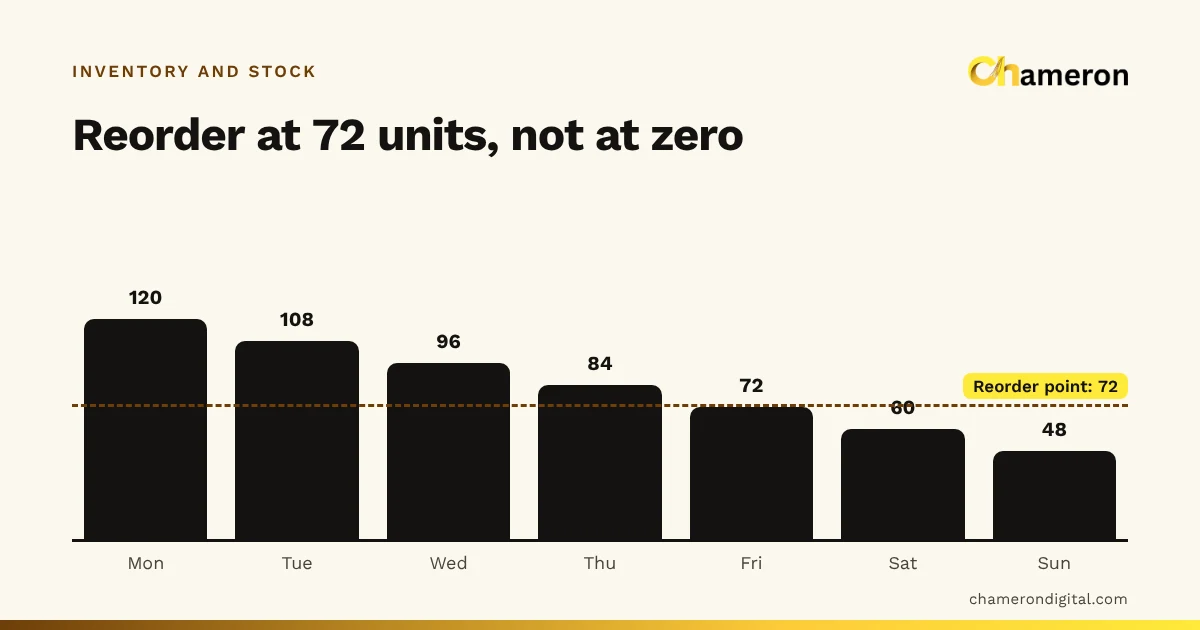
You prevent stockouts and overstocking with the same tool: buying decisions tied to what actually sells. For each important item, set a reorder point (the stock level at which you order) and an order quantity (how much to order) from its daily sales and your supplier’s lead time. Then review a short low-stock list every day and a slow-moving list every month. Stockouts lose sales and customers; overstock ties up cash and ends in discounts or waste. Both shrink when buying follows data instead of memory.
Two symptoms of the same problem
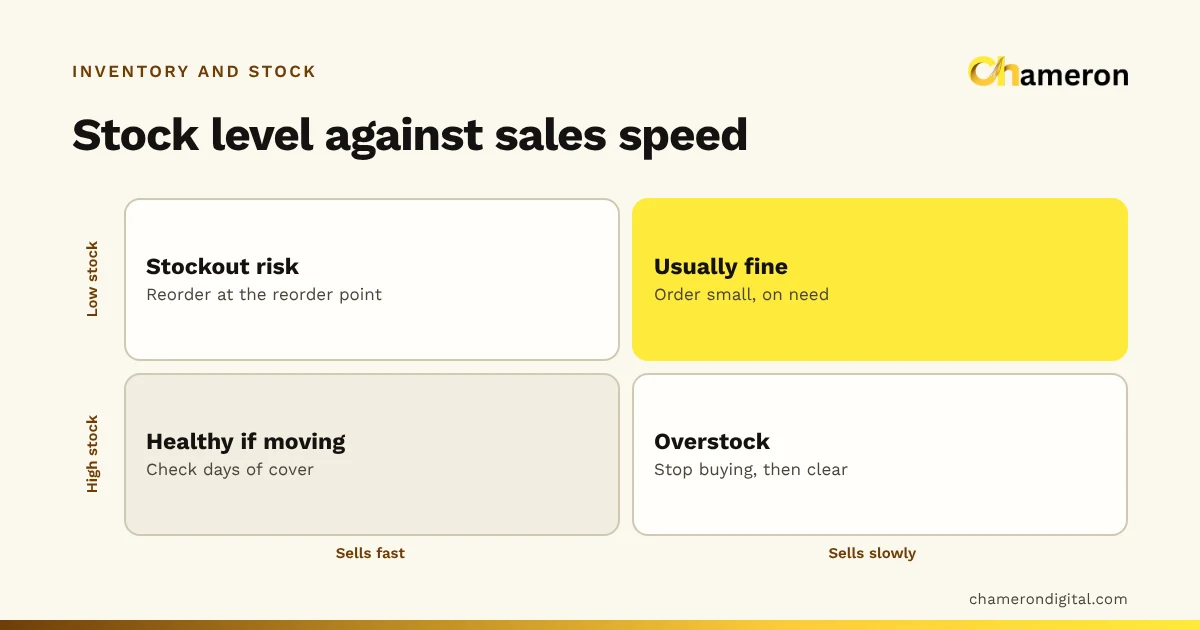
Most shops that run out of fast sellers are also holding too much of something else. The causes are closely linked:
| Why shops run out | Why shops overstock |
|---|---|
| Nobody notices stock is low until the shelf is empty | Orders are placed from habit, not recent sales |
| Supplier lead time is longer than the owner assumes | A supplier scheme or bulk discount tempts a big order |
| A festival or local event lifts demand | Last season’s leftovers were never counted |
| Stock records say items are there when they are not | Stock records miss items that are there, so they are ordered again |
| Cash is stuck in slow items, so fast ones are under-ordered | Too many similar variants split demand between them |
Notice the last row on each side. Money spent on stock that does not sell is money that cannot be spent on stock that does. Fixing overstock often fixes stockouts too.
Step 1: Sort your items by how much they matter
You cannot watch thousands of items equally closely. Sort them into three simple groups:
| Group | Typical items in a general or kirana store | How to manage |
|---|---|---|
| Never out | Rice, atta, oil, milk, sugar, your best-selling brands | Reorder point and safety stock for every item; check daily |
| Keep steady | Regular snacks, toiletries, cleaning products | Reorder point; check weekly |
| Order on need | Slow, expensive or rarely asked-for items | Small display quantity; take customer orders; review monthly |
A good way to sort: list your items by sales value over the last three months. The small number at the top usually account for a large share of sales, and those are the "never out" group. Staples that bring customers through the door belong there even if their margin is thin.
Step 2: Set stock levels from real sales
For each item in the first two groups, you need three numbers. Work them out from the last four to eight weeks of sales.
Example. A kirana sells 18 one-litre pouches of sunflower oil a day. The distributor delivers 3 days after an order, and the owner wants 2 days of safety stock and orders to last about 10 days.
| Number | Calculation | Result |
|---|---|---|
| Safety stock | 18 × 2 | 36 pouches |
| Reorder point | 18 × 3 + 36 | 90 pouches |
| Order quantity | 18 × 10 | 180 pouches |
| Highest stock after a delivery (about) | 36 + 180 | 216 pouches |
When stock falls to 90, the owner orders 180. On a normal week, about 54 pouches sell while waiting for delivery, so the order arrives with 36 still on the shelf. If a festival week lifts sales to 24 a day, 72 sell during those 3 days and 18 remain: the safety stock has done its job.
The highest level, about 216, doubles as a maximum: if the shelf and godown together hold much more than that, something was over-ordered. Round order quantities to the supplier’s pack size, and keep orders shorter for items with a limited shelf life. The reorder point calculator does this arithmetic, and our guide to what a reorder point is explains it in more depth.
Step 3: Build a short review routine
Levels only work if someone looks at them. A routine that takes minutes rather than hours:
- Every day, before closing: check what has fallen to its reorder point. Place orders the same day so lead time starts now, not when someone remembers.
- Every week: compare what arrived with what was ordered, note late deliveries, and check "keep steady" items.
- Every month: list items that have not sold in 60 to 90 days, check days of stock by category, and adjust reorder points for items whose sales have changed.
- Before each season: review last year’s sales for the same weeks and plan seasonal orders separately from routine ones.
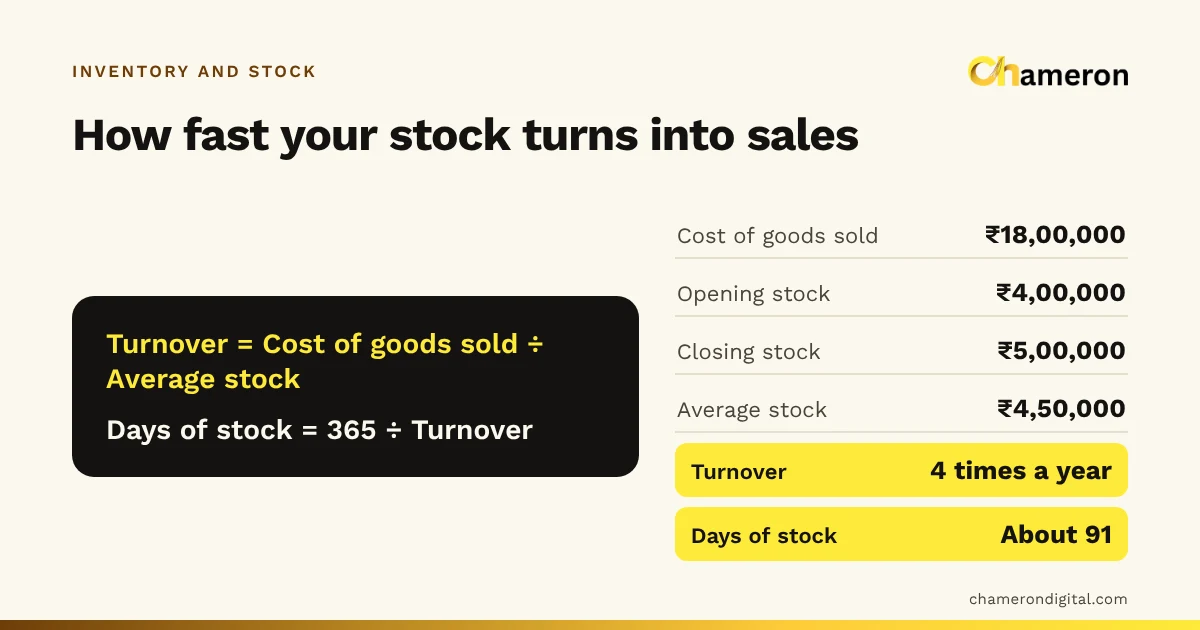
For the monthly check, inventory turnover expressed in days of stock tells you whether buying is running ahead of sales. A count of the shelves now and then keeps the records honest; a stock count sheet helps.
Step 4: Plan for seasons and spikes separately
Average daily sales are fine for ordinary weeks. They are wrong for Diwali, Eid, Christmas, wedding season, school reopening, the first rains or a local fair. Treat these as separate buying decisions:
- Look at the same period last year, item by item, not the shop total.
- Order in two rounds where your supplier allows: a first order before the season and a top-up once you see how it is selling.
- Set an end date. Decide in advance when unsold seasonal stock gets marked down, so it is not still on the shelf next year.
- Return to normal levels afterwards. Reorder points raised for the festival should come back down, or the shop overstocks for months.
Step 5: Work with your suppliers
Lead time is the number most owners guess. Write down the order date and delivery date for a few weeks and you will know your real lead time, including the occasional late delivery.
Ask suppliers about minimum order quantities, whether they will take back unsold or slow stock, and whether they can deliver smaller quantities more often. A distributor who visits twice a week lets you keep far less stock than one who comes once a month. Weigh any bulk discount against the cash it ties up and the risk of being left with stock.
Clearing the overstock you already have
Prevention helps the next order. For stock already sitting there, work through these in order, cheapest first.
Example. A clothing shop bought 120 kurtas of one design at ₹450 each. After 8 weeks it has sold 30, about 3.75 a week. At that pace the remaining 90 will take 24 weeks to sell, with ₹40,500 of cost tied up in them.
- Stop reordering it and similar designs. It sounds obvious, but standing orders and supplier visits keep slow stock coming.
- Ask the supplier about a return or an exchange for designs that sell. Some will agree, especially for regular customers.
- Give it a better place. Move it to the front, the window or near the counter. Some slow stock simply is not seen.
- Bundle it with a fast seller, such as a kurta with a matching dupatta.
- Mark it down on a plan, for example a modest discount now and a deeper one in four weeks if it has not moved. Check what the discount does to your margin with the discount calculator.
Items that have not sold at all for months are dead stock; clear them deliberately rather than letting them occupy space indefinitely.
Warning signs to watch for
| Sign | Points to | What to do |
|---|---|---|
| Customers ask for items you do not have | Stockouts | Note every request; set or raise reorder points |
| Emergency buying from a wholesaler at a higher price | Reorder point too low | Recheck lead time and safety stock |
| Days of stock rising month after month | Buying ahead of sales | Pause routine orders and review by category |
| Godown full while shelves have gaps | Wrong mix | Shift spending from slow to fast items |
| Discounts needed to clear every season | Seasonal over-ordering | Order in two rounds; set end dates |
Common mistakes
- Setting levels once and never changing them. Sales change; review reorder points every few months and around seasons.
- Using last year’s average for this week. Use recent sales, adjusted for any season ahead.
- Ignoring lead time variation. If the supplier is sometimes three days late, your safety stock must cover it.
- Ordering the same quantity of every size or colour. Variants sell unevenly; set levels per variant for clothing and footwear.
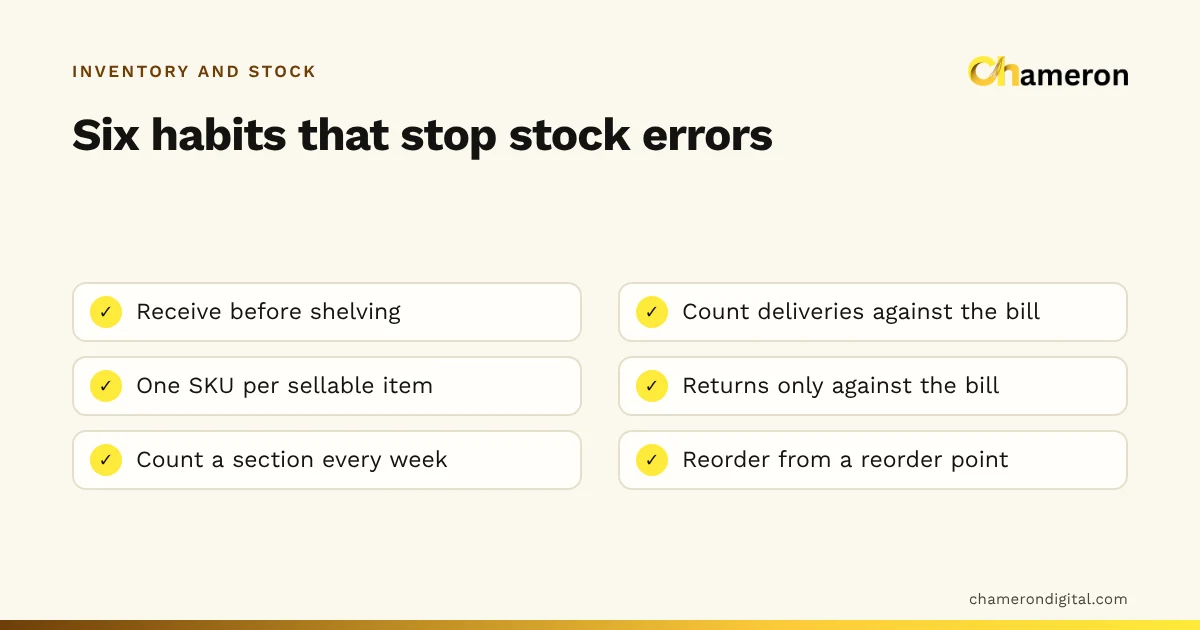
- Trusting stock figures that have not been counted. Missing or damaged items make the system order late.
- Treating every item the same. Strict levels on slow, expensive items create overstock; loose ones on staples create stockouts.
Using software to stay ahead
On paper, the hard part is noticing when stock reaches its reorder point. Software that deducts every sale from stock can list items at or below their level every day, and list items that have not sold for weeks, so the routine above takes minutes.
In BILL OS, reports show what is low, what to reorder and what has not sold, and its Guardian review lists stock that may run out within a week alongside stock unsold for 90 days, both ends of this problem in one place. Shelf counts are approved as adjustments so stock figures stay trustworthy; see inventory and stock.
Conclusion
Stockouts and overstock are not bad luck. They come from buying that is not tied to sales. Sort your items, set a reorder point and order quantity for the ones that matter, check a short list every day, plan seasons separately and clear slow stock on purpose. To start, work out the levels for your ten most important items with the reorder point calculator, then see how much stock a shop should keep as a quick reference.
Questions people ask
What is the difference between a stockout and a shortage?
A stockout means an item is completely unavailable when a customer asks for it. A shortage usually means you have some, but not enough to meet demand, such as one size left of a popular shirt. Both lose sales; a stockout is the more visible one.
How much safety stock should I keep?
Enough to cover the extra sales or delivery delays you realistically see. A simple start is one to three days of average sales for reliable suppliers, more for unreliable ones or long lead times. See what safety stock is for the formula.
Is it better to run out occasionally or to overstock?
It depends on the item. Running out of a staple that brings customers in costs more than a rupee figure suggests, because they may shop elsewhere. Overstocking something perishable or seasonal usually ends in waste or discounts. Set stricter levels for staples and leaner ones for slow, risky items.
How do I handle items with very irregular sales?
Do not set a reorder point from a few unusual weeks. Keep a small display quantity, take customer orders for the rest, and review the item monthly. If it keeps selling, give it a proper reorder point.