The short answer
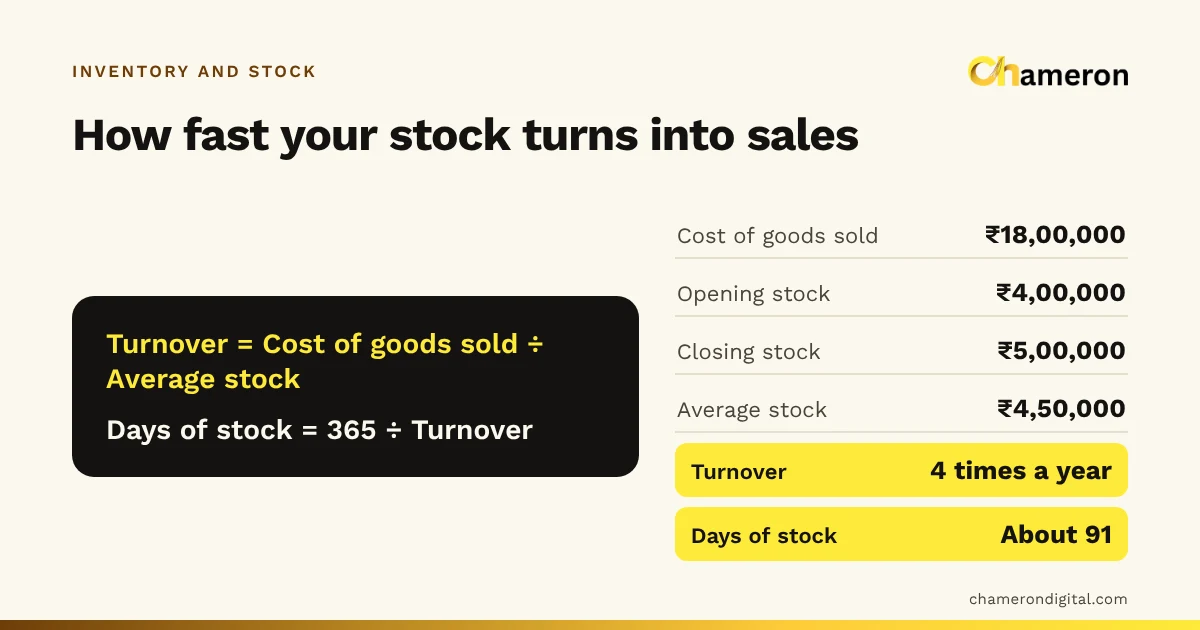
Inventory turnover measures how many times a business sells and replaces its stock in a period. You work it out by dividing the cost of goods sold by the average value of stock held, both at cost. A footwear shop that sold goods costing ₹18,00,000 in a year while holding ₹4,50,000 of stock on average turned its stock 4 times, which means a typical pair sat in the shop for about 91 days before it sold.
The formula in one line
Two details matter. First, use cost of goods sold (what the goods you sold cost you), not your sales total, because stock is valued at cost. Our short answer on cost of goods sold explains how to find it. Second, use the average stock across the period, because the stock on any single day can be unusually high or low.
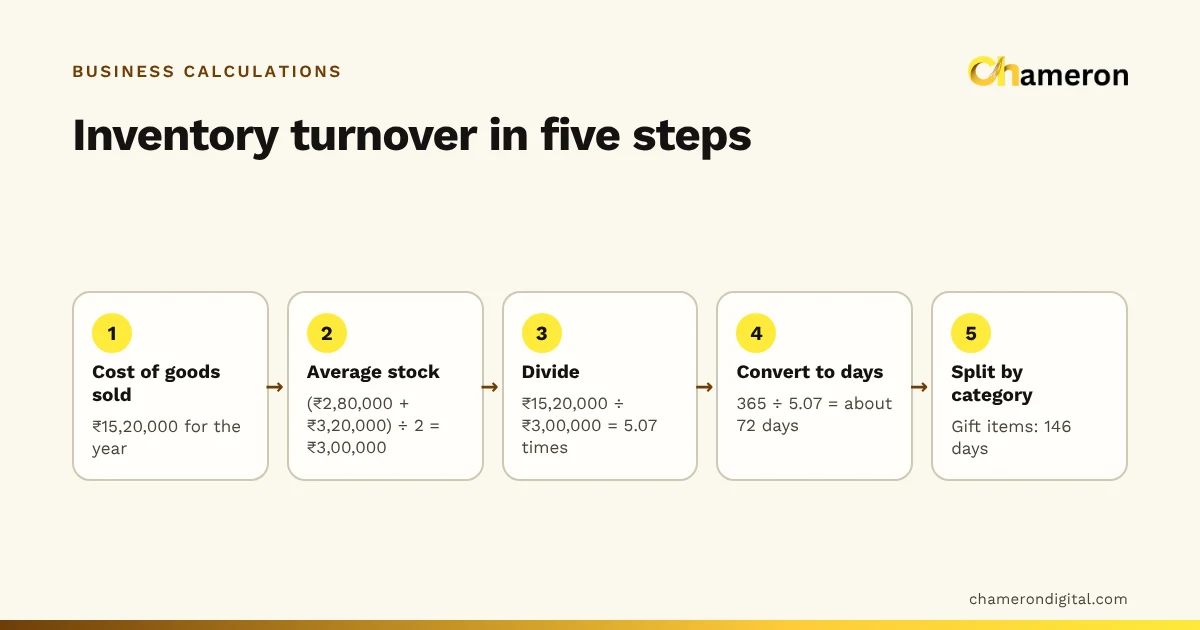
This article is about what turnover means and how to use it. For a step-by-step calculation with monthly figures, categories and where to find each number, see how to calculate inventory turnover.
A worked example
A footwear shop’s figures for the financial year, all at cost and before GST:
| Figure | Amount |
|---|---|
| Cost of goods sold for the year | ₹18,00,000 |
| Stock at the start of the year | ₹4,00,000 |
| Stock at the end of the year | ₹5,00,000 |
| Average stock | (₹4,00,000 + ₹5,00,000) ÷ 2 = ₹4,50,000 |
| Inventory turnover | ₹18,00,000 ÷ ₹4,50,000 = 4 times |
| Days of stock | 365 ÷ 4 = about 91 days |
In plain words: the shop holds roughly three months of sales on its shelves. Every rupee spent on stock takes about three months to come back as a sale, and longer still before it is cash in the bank if some customers buy on credit.
How to read the number
A turnover figure on its own is hard to picture. Converting it to days of stock makes it concrete:
| Turnover per year | Days of stock (approx.) | What it feels like on the shelf |
|---|---|---|
| 2 | 183 | Six months of stock |
| 3 | 122 | Four months |
| 4 | 91 | Three months |
| 6 | 61 | Two months |
| 12 | 30 | One month |
| 24 | 15 | Two weeks |
Whether a figure is healthy depends on what you sell and how you are supplied:
- Perishable and everyday goods (dairy, bread, vegetables, snacks) need fast turnover. Slow turnover there means waste.
- Fashion and seasonal goods (clothing, footwear, festive items) need to sell within the season. Stock still on hand after the season usually has to be discounted.
- Durable, high-value goods (furniture, appliances, hardware) can reasonably turn more slowly, because they do not spoil and customers expect a range to choose from.
- Supplier terms matter. A distributor who delivers twice a week lets a kirana run lean. A supplier with a large minimum order or a long lead time forces you to hold more.
The most useful comparisons are with yourself: this year against last year, this month against the same month last year, and one category against another.
Low turnover: cash stuck on the shelf
Slow-moving stock has costs that do not show up on any bill. It ties up money you could use for fast sellers or to pay suppliers early. It takes shelf and godown space. It gets dusty, damaged, outdated or past its date. And when it finally has to be cleared, it usually goes at a discount.
High turnover: good, up to a point
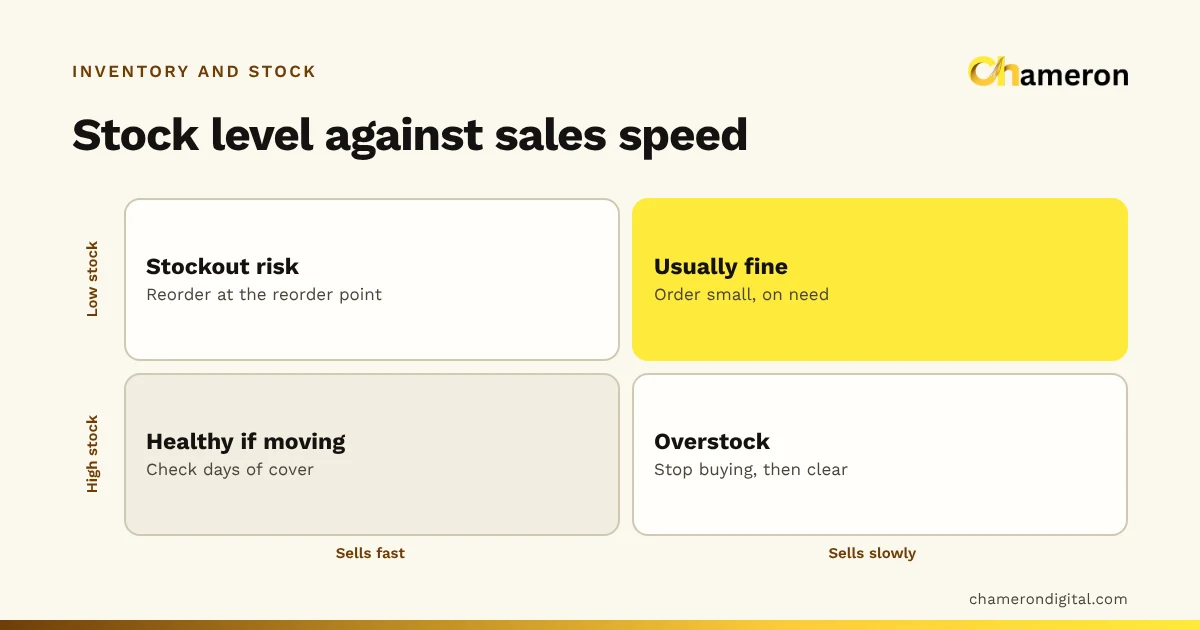
Fast turnover usually means you buy close to what you sell. But if it comes with empty shelves, customers asking for items you do not have, or emergency purchases from a wholesaler at higher prices, the stock is too lean. Lost sales do not appear in your stock figures at all, which is why turnover should always be read together with how often you run out. Our guide to preventing stockouts and overstocking covers how to balance the two.
Why one number for the whole shop can mislead
A whole-shop turnover is an average of fast and slow items, and the average can hide problems. A general store might turn its snacks every few weeks while a corner of kitchenware has not moved since last Diwali; together they produce a respectable-looking figure.
Work out turnover for each category, and for your most valuable items, before you act on it. The categories with low turnover and a large share of your stock value are where most of your cash is stuck, and where improvements pay back first.
Eight ways to improve inventory turnover
You can raise turnover in two ways: sell more from the same stock, or hold less stock for the same sales. For most small businesses the second is quicker and safer.
- Buy from sales history, not memory. Order quantities based on what actually sold in the last few weeks and the same season last year, not on what the supplier is pushing.
- Order smaller quantities more often. If your supplier can deliver weekly instead of monthly, average stock falls even though sales stay the same. Weigh this against any bulk discount you would lose.
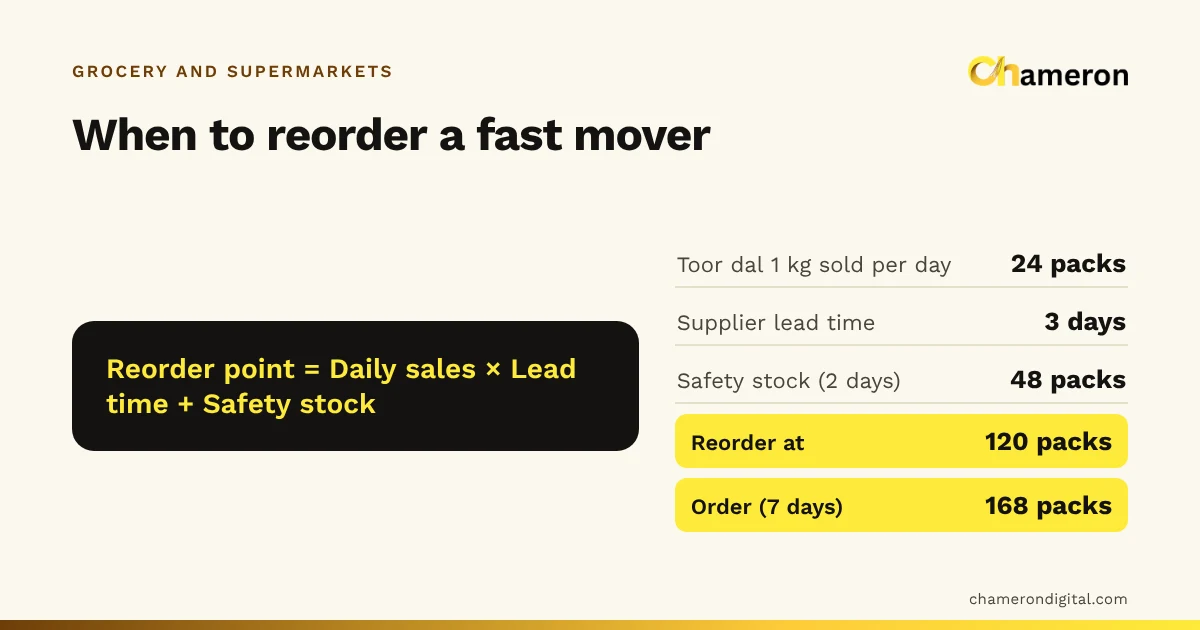
- Set a reorder point for important items. Reorder when stock falls to a set level instead of topping up whenever someone remembers. The reorder point calculator works it out from daily sales and lead time.
- Clear dead stock deliberately. List items that have not sold for, say, 90 days. Return what the supplier will take back, bundle or discount the rest, and stop reordering them. See what dead stock is.
- Trim the range. Five near-identical versions of the same product split demand and multiply stock. Keep the variants, sizes and colours that sell.
- Time seasonal buying. Bring festive, wedding-season or school-reopening stock in close to the season, and mark down what is left promptly afterwards.
- Keep stock records accurate. If the system thinks you have stock that is not there, you reorder late; if it misses stock that is there, you reorder twice. Regular counts keep the figures honest.
- Help slow items sell. Better placement, a display near the counter or a sensible combo offer can move stock that customers simply do not notice.
What improvement looks like in rupees
Suppose the footwear shop above stops reordering slow styles and sizes and brings its average stock down to ₹3,60,000, while still selling goods costing ₹18,00,000 a year:
- New turnover: ₹18,00,000 ÷ ₹3,60,000 = 5 times
- New days of stock: 365 ÷ 5 = 73 days
- Cash released from the shelves: ₹4,50,000 − ₹3,60,000 = ₹90,000
That ₹90,000 is money the owner can now use for better-selling stock, supplier payments or working capital. If it had been funded by a loan at an illustrative 12% a year, it would also save about ₹10,800 a year in interest.
Common mistakes when using turnover
- Using sales value for one number and cost for the other. Divide cost by cost, or selling price by selling price, never a mix.
- Taking the average from two unusual days. A count just after a big festive delivery inflates the average. Use more counts for seasonal businesses.
- Chasing a higher figure at any cost. Cutting stock so far that you run out of best-sellers improves the ratio and hurts the business.
- Comparing with someone else’s shop. A different product mix, location and supplier set make the comparison meaningless.
- Looking once a year. By the time the annual figure looks bad, the stock has been sitting for months.
Inventory turnover in software
Turnover needs two things: an accurate cost of goods sold and a reliable stock value at regular dates. Billing software that records the cost of every purchase and deducts every sale from stock produces both without a manual count each month, though shelf counts are still needed to catch errors and losses.
BILL OS reports include inventory, a reorder list and dead stock, and its Guardian review lists stock that may run out within a week and stock unsold for 90 days, which covers both ends of the turnover problem. Reports download to Excel if you want to work out turnover yourself.
Conclusion
Inventory turnover tells you how hard the money in your stock is working. Read it in days, compare it with your own history and between categories, and check it against how often you run out. To improve it, focus on buying less of what does not sell. To try it with your own figures, use the free inventory turnover calculator, or see how much stock a shop should keep for setting levels item by item.
Questions people ask
What is a good inventory turnover ratio?
There is no single good number. A shop selling milk and bread should turn its stock far faster than one selling furniture or jewellery. Compare your figure with your own past months and between your own categories, and check it against how often you run out.
Is inventory turnover the same as stock rotation?
No. Stock rotation is the physical practice of selling older stock first, such as putting new deliveries behind old ones. Turnover is a number that measures how quickly stock sells overall. Good rotation helps turnover by reducing expired and damaged goods.
Can I calculate turnover using sales instead of cost of goods sold?
You can, but then the stock must also be valued at selling price, or the result is overstated. Most businesses use cost on both sides, which is what our inventory turnover calculator does.
Does higher turnover mean more profit?
Not by itself. Turnover measures speed, not margin. A shop can turn stock quickly at thin margins or slowly at good ones. Look at turnover together with gross margin to see how hard your stock money is working.
How often should I check inventory turnover?
Monthly is practical for most small businesses, using days of stock so that months can be compared. Review it by category at least every quarter and before each big buying season.