The short answer
A stock count compares what is physically on your shelves with what your records say should be there; reconciliation is explaining and correcting every difference. Count one section at a time on a regular cycle, count blind, work out the variance for each item (counted minus expected), investigate the differences before changing anything, and approve each adjustment with a reason. Done this way, a count takes an hour a week instead of a closed shop once a year, and the records become something you can trust.
Full counts and cycle counts
There are two ways to count a shop, and most retailers are better served by the second.
| Full (annual) count | Cycle count | |
|---|---|---|
| What is counted | Everything, at once | One section or group of items at a time |
| Disruption | Shop often closed or half-staffed | An hour or two, often before opening |
| Accuracy | Tired people make mistakes late in the day | Short, focused counts |
| When problems are found | Months after they started | Within weeks |
| Good for | Year-end valuation, a new system's opening stock | Keeping records right all year |
A full count still has its place: when you start using a new system, at year end if your accountant wants one, or when records have drifted so far that nobody trusts them. For the rest of the year, cycle counting does the job.
Plan a counting cycle
Not every item deserves the same attention. Group your items by how much they matter, and count the important ones more often. A common way is to sort items by sales value and split them into three groups (often called ABC).
| Group | Which items | Count every | Example items |
|---|---|---|---|
| A | Fast sellers and high-value items | Week | Branded jeans, phones, perfumes |
| B | Steady middle sellers | 4 weeks | Everyday shirts, belts |
| C | Slow, low-value items | 13 weeks (a quarter) | Socks, buttons, gift bags |
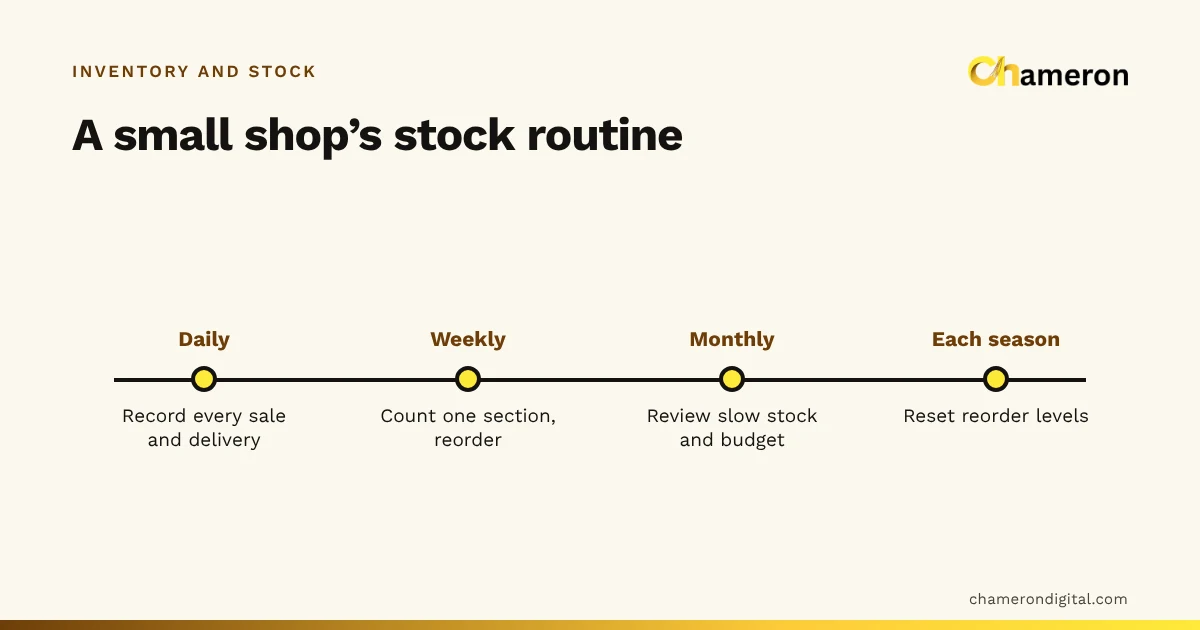
Write the cycle on a calendar: which section, which day, who counts. A count that depends on someone remembering will not happen.
Prepare the section
- Finish paperwork first. Enter any delivery received for that section, and any returns or exchanges, before counting starts. Otherwise you will "find" stock that has simply not been recorded yet.
- Tidy, do not move. Put stray items back where they belong, but do not shift stock between the shelf and the stockroom during the count.
- Print or open a count sheet in shelf order. Listing items in the order they sit on the rack saves walking back and forth. The free stock count sheet has columns for shelf, stockroom and display.
- Decide who counts. Ideally someone who did not receive or sell that stock. For high-value sections, two people count independently and compare.
Count blind, in one unit
The person counting should not see the quantity the records expect. When people know the expected number, they tend to find it. A blind count sheet lists the item and an empty box, nothing else.
A few rules prevent most counting errors:
- Count each location separately, shelf, stockroom and window display, then add them up.
- Count in the unit you sell in. If shirts are sold singly, count singles, not boxes. If a box is sealed and labelled with its quantity, open one at random to check.
- Scan where you can. Scanning each piece with a barcode scanner catches the commonest counting error in clothing and footwear: the right style in the wrong size or colour. Size and colour variants explains why each size must be counted on its own.
- Write zeros. An empty box on the sheet could mean "none" or "forgot". Write 0.
Reconcile: work out what should be there
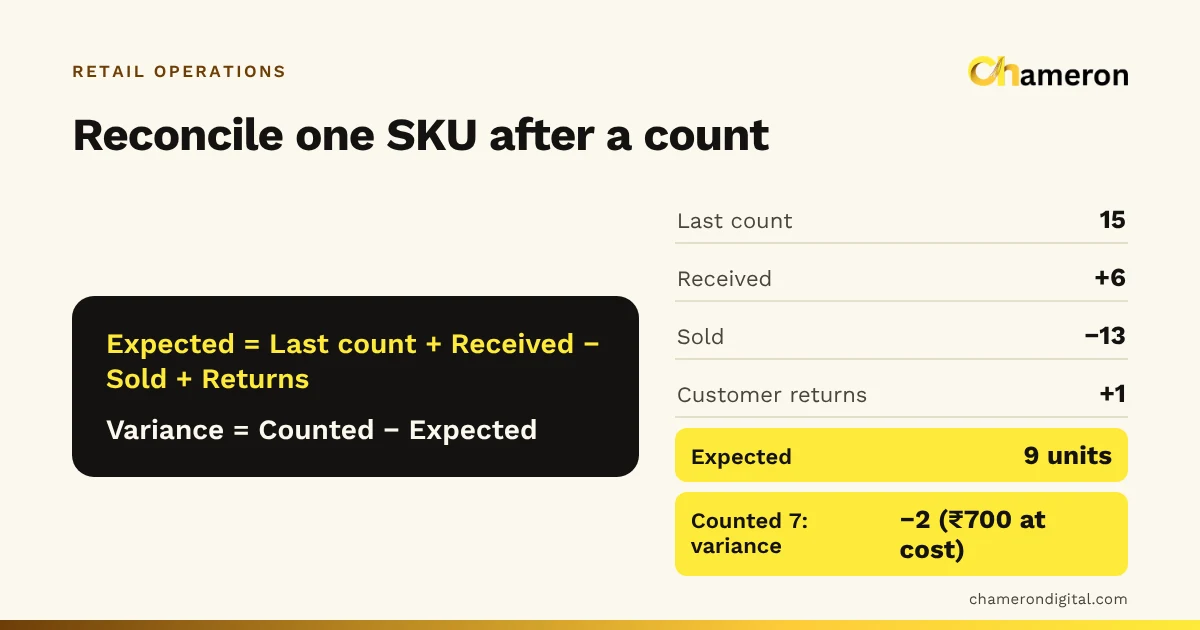
For each item, the expected quantity comes from the last confirmed count plus everything recorded since.
Take one shirt, SHT-0101-WHT-L, which costs ₹350. At the last count there were 15. Since then 6 arrived, 13 were sold and 1 was returned by a customer. Expected stock is 15 + 6 − 13 + 1 = 9. The count finds 7. The variance is 7 − 9 = −2, worth −2 × ₹350 = −₹700 at cost.
Now look at the whole section. Here is a shirt and trouser rack after a count:
| SKU | Expected | Counted | Variance | Cost | Variance value |
|---|---|---|---|---|---|
| SHT-0101-WHT-M | 12 | 12 | 0 | ₹350 | ₹0 |
| SHT-0101-WHT-L | 9 | 7 | −2 | ₹350 | −₹700 |
| SHT-0101-BLU-L | 6 | 8 | +2 | ₹350 | +₹700 |
| SHT-0107-BLK-M | 10 | 9 | −1 | ₹420 | −₹420 |
| TRS-0210-GRY-32 | 5 | 4 | −1 | ₹600 | −₹600 |
| Total | −₹1,020 |
The net difference is −₹1,020, but that hides how much was actually wrong. Add the differences ignoring their sign and the gross variance is ₹700 + ₹700 + ₹420 + ₹600 = ₹2,420. A section can show a net variance of zero while being badly wrong in both directions, so always look at both.
Investigate before you adjust
Every difference has a cause. Check the paperwork explanations first, because they are the most common and the cheapest to fix.
| What you see | Likely cause | Where to look |
|---|---|---|
| One variant short, a sibling variant over by the same amount | Wrong size or colour billed or received | Recent bills and deliveries for that style |
| Over by exactly a delivery's quantity | Delivery not yet entered | Supplier bills received but not recorded |
| Short by a returned item | Return taken back without a bill | Exchange and return records |
| Short, with damaged pieces nearby | Damage not recorded | Damaged or "seconds" bin |
| Short, no other explanation | Miscount, theft or loss | Recount first |
In the example, white L is short by 2 and blue L is over by 2. That pattern almost always means two white shirts were billed as blue. The stock is not missing; the records are crossed. The grey trousers turned up in a trial room on a recount, so their count becomes 5 and needs no adjustment. Only the black shirt, short by one and still unexplained after a recount, is a real loss: ₹420 at cost.
Set a recount rule and keep to it: for example, recount any line more than two units or ₹500 out. Large differences are often counting errors, and one recount is cheaper than a wrong adjustment.
Adjust with a reason, then review
Change the records only after investigating, and give every adjustment a reason from a short fixed list: wrong variant billed, damage, expiry, supplier short-supply, counting error found, unexplained. "Other" with no note is not a reason.
The owner or manager should approve adjustments, not the person who counted. Over a few months the reasons show you where stock goes. If "wrong variant billed" keeps appearing, train the counter to scan every piece. If "unexplained" grows in one section, look at how that section is supervised. The shrinkage question explains how to think about unexplained losses, and items that turn up count after count without selling are worth checking against your dead stock list.
A simple measure to track is unexplained loss as a share of the section's counted value. If the rack above holds stock worth ₹42,000 at cost, the ₹420 unexplained loss is 1% of it. Watch whether that figure rises or falls from one count to the next.
Can you keep selling during a count?
Yes, with care. The risk is a sale between the moment an item is counted and the moment its expected figure is taken, which makes a correct count look wrong. There are two safe approaches:
- Software that handles it. Some systems compare each counted item with its stock at the time of counting, so sales during the count do not create false differences.
- A short freeze on one section. Count the section before opening, or ask the counter not to sell from it for the twenty minutes it takes.
In BILL OS, a stock tally lets you count the shelves, see what is short or extra, and then approve adjustments with a reason, and selling during a count is allowed; see inventory and stock.
Common mistakes
- Adjusting straight to the count. It makes the numbers agree and hides every cause. Investigate first.
- Counting with the expected figure in view. People find what they are told to find.
- Looking only at the net figure. A net zero can hide large errors in both directions.
- Counting by the box. A box that should hold twelve and holds ten is a short you will not see.
- No reasons on adjustments. Without them, next month's count teaches you nothing.
- Counting before entering deliveries. You will chase "extra" stock that is simply unrecorded.
For more problems that make counts drift in the first place, see inventory mistakes to avoid.
The bottom line
A stock count is not about making the screen match the shelf. It is about finding out why they differ. Count a little every week, count blind, reconcile with the formula, investigate before adjusting, and record a reason every time. After a few cycles the differences shrink, and the ones that remain tell you exactly where to look. For the routine that keeps stock right between counts, read how to manage inventory in a small retail shop.
Questions people ask
How often should a small shop count its stock?
Every item should be counted at least once a quarter, and fast-moving or high-value items every week or two. A short weekly cycle count is easier to keep up than one big annual count.
What is an acceptable stock variance?
There is no universal figure. Set your own tolerance per section, for example any single difference above ₹500 at cost or above two units gets a recount, and watch whether your total unexplained shortage grows or falls from count to count.
Should I value variances at cost or at selling price?
At cost. That is what the missing stock cost you to buy, and it matches how stock is valued in your accounts. See how to calculate stock value.
Can we keep billing while we count?
Yes, if your records compare each item against the stock at the moment it was counted, or if you stop sales from that one section until it is counted. Otherwise count sections when they are quiet, such as before opening.
What is the difference between a stock count and a stock tally?
They usually mean the same thing: physically counting what is on hand and comparing it with the records. The glossary has the short definition.