The short answer
Manage sizes and colours by treating each product as a style with variants: the style holds what is shared, and every size in every colour is its own item with its own SKU, barcode, price and stock. Create only the combinations you actually stock, label every piece, take exchanges against the original bill so both sizes' stock changes, and read sales by size before reordering. Track a style as one item instead, and your stock report will say you have ten shirts when the customer in front of you needs a medium you sold out of last week.
The style-and-variant model
Think of two levels.
- The style is the design: "Cotton kurta, straight cut, style 142". It holds what all versions share: name, category, description, HSN code and GST rate, and usually the price.
- The variants are the versions a customer actually picks up: navy in large, maroon in medium. Each has its own SKU, its own barcode, its own stock and, where needed, its own price.
| Level | Example | What it holds |
|---|---|---|
| Style | Kurta, style 142 | Name, category, description, tax details, usual price |
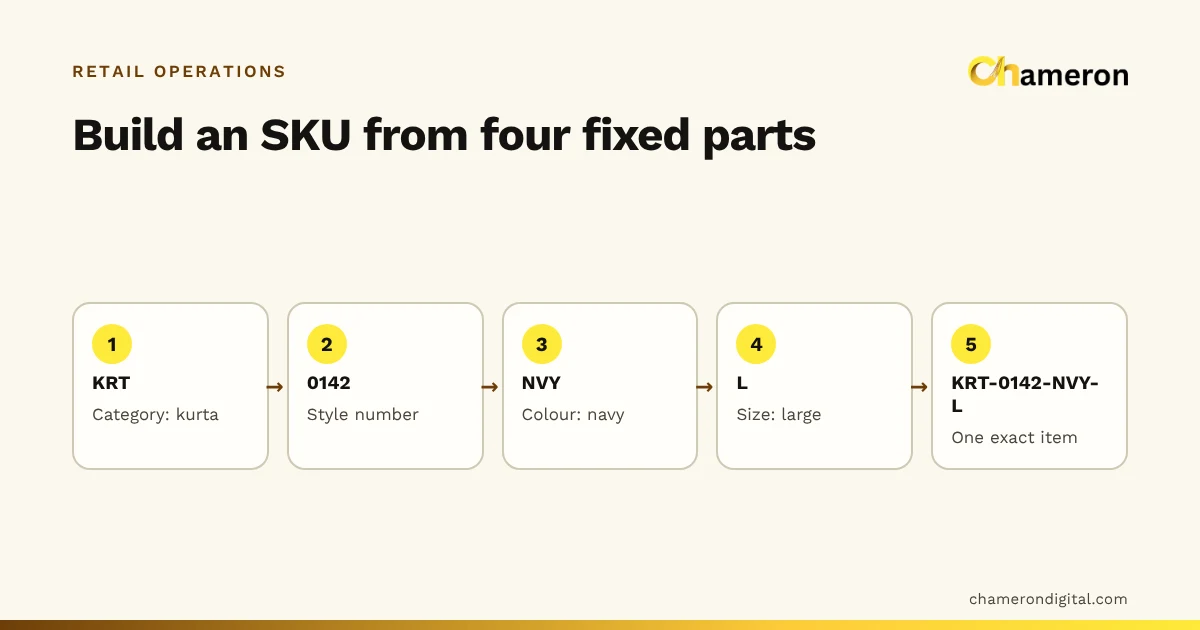
| Variant | Navy, L | SKU KRT-0142-NVY-L, barcode, stock 6, price if different |
| Variant | Maroon, M | SKU KRT-0142-MRN-M, barcode, stock 4, price if different |
The glossary entry for variant gives the short definition. The benefit of two levels is that you can look at the style as a whole ("how did kurta 142 do this season?") and at each variant ("do we have navy in large?") without keeping two sets of records.
Why every size needs its own stock
A style-level stock figure answers a question nobody asks. Customers do not ask "do you have kurta 142?"; they ask "do you have it in large?"
| Size | S | M | L | XL | XXL | Total |
|---|---|---|---|---|---|---|
| In stock | 9 | 2 | 1 | 14 | 11 | 37 |
Thirty-seven pieces sounds healthy. But only three of them are in medium and large, the two sizes this shop's customers buy most. Tracked as one item, the style would never appear on a reorder list, and the shop would keep turning away customers for a style it believes it has plenty of.
Per-variant tracking matters in four places:
- Selling. The cashier can see at once whether another size is in the stockroom.
- Reordering. You reorder the sizes that sell, not the style. See preventing stockouts and overstocking.
- Exchanges. A medium swapped for a large changes two stock figures, not none.
- Buying. Size and colour sales tell you what to buy next season.
Setting up variants without errors
Build the size grid
Start from a grid of colours against sizes, and tick only what you actually stock.
| Colour | S | M | L | XL | XXL |
|---|---|---|---|---|---|
| Navy | ✓ | ✓ | ✓ | ✓ | ✓ |
| Maroon | ✓ | ✓ | ✓ | ✓ | – |
| White | – | ✓ | ✓ | ✓ | – |
Three colours and five sizes would give 15 possible combinations. This shop stocks 5 + 4 + 3 = 12. Creating the other three "just in case" fills reports with zero-stock items that never sell and clutters every search at the counter.
Then work through each variant
- Give each variant an SKU from a fixed pattern, such as style-colour-size. Our SKU naming guide covers colour and size codes.
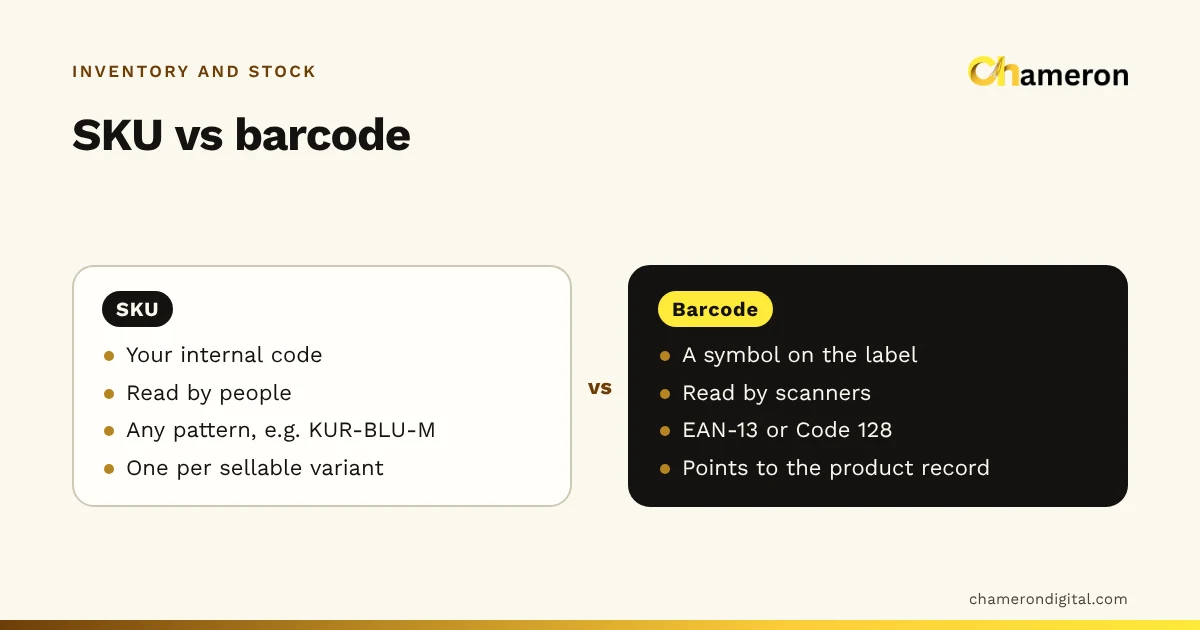
- Give each variant a barcode. Use the manufacturer's code where every size and colour has its own; otherwise print your own. Never let two sizes share a barcode.
- Enter opening stock per variant, counted, not estimated.
- Set a different price only where it differs. If XXL costs ₹100 more, set it on that variant alone.
- Label every piece as it arrives, before it reaches the shelf.
Labels that work for people and scanners
A variant label has two readers. The scanner needs the barcode. The customer and the salesperson need to see the size and colour without scanning. Print both: barcode, SKU, size and colour in plain text, and the price if you show prices on tags. Use the same label size across the store, and test-scan a few labels from each print run. The barcode inventory guide covers label stock and printers.
Exchanges done right
Size exchanges are routine in clothing and footwear, and they are where variant stock most often goes wrong. The rule is simple: take every exchange against the original bill, never as a fresh sale with a manual note.
If the replacement had been cheaper, the difference would go back to the customer as cash or store credit, according to your policy. Where you charge GST, the usual approach is a credit note that reverses the tax on the returned pair, with the replacement taxed as a sale. Treat this as general information and confirm the documentation with your accountant.
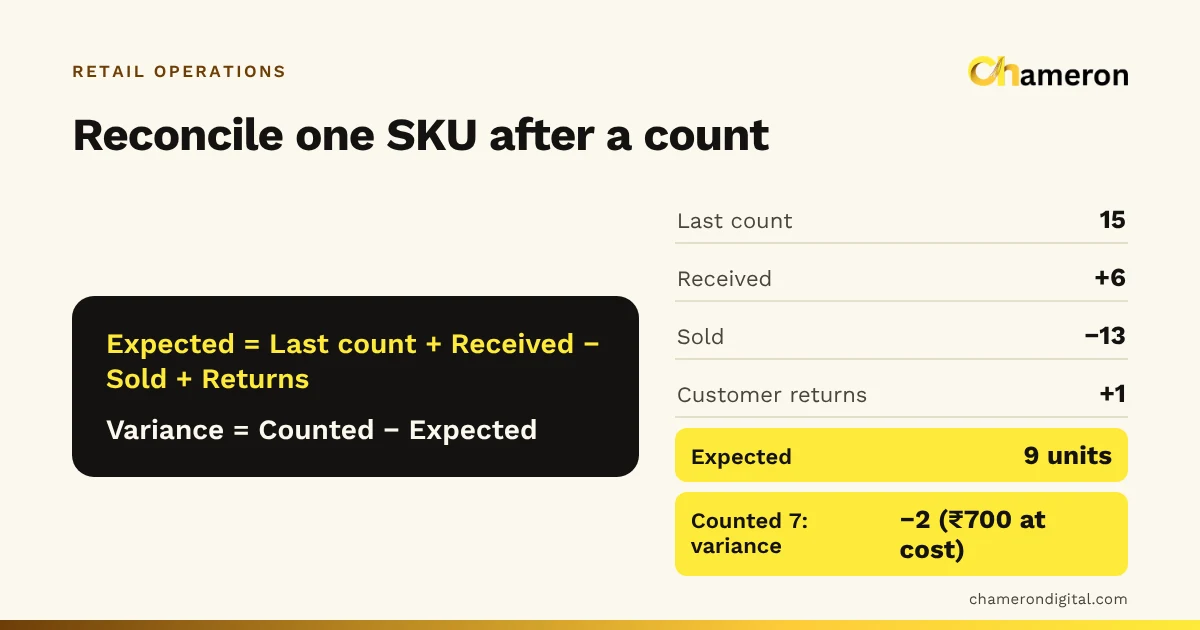
The two mistakes to avoid: putting the returned pair back on the shelf without recording it (stock for UK 8 is now wrong), and swapping a size without a bill at all (both figures are now wrong, and the next stock count will show a pair of crossed differences that look like theft).
Read sell-through by size
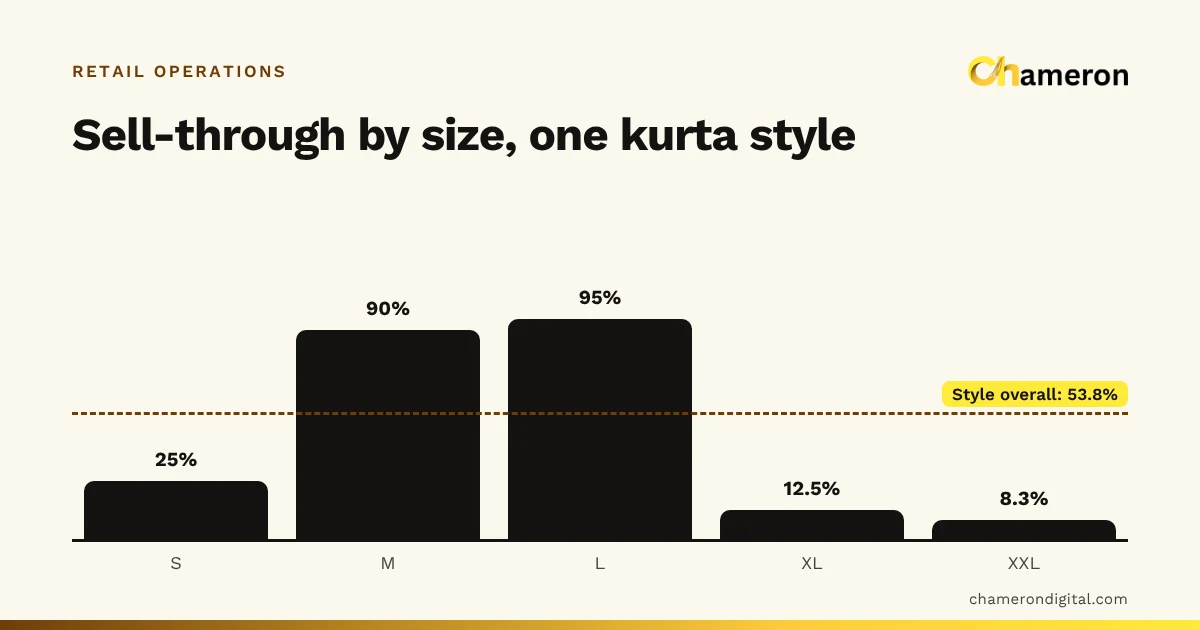
Sell-through is the share of stock received that has sold. It is the most useful single number for a fashion buyer, and it only tells the truth when read by size.
Here is the kurta style from earlier, across all colours, part-way through the season:
| Size | Received | Sold | In stock | Sell-through |
|---|---|---|---|---|
| S | 12 | 3 | 9 | 25% |
| M | 20 | 18 | 2 | 90% |
| L | 20 | 19 | 1 | 95% |
| XL | 16 | 2 | 14 | 12.5% |
| XXL | 12 | 1 | 11 | 8.3% |
| Total | 80 | 43 | 37 | 53.8% |
At style level, 53.8% sell-through looks like an average performer. Size by size, it is two stories: medium and large are almost sold out and should be reordered now, while XL and XXL were over-bought. Pieces that sit unsold through a season risk becoming dead stock.
Buy the size ratio that sold
Many shops order equal quantities of each size, or the size split a supplier suggests. Your own sales history is a better guide.
Adjust for what you know: a style cut slim may need fewer large sizes, and a festival range may sell differently from everyday wear. Then use colour sales the same way. If one colour sold half of a style's units, it deserves more than a third of the next order. For how much to keep on hand overall, see how much stock a shop should keep.
Common mistakes
- One SKU for all sizes. The most damaging mistake, because every report built on it is wrong.
- Creating every combination. Hundreds of zero-stock variants make searching and counting slower.
- Mixing brand sizes without noting them. One brand's 40 and another's L are recorded as what the label says; staff need a note on how they compare.
- Swapping labels between pieces. A quick fix at the counter that leaves two variants wrong.
- Exchanges without the original bill. Stock for both sizes goes wrong, and the return cannot be traced.
- Reordering by style. "Kurta 142 is selling, order 50 more" brings back the same unsold XLs.
How software handles variants
Variants are where a spreadsheet struggles and inventory software earns its place. In BILL OS, you preview every size and colour combination for a style, untick the ones you do not stock, and each variant gets its own SKU, barcode, price and opening stock; labels can be printed for a style's variants or straight after receiving. Reports include sales by size and colour, which is the table above without the arithmetic. See SKUs, barcodes and labels, and our page for clothing and apparel stores.
The bottom line
A clothing or footwear store does not sell styles; it sells sizes and colours. Model each product as a style with variants, create only what you stock, label every piece, take exchanges against the bill, and read sell-through size by size. Do that, and your reorder list will finally match what customers ask for at the counter.
Questions people ask
Is each size a separate SKU?
Yes. Each size in each colour is a separate SKU, because each can run out on its own. A shirt in 4 colours and 5 sizes is 20 SKUs, unless you leave out combinations you do not stock. Our SKU naming guide shows how to code them.
Can different sizes of the same style have different prices?
Yes. Larger sizes, or a different fabric in one colour, often cost more. Give that variant its own price; the rest of the style keeps the common price.
How should I handle 'free size' items?
Treat free size as a single size value, such as FS. The item then has one variant per colour, and reports still work the same way.
What is a size run, or broken size run?
A size run is the full set of sizes for a style. It is 'broken' when the middle sizes are sold out and only the extremes remain. A broken style sells slowly even if plenty of pieces are left, so restock the missing sizes or clear the remainder.
How is GST handled when a customer exchanges a size?
In general, the returned item's tax is reversed with a credit note and the replacement is taxed as a sale. Rates and documentation rules can change, so confirm the treatment for your business with your accountant or the official GST portal.