The short answer
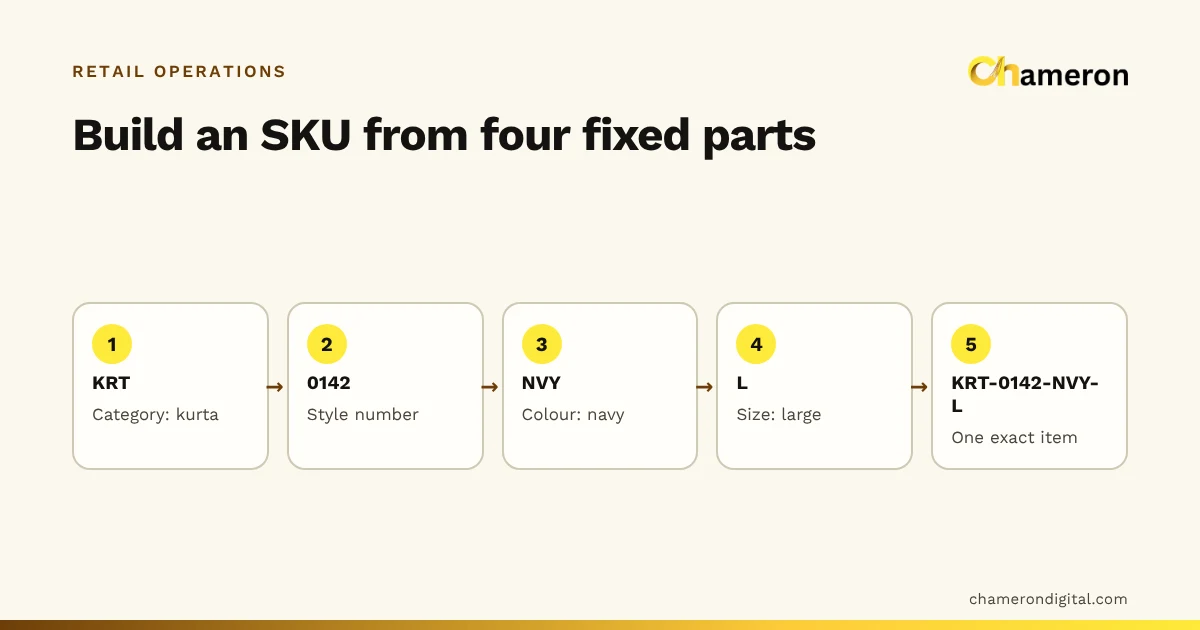
A good SKU is a short code, built from fixed parts in a fixed order, that names one exact item you stock. For a clothing shop that might be category, style number, colour and size: KRT-0142-NVY-L is style 142 kurta, navy, large. Keep codes to letters, numbers and hyphens, never put price or supplier into them, and never reuse a code. Decide the pattern before you create the first product, because changing it later means relabelling the shop.
What an SKU is, and what it is not
A stock keeping unit (SKU) is your business's name for one specific thing you buy, store and sell. A navy cotton kurta in large is one SKU; the same kurta in medium is another, because you can run out of one and not the other. The glossary entry for SKU gives the short definition.
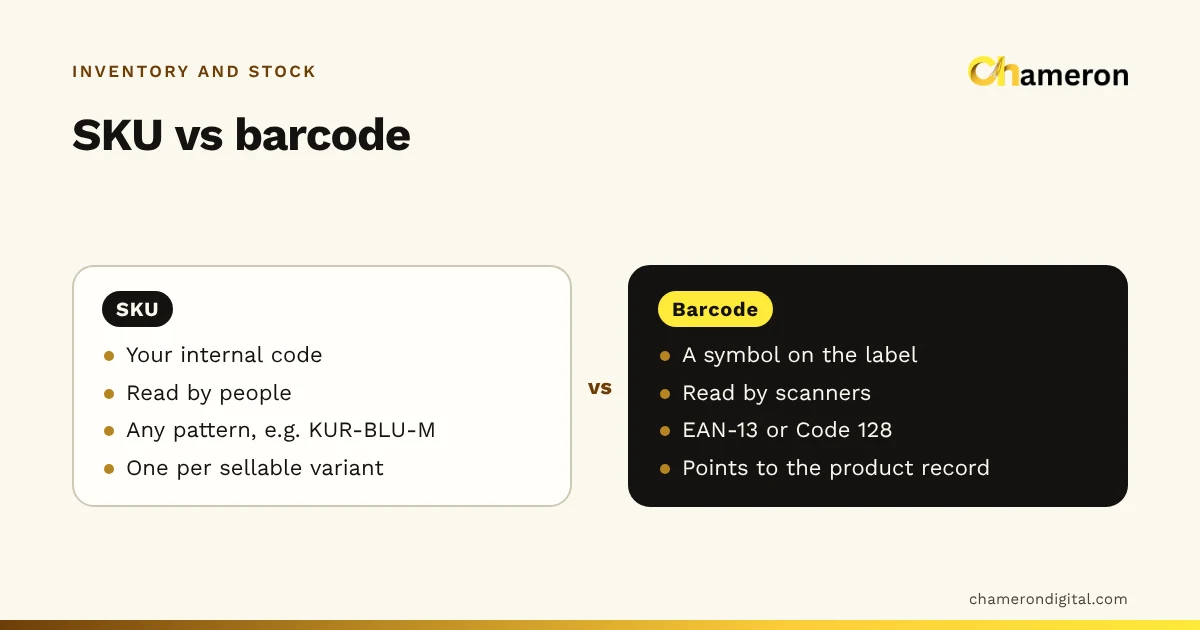
An SKU is not the same as a barcode. A barcode is printed for a scanner, and on packed goods it usually comes from the manufacturer. An SKU is written for people: the cashier, the person receiving a delivery, the owner reading a report. Many items have both, and the two should point to the same product record. The differences are covered in SKU vs barcode.
The test of a good SKU is simple: someone on your team should be able to read it aloud, write it on a count sheet, and know roughly what it is without opening a computer.
The anatomy of a good SKU
Most retail SKUs work best with three or four parts, joined by hyphens, always in the same order. Each part answers one question about the item.
| Part | Question it answers | Length | Example |
|---|---|---|---|
| Category | What kind of item? | 2–4 letters | KRT (kurta) |
| Style or model | Which design or product? | 3–4 digits | 0142 |
| Colour or variant | Which version? | 2–3 letters | NVY (navy) |
| Size or pack | How big, or how much? | 1–4 characters | L, 9, 5KG |
Put the most general part first and the most specific last. That way, sorting a product list alphabetically groups all kurtas together, then each style, then its colours and sizes. Stock reports, count sheets and reorder lists all become easier to read without any extra work.
How many codes a pattern allows
Check that each part has room to grow. A three-digit style number allows 999 styles in a category; four digits allow 9,999. If you add around 300 new styles a year, three digits run out in about three years, so use four from the start. Running out of room is one of the few reasons a shop is forced to change its pattern.
Build your code lists first
The parts only work if everyone uses the same abbreviation for the same thing. Before creating products, write a short list for each part and keep it with the SKU planning worksheet.
| Colour | Code | Size | Code |
|---|---|---|---|
| Black | BLK | Small | S |
| White | WHT | Medium | M |
| Navy | NVY | Large | L |
| Maroon | MRN | Extra large | XL |
| Grey | GRY | Waist 32 | 32 |
| Multicolour | MLT | Free size | FS |
A few habits keep the lists clean:
- One code per meaning. Decide once whether dark blue is
NVYorDBL, and never use both. - Same length within a part. All colour codes three letters, all categories three letters. Codes then line up neatly on reports.
- Your own sizes, mapped from brands. One brand's "40" and another's "L" may be the same fit for your customers, but record what the label says. Note any mapping on the list so receiving staff do not guess.
- A code for "none". For items with no colour or size, simply leave that part out rather than inventing filler such as
XX.
Examples for different kinds of shop
The pattern changes with what you sell. What matters is that each part describes something that makes the item different on the shelf.
| Shop | Item | Pattern | SKU |
|---|---|---|---|
| Clothing | Kurta, style 142, navy, large | Category-style-colour-size | KRT-0142-NVY-L |
| Footwear | Running shoe, model 2210, black, UK 9 | Category-model-colour-size | SHO-2210-BLK-9 |
| Hardware | PVC elbow, 1 inch, pack of 10 | Category-item-size-pack | PVC-ELB-1IN-P10 |
| Electronics | USB-C cable, 1 metre, white | Category-item-length-colour | CBL-USBC-1M-WHT |
| Stationery | A4 notebook, 200 pages, ruled | Category-size-pages-type | NBK-A4-200-RUL |
| General store | Basmati rice, 5 kg bag | Item-pack | RIC-BAS-5KG |
Notice that the hardware and stationery patterns use different parts from clothing. That is fine. A shop that sells both can use one pattern per category, as long as each category's pattern is written down and followed.
For a shop selling mostly packed groceries, the manufacturer's barcode does most of the work and your own codes matter mainly for loose and local items; see barcodes and SKUs in a grocery store.
Eight rules that keep SKUs useful
- Readable beats clever.
KRT-0142-NVY-Ltells a person what it is;100142037does not. - Fixed parts, fixed order. Category, then style, then colour, then size, every time.
- Letters, numbers and hyphens only. Spaces, slashes and full stops cause trouble in spreadsheets, imports and some label printers.
- Avoid look-alike characters. Letter O and zero, letter I and one, are easily confused on a handwritten count sheet. Many shops leave O and I out of their letter codes entirely.
- Pad numbers with zeros.
0042sorts correctly next to0142;42does not. - Uppercase only. Some systems treat
nvyandNVYas different codes. - One item, one code. If the same kurta arrives from two suppliers at different costs, it is still one SKU, with two purchase records.
- Never reuse a code. A discontinued item keeps its SKU forever, so old bills, returns and reports still make sense.
What to leave out of an SKU
The commonest mistake is trying to make the code carry information that changes. When it changes, the code is wrong, and changing the code breaks history.
| Do not include | Why | Where it belongs instead |
|---|---|---|
| Selling price | Prices change with every revision or sale | The price field on the product |
| Supplier name | You may switch suppliers for the same item | Purchase records |
| Date or season received | The same item arrives many times | The purchase or batch record |
| Shelf or rack location | Shops rearrange | A location field or the count sheet |
| Cost price | It changes, and staff should not read it off a label | Purchase records |
A season code is a reasonable exception for fashion stores whose designs genuinely change each season, but only if a repeat design would get a new style number anyway.
Edge cases you will meet
- Bundles and combos. A "3 socks for ₹299" pack sold as one unit needs its own SKU. If you also sell the socks singly, keep both, and decide whether the pack is assembled in advance or at the counter.
- Loose items sold by weight. One SKU per item, with the unit (kg or g) set on the product. The quantity on the bill carries the weight; do not create a code per weight.
- Repacked goods. If you buy dal in a 25 kg sack and sell 1 kg packets, the sack and the packet are different SKUs. Record the repacking as stock moving from one to the other.
- Seconds and damaged stock. A shirt with a stain sold at a lower price is still the same SKU. Record the damage and the discount; a new code splits your sales history.
- Items that arrive without a barcode. Give them an SKU as usual and print your own label. The barcode labels help page shows how this is done in BILL OS.
Common mistakes
- Letting cashiers invent codes at the counter. Within a month the same item has three codes and stock is split across them. Only the person who creates products should create codes.
- Changing the pattern halfway. Two patterns in one product list confuse everyone. If you must change, do it for a whole category at once.
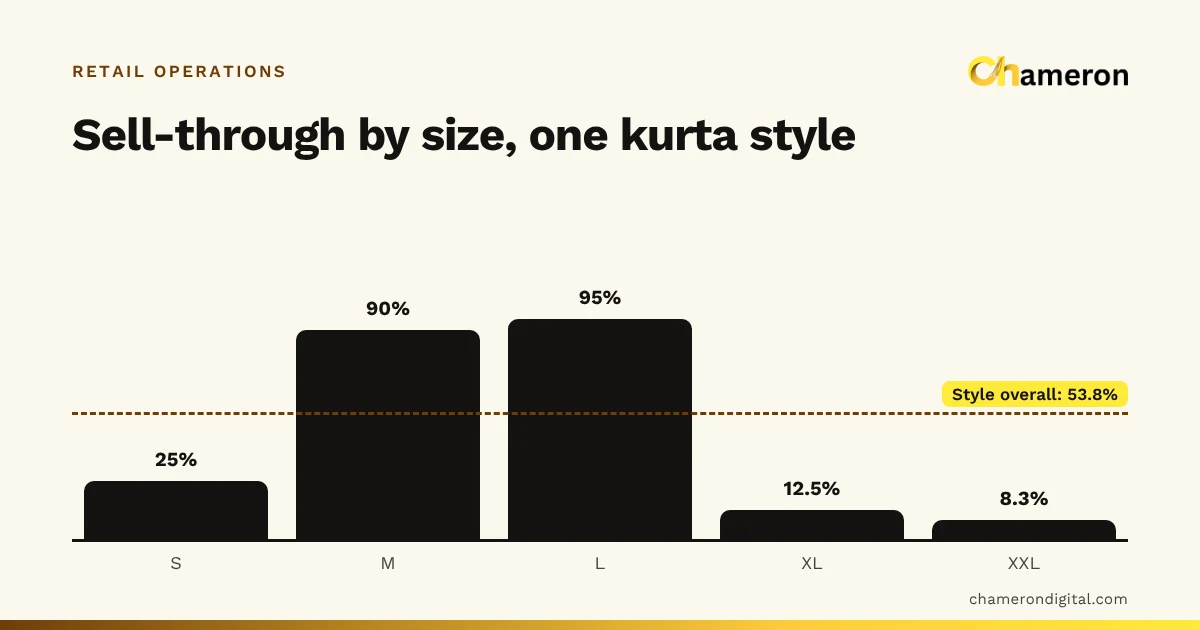
- One code for all sizes. The report will say ten shirts are in stock when all ten are XXL. Every size needs its own SKU.
- Codes so long nobody uses them. If staff search by name because the code is too long to type, the code has failed.
- Duplicate codes from spreadsheets. Copying rows in Excel copies codes. Check for duplicates before any import.
How software helps
The most reliable SKU scheme is one people never have to type by hand. Inventory software can create the code when the product is created, follow a fixed pattern and refuse duplicates. In BILL OS, a new product gets an SKU automatically, size and colour variants follow a style-colour-size pattern, and codes are never repeated within the business; see SKUs, barcodes and labels. You still choose the names and code lists, which is why planning them on paper first is worth the hour it takes.
The bottom line
An SKU scheme is a small decision with a long life. Choose three or four short parts, write down the code list for each, leave out anything that changes, and never reuse a code. Do it once, before the product list grows, and every bill, label, stock count and report afterwards becomes easier to read. To plan your own pattern, start with the free SKU planning worksheet.
Questions people ask
How long should an SKU be?
Long enough to be unique and readable, short enough to fit on a label and be typed. For most shops, 8 to 15 characters in three or four parts is plenty.
Can I use the manufacturer's barcode number as the SKU?
You can, but it is better to keep them separate. The barcode is what the scanner reads; the SKU is the name your team uses. Many items you stock will have no barcode at all, and a 13-digit number tells nobody what the item is. See SKU vs barcode.
Should the SKU include the size and colour?
Yes, if the item comes in sizes or colours. Each size in each colour is a separate thing on the shelf, so it needs its own SKU. Our guide to size and colour variants explains how to set them up.
What should I do with an SKU when I stop selling an item?
Mark the item inactive and keep the code. Do not delete it or give the code to a new product, because past bills, returns and reports still point to it.
Do I need to change my existing SKUs to follow a new pattern?
Not necessarily. Apply the new pattern to new products and to items you relabel anyway. If you do rename old codes, map every old code to its new one and relabel the shelf the same day.