The short answer
Stock value is the number of units you hold multiplied by what each unit cost you. Count what is on the shelves and in the godown, multiply each item’s quantity by its cost price (including freight, excluding GST you can claim back) and add the lines up. The only real decision is which cost to use when you bought the same item at different prices, and for that most small businesses use either FIFO or the weighted average.
The basic formula
Here is a count from a small hardware shop on the last day of the month, valued at cost:
| Item | Quantity | Cost per unit | Value at cost |
|---|---|---|---|
| LED bulb, 9 W | 150 | ₹55 | ₹8,250 |
| Extension board | 40 | ₹210 | ₹8,400 |
| PVC pipe, 3 m | 60 | ₹140 | ₹8,400 |
| Wall paint, 1 litre | 35 | ₹320 | ₹11,200 |
| Total | ₹36,250 |
That ₹36,250 is the money the owner has sitting on the shelves. It is the figure that goes into the closing stock line of the accounts, into the cost of goods sold for the month and into any inventory turnover calculation.
A real shop has hundreds or thousands of lines, but the arithmetic never changes. A printed stock count sheet with a cost column does the job on paper.
Cost price or selling price?
Owners sometimes value stock at the price on the label because that is the number they see every day. Using the same four items:
| Item | Value at cost | Selling price | Value at selling price |
|---|---|---|---|
| LED bulb, 9 W | ₹8,250 | ₹80 | ₹12,000 |
| Extension board | ₹8,400 | ₹299 | ₹11,960 |
| PVC pipe, 3 m | ₹8,400 | ₹190 | ₹11,400 |
| Wall paint, 1 litre | ₹11,200 | ₹420 | ₹14,700 |
| Total | ₹36,250 | ₹50,060 |
The ₹13,810 difference is profit that has not happened yet. It only becomes real when the goods sell at full price, and some never will: some get discounted, damaged or left behind when fashions change. Valuing stock at selling price counts that profit in advance, which flatters the accounts and makes every stock-based ratio wrong.
Use cost for the books and for decisions. The selling-price total is still a handy planning number: it tells you the most sales this stock could produce, and the gap shows the gross profit locked up in it. If you want to compare the two as percentages, the margin and markup calculator converts either way.
What counts as "cost"
The cost per unit is not just the supplier’s rate. It is the landed cost: everything you paid to get the item onto your shelf, ready to sell.
| Include | Usually leave out |
|---|---|
| Supplier’s price after trade discount | GST you can claim as input tax credit |
| Freight, courier or transport to your shop | Rent, salaries and electricity |
| Loading, unloading and handling charges | Interest on the money you borrowed to buy stock |
| Non-refundable duties or levies | Your own selling and advertising costs |
Example. The shop buys 200 extension boards at ₹200 each, a bill of ₹40,000 before GST, and pays ₹2,000 to the transporter. The landed cost is (₹40,000 + ₹2,000) ÷ 200 = ₹210 per board, the figure used in the table above.
GST is the line people get wrong most often. If your business is registered and can claim the GST charged on a purchase as input tax credit, that tax is money you get back, so it is not part of the cost. If you cannot claim it, it usually is. The rules depend on your registration and the goods, so confirm the treatment with your accountant.
When you paid different prices: FIFO and weighted average
Prices rarely stay still. Suppose a stationery shop sells A4 notebooks and its records for September look like this:
| Date | Event | Units | Cost per unit | Amount |
|---|---|---|---|---|
| 1 Sept | Opening stock | 100 | ₹40 | ₹4,000 |
| 10 Sept | Purchase | 200 | ₹45 | ₹9,000 |
| 25 Sept | Purchase | 100 | ₹48 | ₹4,800 |
| Available | 400 | ₹17,800 |
During the month it sold 250 notebooks, leaving 150 on the shelf. Which notebooks are those 150? The answer depends on the method.
FIFO: first in, first out
FIFO assumes the oldest stock is sold first, so what remains is the most recent stock. The 250 sold were the 100 from opening stock and 150 of the 10 September lot.
FIFO matches how most shops physically rotate stock, especially food, medicines and anything with a date. When prices are rising, it gives a closing value close to current replacement cost. The glossary entry on FIFO and FEFO explains the expiry-based version, and our short answer on FIFO in inventory covers it in more detail.
Weighted average cost
Weighted average treats every notebook as costing the same: the total cost of everything available divided by the units available.
This is the simplest method when identical goods arrive in many small lots at slightly different prices. Software that recalculates the average after every purchase (a "moving" average) can give a slightly different figure from this month-end calculation, because sales made between purchases use the average at that moment.
Comparing the results
| Method | Closing stock | Cost of goods sold |
|---|---|---|
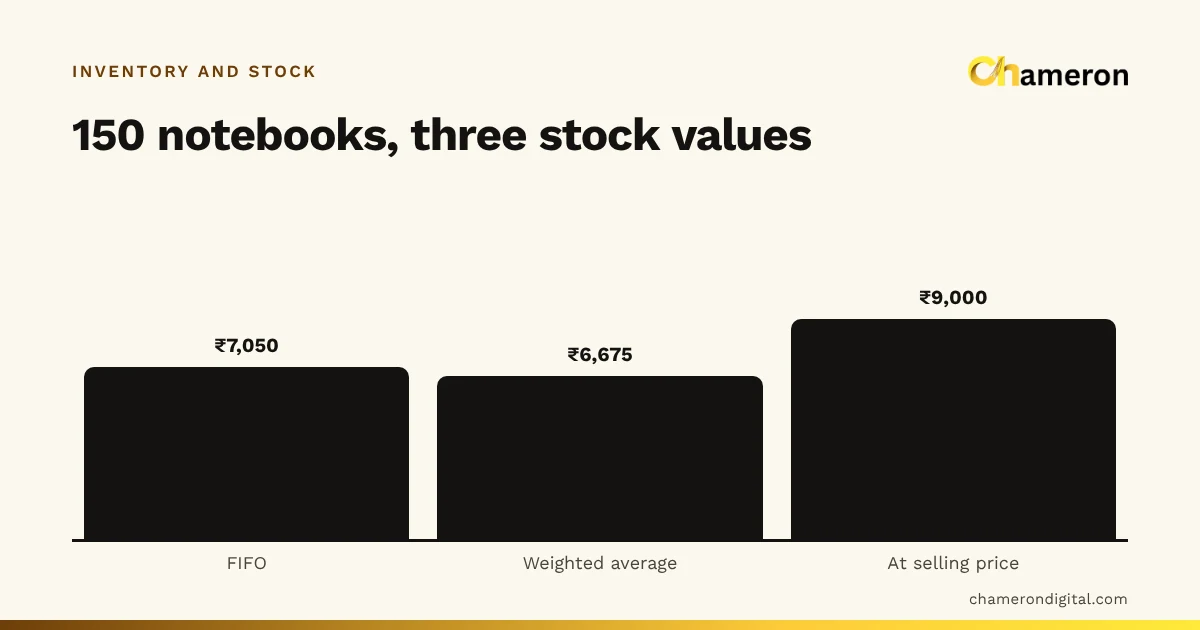
| FIFO | ₹7,050 | ₹10,750 |
| Weighted average | ₹6,675 | ₹11,125 |
Same notebooks, same sales, a ₹375 difference in both figures. And if the 150 were valued at the shop’s selling price of ₹60, they would appear to be worth ₹9,000, which includes profit not yet earned. With rising prices, FIFO shows a higher stock value and a lower cost of sales, so a slightly higher gross profit. Over time the methods even out, because what is left in stock this month is sold next month.
What matters most is consistency. Switching method from one year to the next makes profit jump for reasons that have nothing to do with trading. A third shortcut, valuing everything at the latest purchase price (150 × ₹48 = ₹7,200), is easy but is not a recognised costing method; use it only as a rough check.
Write down stock that is worth less than it cost
Cost is the starting point, not the final word. Accounting practice generally values stock at the lower of cost and net realisable value: what the item can actually be sold for, minus the costs of selling it.
Example. Twenty of the extension boards are an older model with a cracked casing. They cost ₹210 each but will only sell for about ₹150. They should be valued at ₹150, not ₹210:
- Value at cost: 20 × ₹210 = ₹4,200
- Value at realisable price: 20 × ₹150 = ₹3,000
- Write-down: ₹1,200
The same applies to dead stock that has not sold for months, seasonal goods past their season, and anything near expiry. Writing it down feels like losing money, but the loss has already happened; the write-down only makes the accounts admit it. Ask your accountant how write-downs should be recorded for your business.
How to value your stock, step by step
- Pick the date. Month-end or year-end, after the last sale and before the next delivery is unpacked.
- Count everything you own. Shelves, godown, display, items out for repair and goods in transit that you have already paid for. Leave out goods held for someone else.
- Set aside damaged and expired units and count them separately.
- Find the landed cost for each item from purchase bills, using your chosen method (FIFO or weighted average).
- Multiply and add up. Quantity × cost for each line, then total by category and for the shop.
- Apply write-downs for damaged, outdated and very slow items.
- Compare with last month. A big jump with no matching rise in sales is worth investigating.
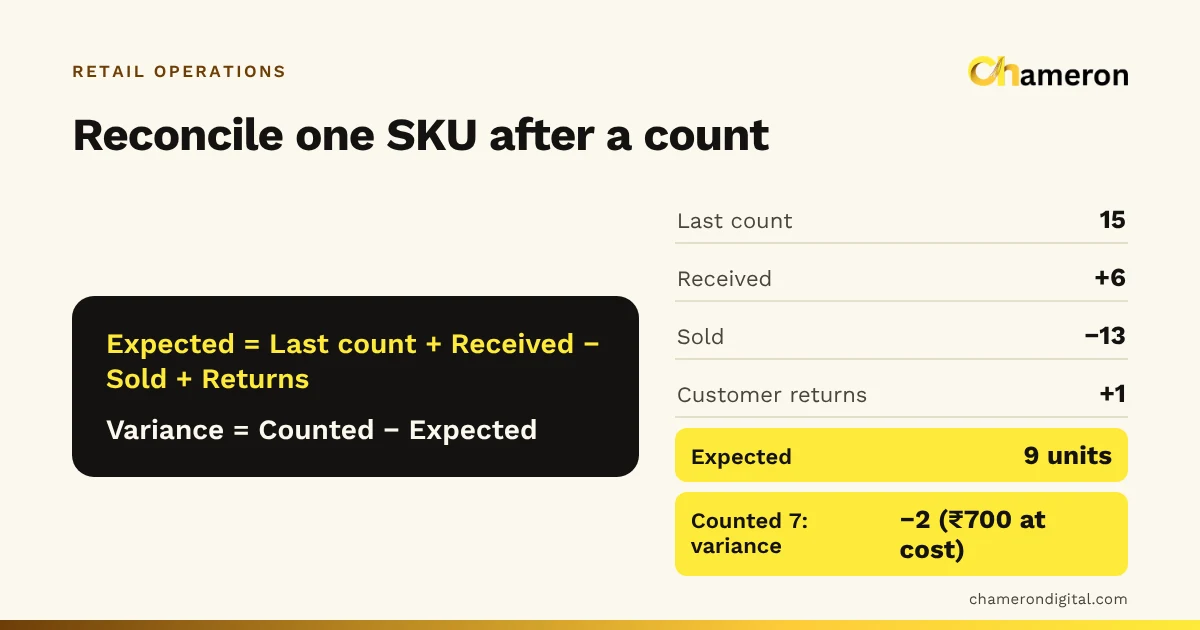
If the count does not match what your records say should be there, reconcile it first. Our guide to stock count and reconciliation walks through that.
Common mistakes
- Valuing at MRP or selling price. It counts profit you have not earned and makes turnover look slower than it is.
- Leaving freight out of cost. Every unit is undervalued and every margin looks better than it really is.
- Including claimable GST. Stock and cost of sales are both overstated.
- Ignoring stock in the godown or at another branch. Count every location you own stock in.
- Keeping damaged stock at full cost. The value on paper will never turn into cash.
- Changing methods to improve a year’s profit. Choose one with your accountant and stick to it.
Stock value in billing software
When every purchase is recorded at landed cost and every sale, return and adjustment goes through one stock ledger, the software knows the quantity of every item at any moment, and the stock value becomes a report rather than a weekend of counting. You still need regular shelf counts to catch breakage and theft.
In BILL OS, deliveries are received against the supplier’s bill, damaged units are set aside, and shelf counts are approved as adjustments with a reason; the inventory and stock page explains how. Its inventory and dead stock reports download to Excel, so you can check the valuation alongside your accountant’s method.
The bottom line
Stock value is quantity times cost, where cost means landed cost without recoverable GST. When prices change, FIFO and weighted average give slightly different answers; choose one and use it every time. Then write down anything that will not sell at cost. With a reliable stock value each month, you can work out your cost of goods sold and your inventory turnover, and see how much cash the shelves are really holding.
Questions people ask
Should stock be valued at cost or at selling price?
At cost for your books, reports and turnover calculations. The value at selling price is useful only as a planning figure: the gap between the two is the gross profit you would earn if everything sold at full price.
Is GST included in stock value?
Generally not, if you are registered and can claim the GST on purchases as input tax credit. Then it is recoverable and not part of the cost. If you cannot claim it, it usually becomes part of the cost. Confirm the treatment with your accountant.
Which is better, FIFO or weighted average?
Neither is right for every shop. FIFO matches how most perishable and dated goods actually leave the shelf. Weighted average is simpler when identical items arrive at slightly different prices. Pick one with your accountant and keep using it.
How often should I calculate stock value?
At least at every financial year-end for the accounts, and ideally every month for your own reports. A monthly figure lets you track inventory turnover and spot stock building up.
What is the difference between stock value and stock quantity?
Quantity is how many units you hold; value is what they cost you in rupees. Ten fridges and five hundred pens are very different amounts of money tied up, which is why stock decisions need the value, not just the count.