The short answer
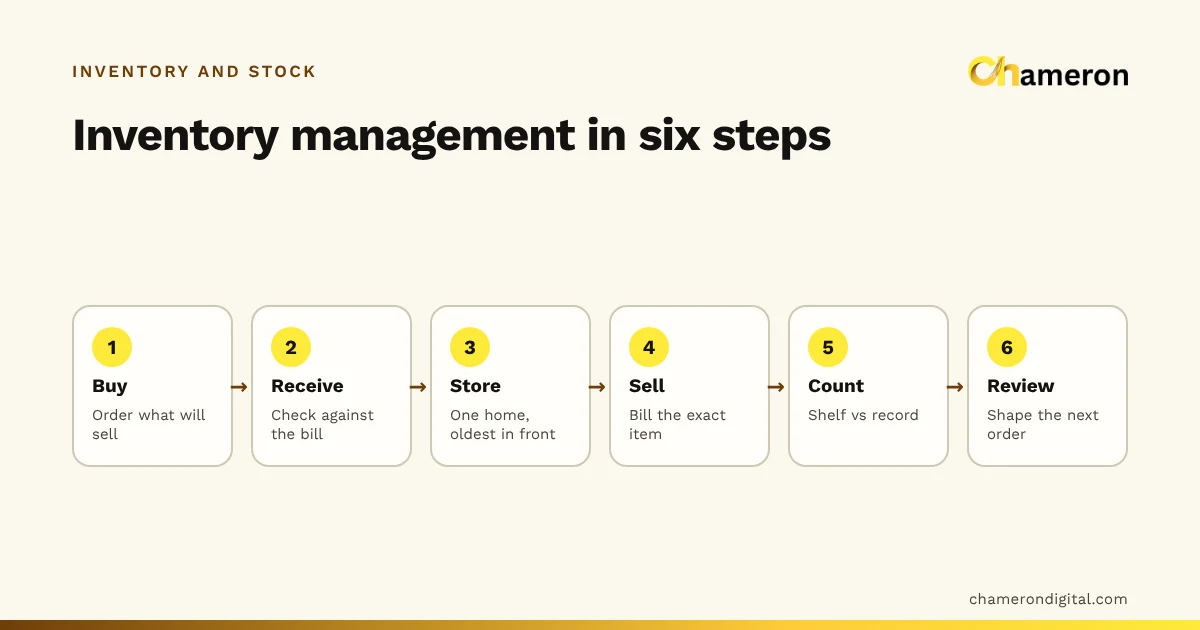
Inventory management is the work of deciding what stock to buy, recording it as it comes in and goes out, and checking that the record matches the shelf. The goal is to have what customers ask for without tying up more money than you need. In a shop it covers six stages: buying, receiving, storing, selling, counting and reviewing. Done well, you can say at any moment what you hold, what it cost and what to order next.
What inventory management covers
Inventory is everything you hold to sell, or to turn into something you sell. For a retail shop that means finished goods on shelves and in the stockroom. For a restaurant it means ingredients and packaging. Managing it is a loop of six stages, and each one answers a different question.
| Stage | What happens | The question it answers |
|---|---|---|
| Buy | Decide what and how much to order | What will sell before the next delivery? |
| Receive | Check deliveries against the supplier's bill | Did we get what we paid for? |
| Store | Put stock in a known place, oldest in front | Can anyone find it quickly? |
| Sell | Record every sale and return against an item code | What actually left the shop? |
| Count | Compare the shelf with the record | Is the record right? |
| Review | Look at what sold, what did not and what is missing | What should we buy differently? |
The stages depend on each other. A delivery that is never recorded makes the count look like theft. A sale billed under the wrong item makes two records wrong at once. That is why inventory problems rarely have a single cause: they come from small gaps at several stages.
Why inventory management matters
Stock is cash on a shelf
Consider an example electrical goods shop holding ₹6,00,000 of stock at cost. If ₹90,000 of that has not sold in six months, 15% of the money in the shop is doing nothing. It cannot pay rent, it cannot buy the fast-selling switches customers keep asking for, and some of it may never sell at full price. Good inventory management makes that ₹90,000 visible early, while it can still be cleared.
Running out costs more than the lost sale
A customer who finds an empty shelf may buy elsewhere and keep buying there. Stockouts of everyday items do more damage than the margin on one sale suggests. Reorder points, covered below, exist to prevent them.
Overstock spoils, fades and gets damaged
Too much stock brings its own losses: expired packaged food, last season's colours, dusty boxes and items damaged by repeated handling. It also crowds the shelves, which hides the stock that does sell.
Losses stay hidden without counts
Shrinkage (stock lost to theft, damage, billing errors and receiving mistakes) only shows up when someone compares the shelf with the record. See what shrinkage is and how to measure it.
Your accounts depend on it
Your profit for a period depends on the value of stock at the start and end of it, so a wrong stock figure means a wrong profit figure. Purchase records also support the input tax credit you claim under GST. The rules are your accountant's area, but clean stock records make their job far easier.
Periodic and perpetual tracking
There are two basic ways to know what you hold.
Periodic tracking means counting stock at the end of a period and working backwards. You do not know what you have until you count.
The weakness is that anything missing (theft, damage, unbilled sales) is silently counted as "sold". You cannot separate real sales from losses.
Perpetual tracking means updating the stock record with every movement: each sale, receipt, return and write-off. The record always shows what should be on the shelf, so a count reveals the difference between what should be there and what is.
| Periodic | Perpetual | |
|---|---|---|
| When you know stock levels | Only after a count | At any time |
| Losses | Hidden inside "sold" | Visible as count differences |
| Effort | Low daily, heavy at count time | Small, steady effort every day |
| Suits | Very small ranges, cash-only stalls | Most shops with more than a few dozen items |
Most shops that bill on software already have perpetual tracking for sales. The common gap is receiving: if purchases are not entered against the same item codes, the record drifts.
The main inventory management methods
You do not need every method in the textbook. These five cover most of what a shop or small food business needs.
ABC analysis: manage the few items that matter most
Sort your items by sales value over the past year and split them into three groups. In this invented example of a shop with 500 items:
| Class | Items | Annual sales value | Share | How to manage |
|---|---|---|---|---|
| A | 60 | ₹14,00,000 | 70% | Count often, set reorder points, never run out |
| B | 140 | ₹4,00,000 | 20% | Count monthly, reorder on a schedule |
| C | 300 | ₹2,00,000 | 10% | Count each quarter, buy in small lots, prune |
| Total | 500 | ₹20,00,000 | 100% |
The split will be different in your shop, but the idea holds: a small group of items usually carries most of the sales, and that is where your attention should go.
Reorder points and order quantities
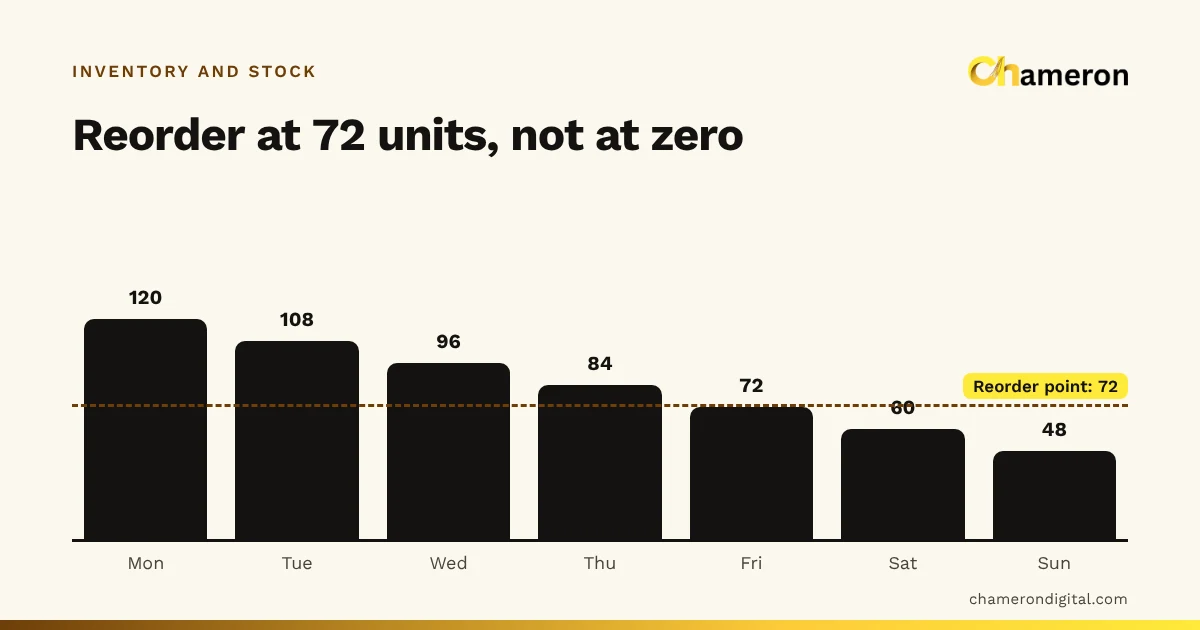
A reorder point is the stock level that triggers a new order: daily sales multiplied by the supplier's lead time, plus a buffer called safety stock. Pair it with an order quantity, such as two weeks of sales, and buying becomes a rule rather than a guess. The reorder point calculator does the arithmetic.
FIFO and FEFO
First in, first out (FIFO) means selling older stock before newer stock. First expiry, first out (FEFO) means selling whatever expires soonest first, which matters for food, cosmetics and medicines. Both are about how you arrange shelves as much as how you record stock. See what FIFO means in inventory.
Cycle counting
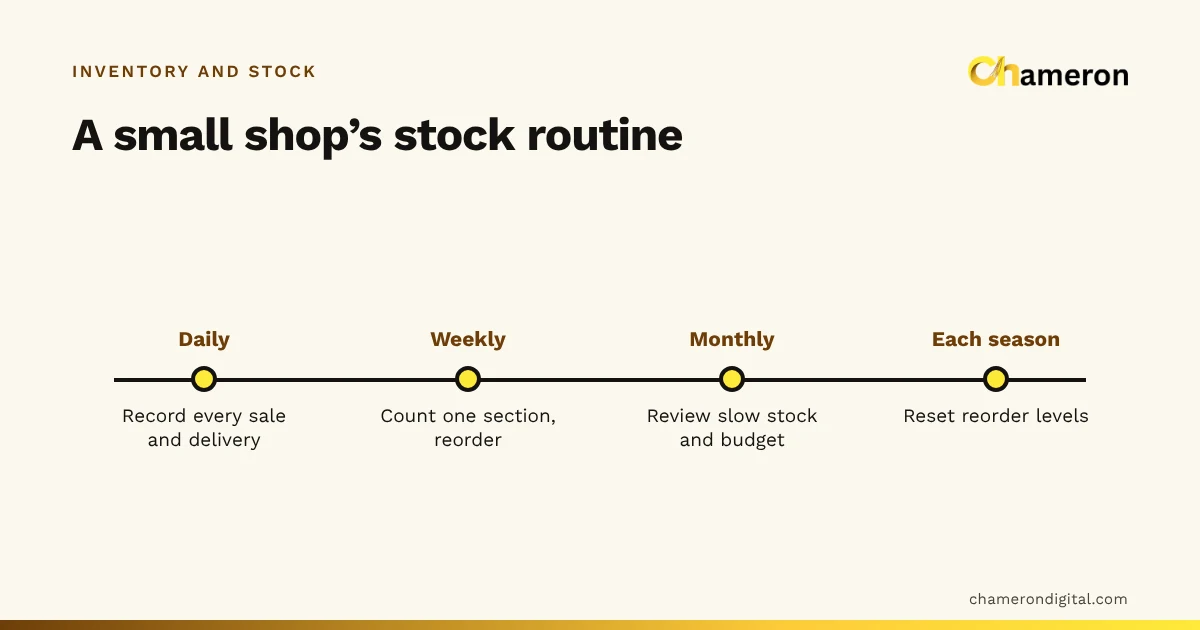
Instead of closing the shop once a year for a full count, count a small section every week so the whole shop is covered over a cycle. Differences are found while people still remember what happened. Our stock count and reconciliation method explains the steps.
Buying little and often
For items with reliable local suppliers, smaller and more frequent orders keep less money on the shelf. The trade-off is more ordering effort and sometimes a higher unit price. It works for fast-moving staples, less well for items with long lead times or large minimum orders.
The numbers that show whether it is working
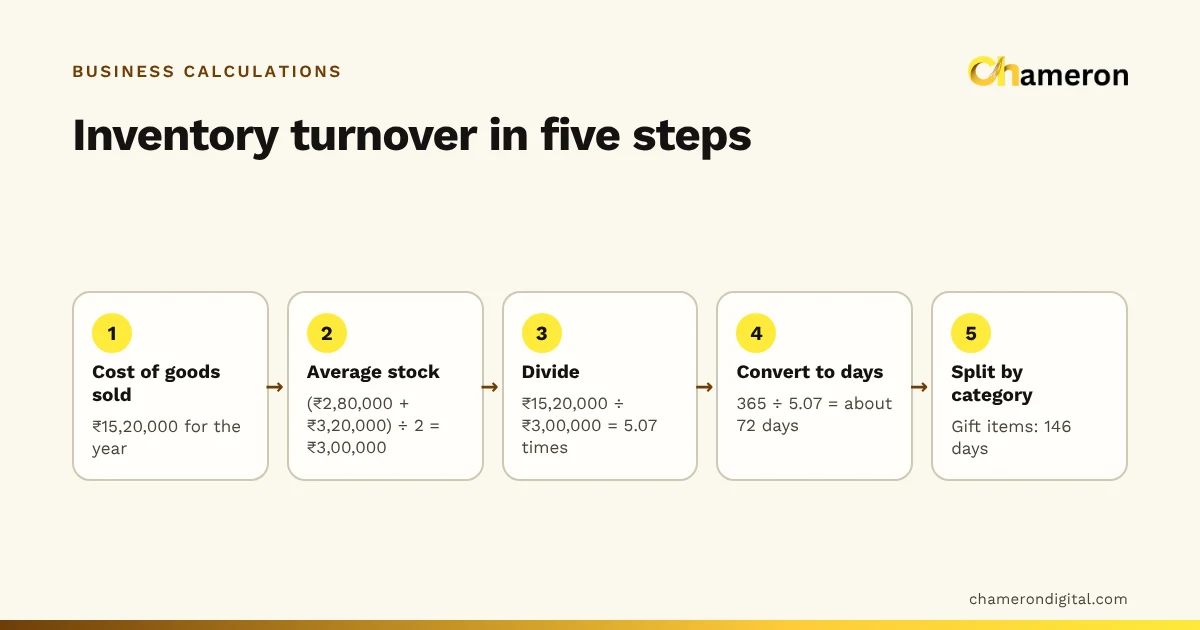
A worked example: a shop's cost of goods sold for the year is ₹18,00,000. It started the year with ₹2,80,000 of stock and ended with ₹3,20,000, so average stock is ₹3,00,000.
| Measure | Calculation | Result |
|---|---|---|
| Average stock | (₹2,80,000 + ₹3,20,000) ÷ 2 | ₹3,00,000 |
| Inventory turnover | ₹18,00,000 ÷ ₹3,00,000 | 6 times a year |
| Days of stock | 365 ÷ 6 | about 61 days |
On average, an item sits on this shop's shelves for about two months before it sells. Whether that is good depends on the category: grocery staples should move far faster than furniture or jewellery. Compare against your own past figures first. Try it with your numbers in the inventory turnover calculator, and read what inventory turnover means for how to interpret it.
The fourth number, dead stock, is simply the value of items with no sale in a set period, often 90 days.
How it differs by type of business
The principles are the same everywhere; the pressure points differ.
| Business | What makes it harder | Where to focus |
|---|---|---|
| Clothing and footwear | Every size and colour is its own item | Variants and broken size runs |
| Grocery and kirana | Thousands of low-value items, expiry, loose goods | Fast movers and expiry |
| Restaurants | Ingredients leave through recipes and waste | Recipes, waste and purchasing |
| Electronics and hardware | High unit value, slow-moving accessories | Tight counts on A items, pruning C items |
Manual records or software?
A notebook or spreadsheet can work for a small, stable range, as long as someone updates it every day. It breaks down when several people bill, when items have sizes and colours, or when nobody has time to post purchases. Software helps mainly because the stock record updates as a side effect of billing and receiving, not as a separate job. Our comparison of manual inventory and inventory software sets out the trade-offs.
In BILL OS, for example, sales, returns, deliveries received against the supplier's bill and approved count adjustments all go through one stock ledger, and reports list what is low, what to reorder and what has not sold.
Common mistakes
- Treating inventory as a once-a-year job. An annual count tells you what went wrong months ago. Small, regular counts tell you this week.
- Managing every item the same way. Counting a ₹10 eraser as carefully as a ₹4,000 mixer grinder wastes time that A items need.
- Valuing stock at selling price. It inflates the figure and hides how much cash is really tied up.
- Recording sales but not purchases. The record can only be right if both sides are entered against the same item codes.
- Adjusting the record without a reason. If differences are simply overwritten, the same loss repeats. Our list of inventory mistakes to avoid covers more.
The bottom line
Inventory management is not a single task but a loop: buy with a reason, record every movement, check the record against the shelf, and let what you learn shape the next purchase. Start with your A items, a perpetual record and a weekly count of one section. Once those are steady, add reorder points and a monthly dead-stock review. For a step-by-step setup in a single shop, read how to manage inventory for a small retail shop.
Questions people ask
Is inventory management the same as stock management?
For a shop, yes. Indian businesses usually say stock; accountants and software often say inventory. Both mean controlling the goods you hold for sale, from purchase to sale.
Does a small shop really need inventory management?
Every shop already does some of it, even if it is only a notebook and the owner's memory. The question is whether the method is good enough to stop stockouts, dead stock and unexplained losses. Our guide to managing inventory in a small retail shop shows a light setup that works without a warehouse or a big system.
Should stock be valued at cost or at selling price?
At cost, meaning what you paid to get the item onto your shelf, before any GST you can claim back. Valuing at selling price counts profit you have not yet earned. For your books, ask your accountant which valuation method to use.
What is the single most useful inventory number?
If you track only one, track count differences: what the shelf says compared with the record. It tells you whether every other number can be trusted. After that, inventory turnover shows whether your money is moving.
How is inventory management different in a restaurant?
A restaurant manages ingredients rather than finished goods, so stock leaves through recipes, waste and staff meals as well as sales. See our guide to restaurant inventory management.