The short answer
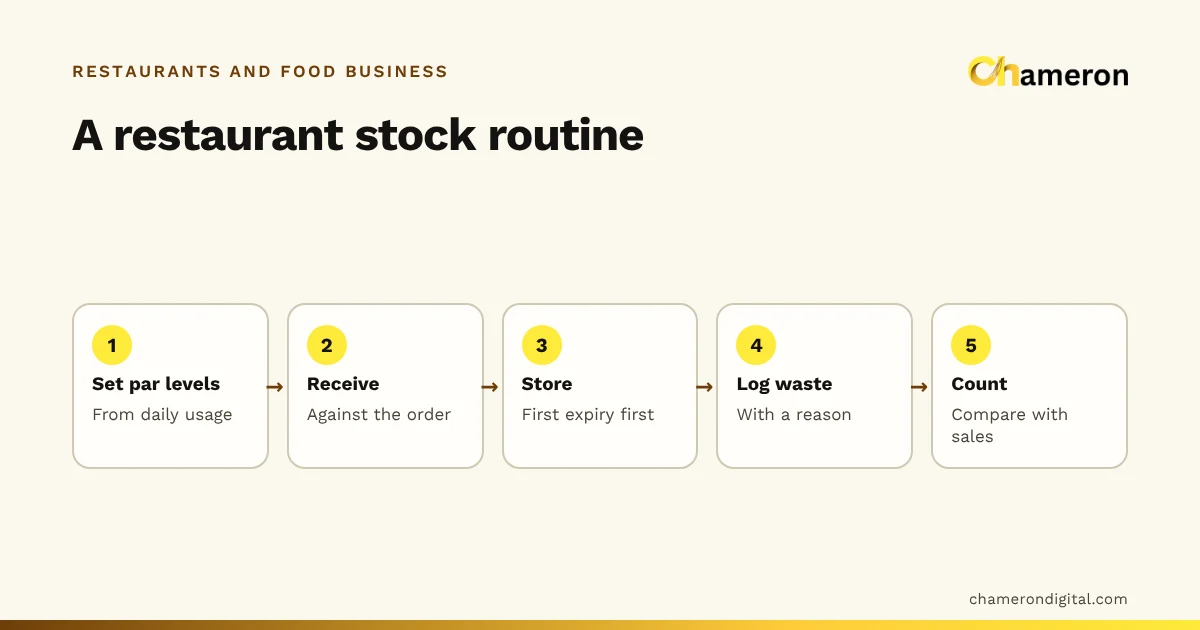
Restaurants manage inventory better by running a short, repeated routine rather than relying on a big monthly count. Sort ingredients by how fast they spoil and what they cost, set a par level for each, check every delivery against the order, store so the earliest expiry is used first, record waste the moment it happens, and count the expensive items often enough to compare what you used with what you sold. Each step is simple. Doing them every day is what keeps food cost where you planned it.
Why restaurant stock is harder than shop stock
A shop sells the same packet it bought. A restaurant buys raw ingredients, cuts, cooks and portions them, and sells something different. That creates problems a shop does not have:
- Ingredients spoil, often within days, so overbuying turns straight into waste.
- Portions are made by hand, so a heavy-handed cook can use more than the recipe allows on every plate.
- One ingredient goes into many dishes, so you cannot see its use by looking at a single item's sales.
- Prepared items (gravies, marinated meat, chopped onions) are stock too, but are rarely counted.
The goal of inventory management in a kitchen is not to know the exact gram count at every moment. It is to keep enough to serve every guest, little enough that nothing spoils, and to notice quickly when usage and sales stop matching.
Step 1: sort what you stock
Not every ingredient needs the same attention. Group them by shelf life and value, then decide how often to count each group.
| Group | Examples | Count | Storage rule |
|---|---|---|---|
| High-value perishables | Chicken, mutton, fish, paneer, cream | Daily or every 2–3 days | Cold store, dated, used first-expiry-first |
| Other perishables | Vegetables, milk, curd, herbs, bread | Weekly, visual check daily | Rotate on every delivery |
| Prepared items | Gravies, marinades, batters, chopped vegetables | Daily, before closing | Labelled with item and prep date |
| Dry store | Rice, atta, dals, oil, spices, sugar | Weekly or monthly | Sealed, off the floor, oldest in front |
| Drinks and packaging | Soft drinks, water, containers, bags | Weekly | Counted in units, not by eye |
Put the high-value perishables first. A few kilos of mutton going missing matters far more than a kilo of salt.
Step 2: set par levels and reorder points
A par level is how much of an ingredient you want on hand after a delivery. It replaces guesswork ("we usually order 20 kg") with a number tied to real usage.
Example: paneer. The kitchen uses about 8 kg a day. The supplier delivers every 2 days, and the chef wants one day of safety in case a delivery is late or a party books in. Par = 8 × (2 + 1) = 24 kg. If 9 kg is on hand at ordering time, the order is 24 − 9 = 15 kg.
For dry goods bought less often from suppliers with a longer lead time, a reorder point works better: the stock level at which you place the next order.
Example: basmati rice. Usage is 12 kg a day, the wholesaler takes 3 days to deliver, and you keep 2 days of safety stock (24 kg). Reorder point = 12 × 3 + 24 = 60 kg. When the rice falls to 60 kg, order. If you want each order to cover 10 days, order 12 × 10 = 120 kg. The reorder point calculator does this for any item, and the question page on safety stock explains how big the buffer should be.
Review par levels when the menu changes, before festivals and wedding season, and whenever a supplier changes delivery days.
Step 3: receive deliveries properly
Many stock problems start at the back door. A delivery accepted without checking can be short, poor quality or priced higher than agreed, and nobody notices until the count does not add up.
At every delivery:
- Check against the purchase order or the list you sent, not just the supplier's bill.
- Weigh meat, fish, paneer and vegetables. A 10 kg crate of tomatoes that weighs 9 kg is a kilo you paid for and never received.
- Check quality and temperature. Reject what you would not serve.
- Check the price on the bill against the agreed rate. Price creep on a staple is one of the quietest ways food cost rises.
- Record what was actually received, including part deliveries, before it goes into storage.
- Put it away straight away, newest behind oldest.
Receiving needs one responsible person per shift. When "whoever is free" signs for deliveries, nobody owns the shortfalls.
Step 4: store and issue first-expiry-first
Good storage reduces spoilage more than any software. The core rule is first expired, first out (FEFO): use whatever expires soonest, which is usually but not always the oldest stock. The glossary explains FIFO and FEFO, and the FIFO question page covers how it affects stock value.
- Label everything that is opened or prepared with the item name and date.
- Keep the oldest in front, on the shelf and in the cold store.
- Set a shelf life for prepared items (for example, a base gravy kept for a set number of days) and discard on schedule rather than by smell.
- Issue from store to kitchen in recorded quantities if you have a separate store room. It turns one big mystery into two smaller ones: store loss and kitchen usage.
Step 5: record waste the moment it happens
Waste that is not written down looks exactly like theft or over-portioning in the numbers. A simple waste log changes that.
| Date | Item | Quantity | Reason | Recorded by |
|---|---|---|---|---|
| Mon | Paneer | 0.5 kg | Expired | Store |
| Mon | Chicken tikka | 2 plates | Returned, overcooked | Grill |
| Tue | Coriander | 1 bunch | Spoiled | Kitchen |
| Tue | Dal makhani | 1.5 kg | Overproduced, discarded at close | Kitchen |
| Wed | Staff meal | 3 portions | Staff food | Manager |
After a few weeks, the reasons tell you what to fix. Lots of "overproduced" means the prep list is too generous. Lots of "returned" from one station means a training or timing problem. Lots of "expired" means the par level is too high.
Step 6: count and compare usage with sales
A count is only useful if you compare it with something. For each key ingredient, compare what you actually used with what the recipes say you should have used for the dishes sold.
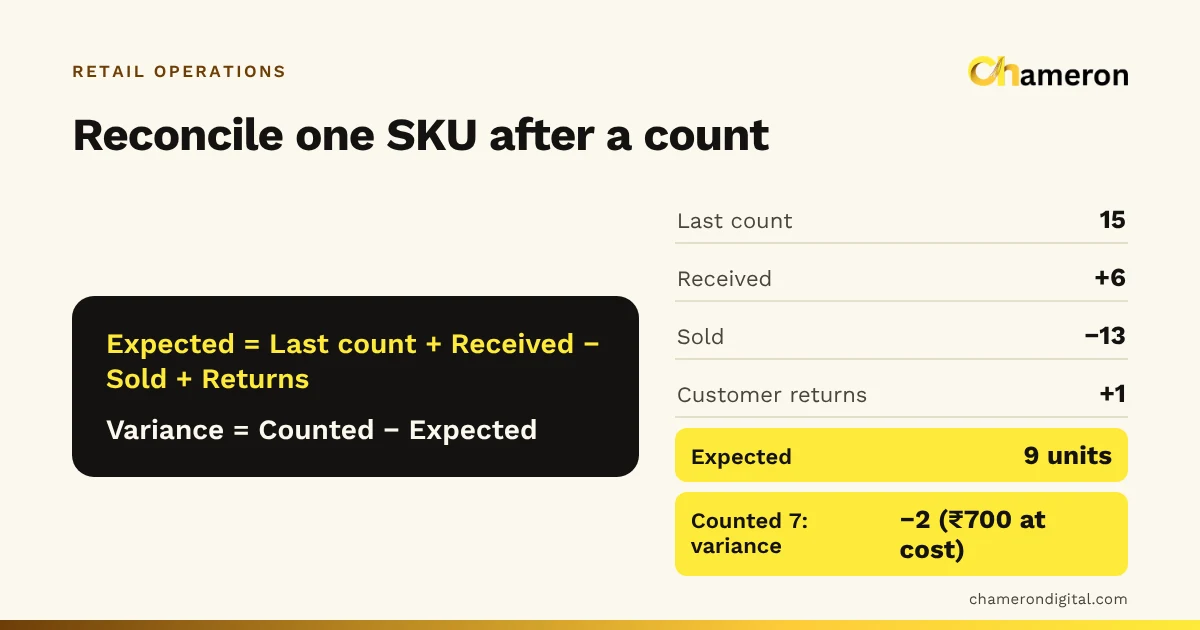
Example: chicken, one week. Opening stock was 18 kg, 40 kg was received and 10 kg is left at the count. Actual usage = 18 + 40 − 10 = 48 kg. The recipes for the chicken dishes sold that week add up to 44 kg, and the waste log shows 1.5 kg. Unexplained variance = 48 − 44 − 1.5 = 2.5 kg, about 5.7% of what the recipes called for.
At ₹230 a kilo, that is ₹575 in a week, or around ₹29,900 over a year, for one ingredient. The cause is usually one of three things: portions bigger than the recipe, waste that was not logged, or stock leaving the building. Weighing a few portions during service usually tells you which.
The stock count sheet gives you a ready format, and stock counts and reconciliation covers how to run a count without stopping work.
The numbers worth tracking
You do not need a dozen reports. Four numbers, checked weekly, tell you most of what matters:
| Number | How to work it out | What it tells you |
|---|---|---|
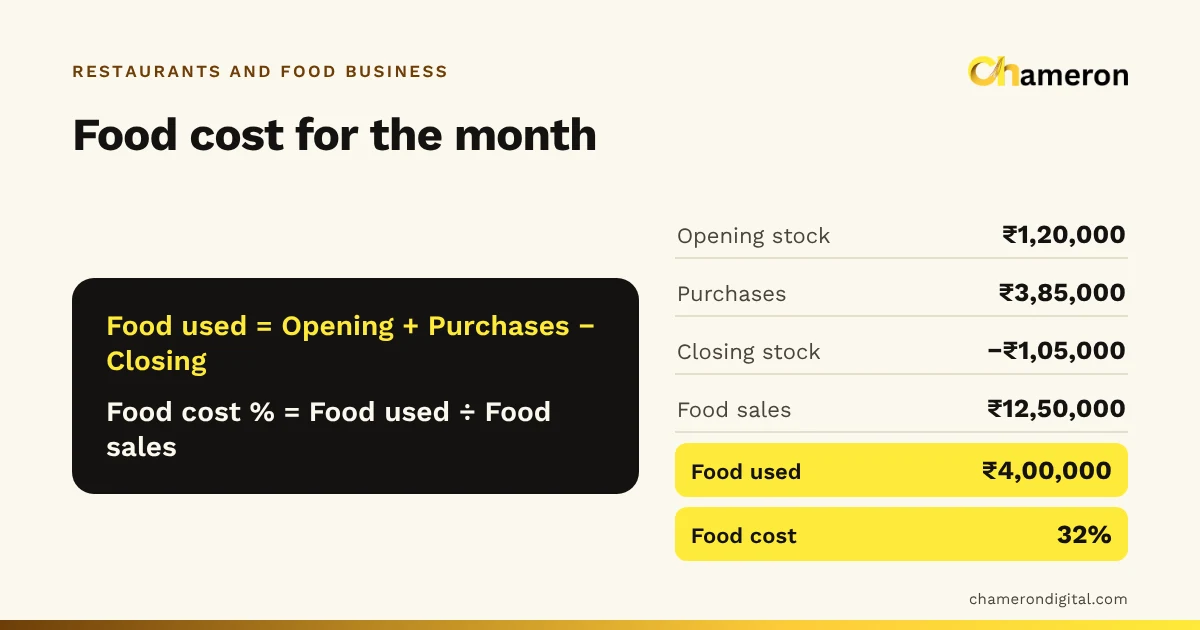
| Actual food cost % | Ingredients used ÷ food sales × 100 | Whether the kitchen is on plan overall |
| Waste value | Total of the waste log at cost | How much is thrown away, and why |
| Usage variance | Actual usage − recipe usage − waste, for key items | Over-portioning or loss |
| Days of stock on hand | Stock value ÷ average daily food cost | Whether cash is sitting on shelves |
For days on hand: if the stock is worth ₹42,000 and the kitchen uses about ₹7,000 of ingredients a day, you hold about 6 days of stock. For a menu built on fresh ingredients, that may be more than you need. Our guide on food cost percentage and profit margin shows how a rise in food cost flows through to profit, and the food cost calculator handles the per-dish arithmetic.
Common mistakes
- Ordering by habit. "Same as last week" ignores bookings, weather and menu changes. Order to par.
- Counting everything monthly and nothing in between. By the time a monthly count shows a problem, the money is gone. Count expensive perishables often.
- Ignoring prepared items. Ten litres of gravy is stock. Leave it out and the count shows a loss that is really sitting in the fridge.
- Accepting deliveries unchecked. Short weights and price changes go straight into food cost.
- No recipes, or recipes nobody follows. Without a recipe there is nothing to compare usage with. See food cost basics for building one.
- Treating the waste log as a punishment. If staff fear it, they stop writing in it. Make it routine, not blame.
Doing it in software
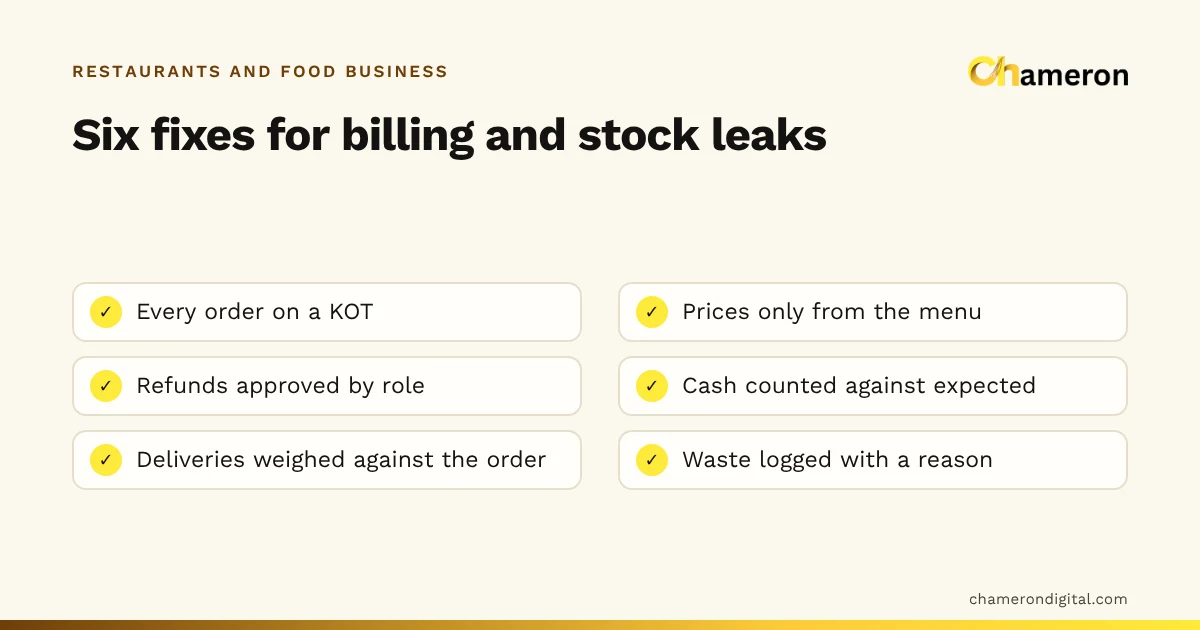
The routine above works on paper, but software removes the arithmetic. When each menu item is linked to a recipe, every sale can deduct its ingredients, so stock on screen reflects real usage. DINE OS, for example, flags low stock, records adjustments and waste with a reason, and handles purchase orders and receiving against them, including part deliveries; see restaurant stock and purchasing. Software does not replace counting. It makes the comparison between counted stock and expected stock quick enough to do every week. For problems that keep recurring, see common restaurant billing and inventory problems.
The bottom line
Better restaurant inventory is a habit, not a project. Sort your ingredients, set par levels from real usage, check what arrives, store so the earliest expiry is used first, write down every bit of waste, and count the costly items often enough to compare with sales. Start with your five most expensive ingredients this week. Once their numbers are under control, the rest of the store is easy.
Questions people ask
How often should a restaurant count its stock?
Count high-value, fast-spoiling items such as meat, fish, paneer and dairy daily or every few days, the rest of the cold store weekly, and the full stock including dry store monthly. Always count at the same point in the day, ideally after closing.
What is a par level in a restaurant?
A par level is the amount of an ingredient you want on hand after each delivery: enough to last until the next one, plus a small safety buffer. Before ordering, you subtract what is on hand from the par and order the difference.
What is the difference between FIFO and FEFO?
FIFO (first in, first out) uses the oldest stock first. FEFO (first expired, first out) uses whatever expires soonest first, which matters when deliveries arrive with different shelf lives. Most kitchens use FEFO with date labels. See the glossary.
How much stock should a restaurant keep?
Only enough to reach the next delivery with a small buffer. Perishables should be bought for a day or two at a time; dry goods can cover a week or more if storage allows. Extra stock ties up cash and raises waste.
Does staff food count as waste?
Record it separately, with its own reason, so it is neither hidden in waste nor mistaken for loss. It is a real cost that belongs in your food cost.