The short answer
Restaurant food cost is calculated in two ways, and you need both. The plate food cost adds up every ingredient in one portion from its recipe; divided by the menu price before GST, it gives the dish's food cost percentage. The period food cost works out what the kitchen actually used over a month: opening stock + purchases − closing stock, divided by food sales. The first tells you whether a price is right; the second tells you whether the kitchen is cooking to the recipe.
Two kinds of food cost
| Plate food cost | Period food cost | |
|---|---|---|
| Also called | Recipe cost, theoretical cost | Actual cost |
| Calculated from | The recipe and ingredient prices | Stock counts and purchase bills |
| Covers | One portion of one dish | Everything used in a month |
| Answers | "Is this dish priced right?" | "Did we use what we should have?" |
| When | When you set or review a price | Every month after the stock count |
Method 1: cost one plate from its recipe
Take one dish and list every ingredient in a single portion, with the quantity and what you pay for it.
The recipe card
Paneer Butter Masala, one portion, menu price ₹280 before GST:
| Ingredient | Quantity | Purchase price | Cost |
|---|---|---|---|
| Paneer | 120 g | ₹380 per kg | ₹45.60 |
| Makhani gravy (sub-recipe, below) | 150 g | ₹90 per kg | ₹13.50 |
| Butter | 10 g | ₹520 per kg | ₹5.20 |
| Fresh cream | 15 ml | ₹220 per litre | ₹3.30 |
| Kasuri methi, spices, oil | as per recipe | costed together | ₹2.40 |
| Coriander and ginger garnish | as per recipe | costed together | ₹1.00 |
| Plate cost | ₹71.00 |
Two details make the difference between a rough guess and a reliable figure.
Cost sub-recipes by the batch
Gravies, marinades, chutneys and dosa batter are made in batches, so cost the batch and divide by what it yields after cooking.
| Makhani gravy batch | Quantity | Cost |
|---|---|---|
| Tomatoes | 3 kg at ₹30 | ₹90 |
| Onions | 1.5 kg at ₹40 | ₹60 |
| Cashews | 250 g at ₹900 per kg | ₹225 |
| Ginger-garlic paste | 200 g at ₹150 per kg | ₹30 |
| Oil and whole spices | as per recipe | ₹45 |
| Batch cost | ₹450 |
The batch yields 5 kg of finished gravy, so it costs ₹450 ÷ 5 = ₹90 per kg. Dividing by the raw weight instead would understate the cost whenever cooking reduces the batch.
Allow for yield
Many ingredients lose weight before they reach the pan: bones, trimming, peel, stalks. Cost them per usable kilo.
Packaging for takeaway
For a takeaway or delivery portion, add the container, lid, bag and any sachets. With ₹12 of packaging, the paneer dish costs ₹83, and its food cost at the same price becomes ₹83 ÷ ₹280 = 29.6%. If takeaway is a large share of your sales, cost those portions separately.
Pricing from a target
Turn the formula round to find the price for a target food cost: price = plate cost ÷ target. At a 28% target, the ₹71 dine-in portion needs at least ₹71 ÷ 0.28 = ₹253.57, so ₹280 is comfortably above it. The food cost calculator does this arithmetic, and the menu price calculator adds packaging and rounds the price to a menu-friendly figure.
Plate costs go out of date quietly. If paneer rises to ₹440 a kilo, the 120 g portion costs ₹52.80, the plate costs ₹78.20, and food cost rises to 27.9% with no change to the menu. Recost your main dishes whenever a key ingredient moves noticeably.
Method 2: period food cost from stock
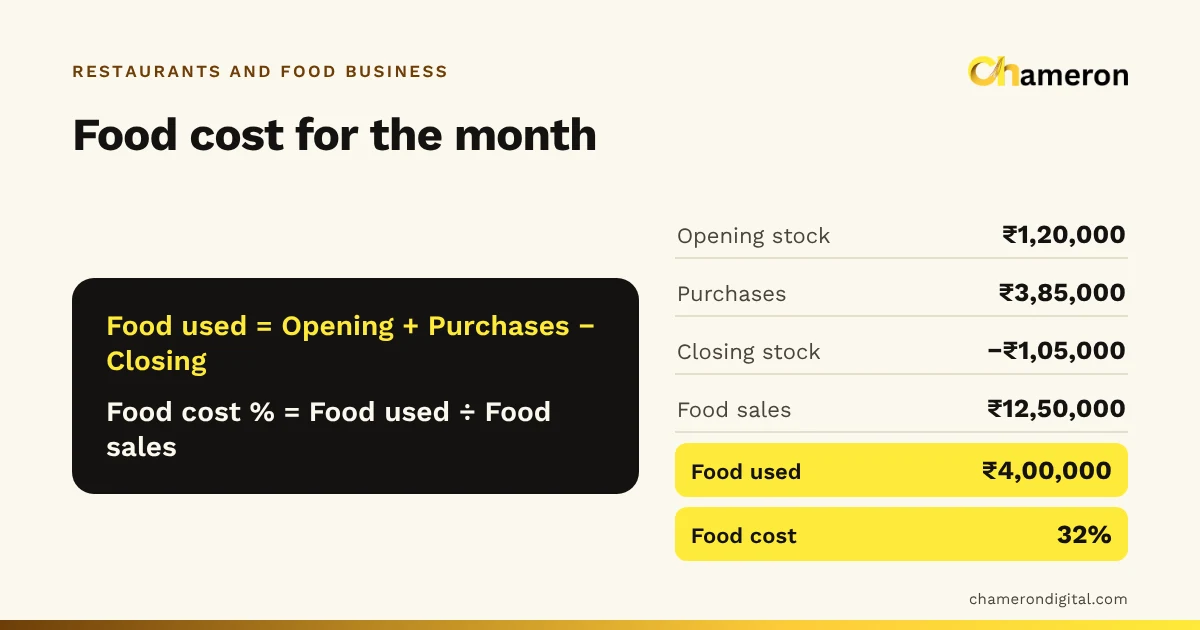
Recipes tell you what should happen. Stock tells you what did. At the end of each month, count everything in the kitchen and stores and value it at cost.
| Month of September | Amount |
|---|---|
| Opening stock (count on 31 August, at cost) | ₹1,20,000 |
| + Food purchases during the month | ₹3,85,000 |
| − Closing stock (count on 30 September, at cost) | ₹1,05,000 |
| = Food used | ₹4,00,000 |
| Food sales before GST | ₹12,50,000 |
| Food cost % | 32% |
₹1,20,000 + ₹3,85,000 − ₹1,05,000 = ₹4,00,000, and ₹4,00,000 ÷ ₹12,50,000 = 0.32.
Adjust for food that was not sold
Some of that ₹4,00,000 never reached a paying guest. The usual adjustments are:
- Staff meals, if you record them as a staff cost.
- Transfers to another outlet, a bar or a catering order billed separately.
- Complimentary dishes given for a reason you want to see on its own line.
If staff meals came to ₹20,000 in September, the food cost of sales is ₹3,80,000, or 30.4% of food sales. Record these items through the month; working them out from memory at the count is guesswork.
Compare the two: the gap that matters
Now put the two methods side by side. Multiply each dish's portions sold in September by its plate cost and add them up. That is the theoretical food cost: what the month should have cost if every plate matched its recipe and nothing was wasted.
| September | Amount | % of food sales |
|---|---|---|
| Theoretical food cost (recipes × portions sold) | ₹3,62,500 | 29.0% |
| Actual food cost of sales (from stock, after staff meals) | ₹3,80,000 | 30.4% |
| Gap | ₹17,500 | 1.4 points |
₹17,500 of food was used but is not explained by sales or staff meals. Some gap is normal, because nobody portions to the gram. The useful questions are whether it is growing, and which ingredients it comes from.
Where the gap comes from
- Portions. A ladle of gravy that grows during the rush, or an extra piece of paneer, repeated across hundreds of plates.
- Waste. Spoiled vegetables, over-prepared batches, burnt dishes, returned plates. Waste written down with a reason becomes a number; waste thrown away silently becomes "the gap".
- Recipes that are wrong. If the recipe card says 120 g and the cooks were trained on 140 g, the gap is in the card, not the kitchen.
- Price changes not recosted. Theoretical cost at old prices understates what the plates really cost.
- Counting errors. A missed shelf in the closing count makes the month look worse and the next month look better.
- Loss. Theft does happen. The gap cannot prove it, but an ingredient whose gap keeps growing deserves a closer look.
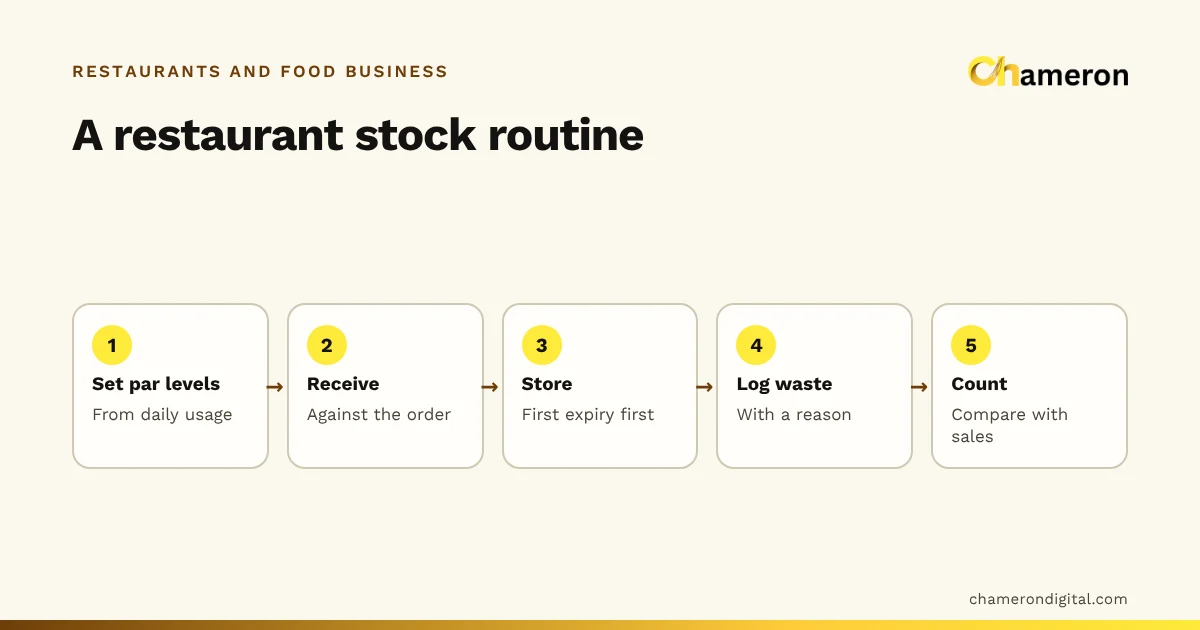
Ingredient-level checks narrow it down quickly. Compare what the recipes say you used of each costly item with what the stock count says you used. Our guide to restaurant inventory management covers the counting routine, and the stock count sheet is a printable starting point.
Common mistakes
- Including GST. Use menu prices and food sales before GST, and ingredient costs net of any GST you can claim back.
- Costing gravies by the raw weight instead of the cooked yield.
- Forgetting the small things: oil, garnish, butter on the naan, the lemon wedge. Each is tiny; together they are not.
- Counting on different days. A count on the 28th one month and the 3rd the next makes months impossible to compare.
- Treating the average as the answer. A 30% average can hide a dish at 45%. Check plate costs dish by dish, then use menu profitability analysis to decide what to do about them.
- Confusing food cost with profit. A 30% food cost leaves 70% of sales to pay wages, rent, gas and electricity before any profit. Our guide to food cost percentage vs profit margin explains the difference.
Food cost in restaurant software
Software does not change the formulas, but it removes most of the manual work. When menu items are linked to recipes, each sale deducts its ingredients, so the theoretical usage builds up as you trade, and a physical count shows the gap straight away. In DINE OS, recipes are linked to ingredients, each settled sale deducts what it used, and waste and adjustments are recorded with a reason; see restaurant stock and purchasing for how that works.
The bottom line
Cost every main dish from its recipe, including sub-recipes, yield and packaging, so you know each plate's food cost before you price it. Then, every month, work out what the kitchen actually used from opening stock, purchases and closing stock. The plate figure keeps your prices honest; the period figure keeps the kitchen honest; and the gap between them is where the savings are. Try your own numbers in the food cost calculator.
Questions people ask
What is a good food cost percentage for a restaurant?
There is no single right figure. It depends on your cuisine, format, rent and wages. Decide a target for each dish and the menu as a whole from your own costs, then watch the gap between that target and your actual figure.
Should packaging be included in food cost?
For takeaway and delivery, yes: the container, lid, bag and sachets are part of what each portion costs to serve. For dine-in, leave packaging out. The menu price calculator has a separate field for it.
Are staff meals part of food cost?
They use food but do not produce sales, so many restaurants record them separately as a staff cost. Whichever way you choose, record them every day and treat them the same way every month.
How often should I count stock for food cost?
For period food cost, count at least once a month on the same day and at the same time, before or after service. Count costly items such as paneer, meat, cheese and dry fruits weekly so problems surface sooner.
Is food cost the same as cost of goods sold?
It is the restaurant version of it. Cost of goods sold uses the same opening + purchases − closing logic for any business. See what is cost of goods sold.