The short answer
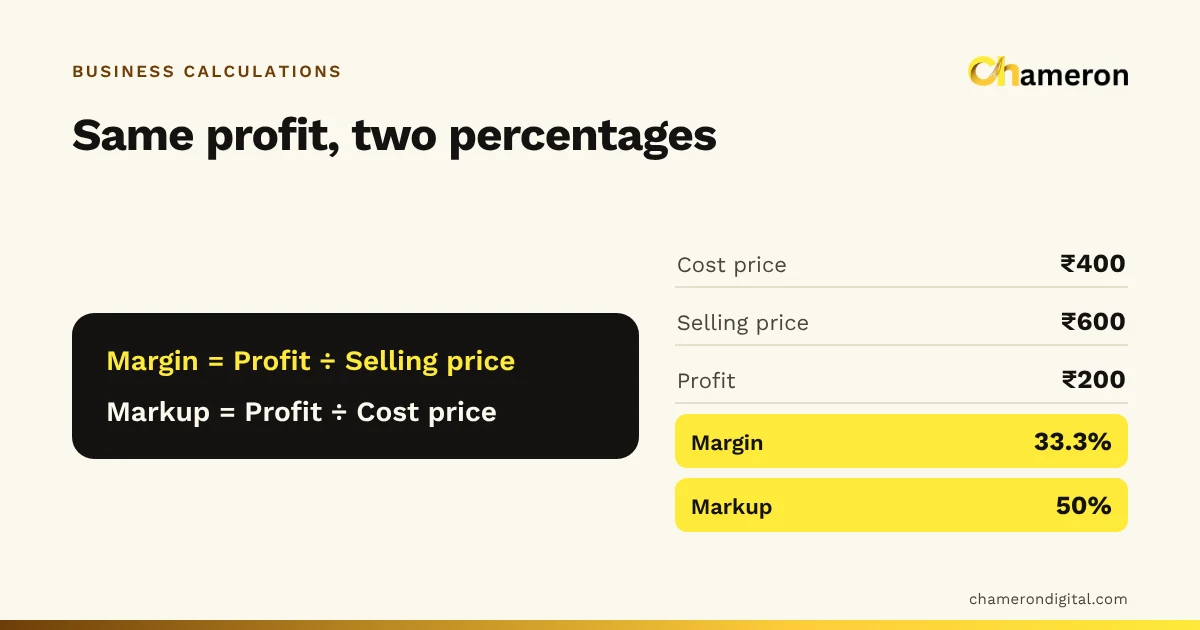
Margin and markup measure the same profit against different numbers. Margin is profit as a share of the selling price; markup is profit as a share of the cost. An item that costs ₹400 and sells for ₹600 makes ₹200 profit: that is a 33.3% margin but a 50% markup. Confusing the two is how many shops price below what they intended.
The two formulas
Both start from the same number: the profit on one unit.
Margin answers the question "of every ₹100 I take at the counter, how much do I keep?" Markup answers "how much did I add on top of what I paid?" Both are useful, but they are not interchangeable.
Gross margin, not net profit
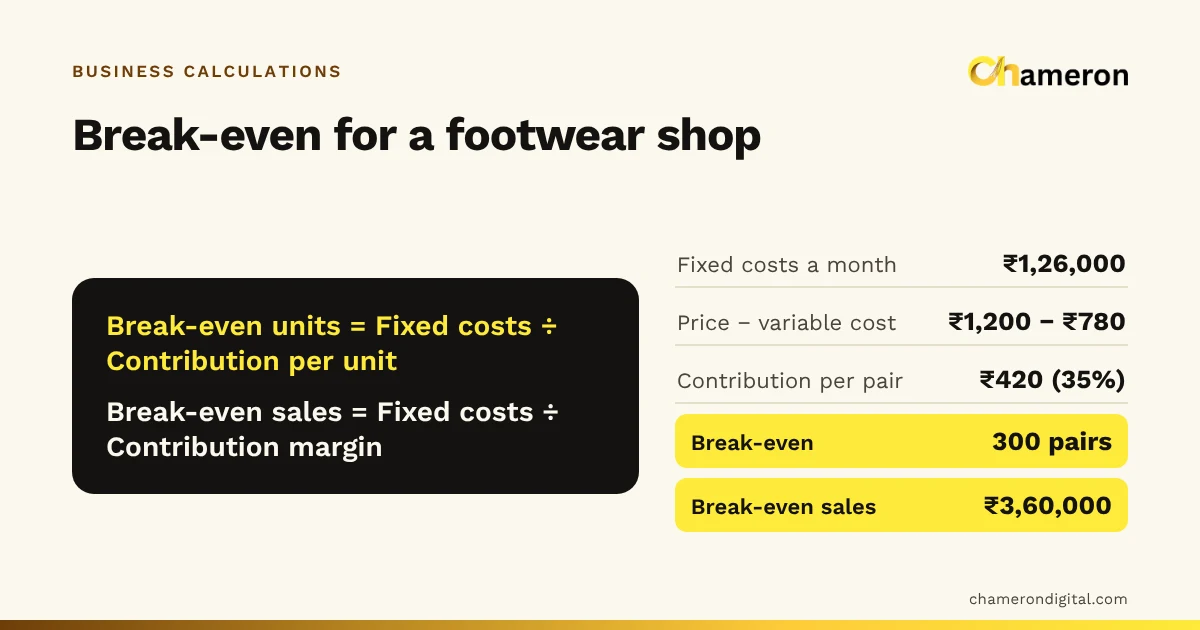
The margin in this guide is gross margin: selling price minus the cost of the goods. It does not include rent, salaries, electricity or other running costs. Those come out of gross profit later. A product can have a healthy gross margin and the business can still lose money if overheads are too high, which is why the break-even point matters.
A worked example in rupees
A clothing shop buys a shirt for ₹400 (before GST it can claim back) and sells it for ₹600 (before GST it charges).
| Step | Calculation | Result |
|---|---|---|
| Profit | ₹600 − ₹400 | ₹200 |
| Margin | ₹200 ÷ ₹600 × 100 | 33.3% |
| Markup | ₹200 ÷ ₹400 × 100 | 50% |
Same shirt, same profit, two very different percentages. If the owner tells a new manager to "keep a 50% margin" but means markup, the manager may reprice the shirt to ₹800, a 100% markup. If the owner says "add a 33% markup" but means margin, the shirt goes out at ₹532 and earns ₹132 instead of ₹200.
Why margin is always lower than markup
The selling price is always larger than the cost (if you are making a profit), so dividing the same profit by the bigger number gives the smaller percentage. That is all there is to it, but it has a practical consequence: a margin target needs a bigger price increase than it sounds like.
Converting margin to markup, and back
You do not need to recalculate from prices every time. These two conversions work for any item:
For example, a 25% margin is a 0.25 ÷ 0.75 = 33.3% markup. A 100% markup is a 1 ÷ 2 = 50% margin.
| Margin | Equivalent markup |
|---|---|
| 10% | 11.1% |
| 20% | 25% |
| 25% | 33.3% |
| 30% | 42.9% |
| 33.3% | 50% |
| 40% | 66.7% |
| 50% | 100% |
| 60% | 150% |
Keep this table near the counter or in the purchase file. It prevents most pricing mix-ups.
How to price for a target margin
This is where most mistakes happen. Suppose an item costs ₹400 and you want a 35% margin. The tempting calculation is ₹400 + 35% = ₹540. But ₹140 profit on a ₹540 price is only a 25.9% margin.
The correct way is to divide:
Check it: ₹615.38 − ₹400 = ₹215.38 profit, and ₹215.38 ÷ ₹615.38 = 35%. In practice you would round to a price that suits your shelf labels, such as ₹619 or ₹625, and the margin moves slightly with it.
If you prefer to think in markup, the price is simply cost × (1 + markup). A 50% markup on ₹400 is ₹400 × 1.5 = ₹600.
When to use margin and when to use markup
| Situation | Better measure | Why |
|---|---|---|
| Setting a price from a supplier’s cost | Markup | Multiply the cost by one number, quickly |
| Checking how much of your sales you keep | Margin | It relates profit to revenue, which is what you earn |
| Comparing products or categories | Margin | Products with different costs become comparable |
| Planning sales targets and break-even | Margin | Sales targets are worked out from revenue |
| Reading supplier "MRP margin" offers | Margin (usually) | Many trade schemes quote margin on MRP; confirm which |
Many shops use markup at the purchase desk and margin in their reports. That is fine, as long as everyone knows which one they are looking at and the reports say so.
How discounts eat into margin
A discount comes straight out of profit, not out of the price as a whole. Take the ₹600 shirt with ₹200 profit. A 10% discount takes ₹60 off the price, and all ₹60 comes out of the profit, which falls to ₹140. The margin drops from 33.3% to 25.9%, and you now need to sell about 43% more shirts to earn the same total profit.
That does not make discounts wrong; clearing end-of-season stock or winning a regular customer can be worth it. But it is worth running the numbers first with the discount calculator.
Common mistakes
- Adding the margin percentage to the cost. As shown above, a 35% "margin" added to cost is really a 35% markup and a 25.9% margin.
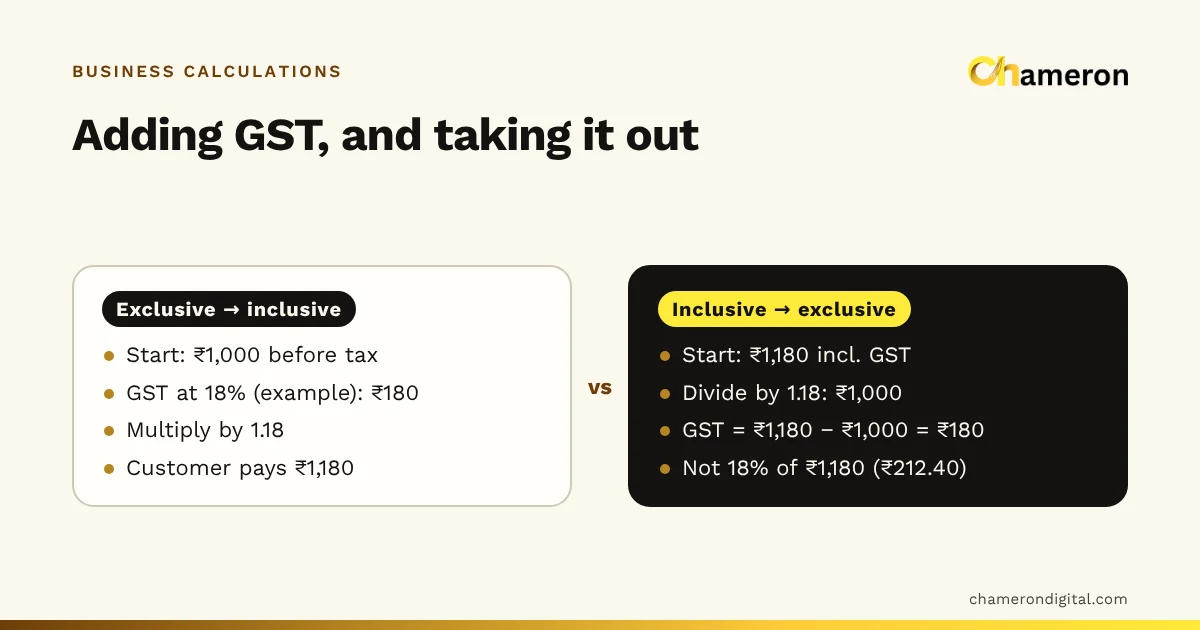
- Mixing GST into the calculation. Use prices before GST for both cost and selling price. Otherwise margins look higher than they are, and they change whenever a rate changes.
- Using MRP when you actually sell below it. Calculate margin on the price customers really pay after regular discounts.
- Forgetting freight and other landing costs. The cost should include delivery charges and anything else you pay to get the item onto your shelf.
- Comparing a margin with a markup. A supplier offering "25%" and your report showing "30%" may be describing the same profit in two different ways.
Margin and markup in billing software
When cost prices are recorded against each product, billing software can show margin per item, per bill and per category without anyone working it out by hand, and can flag items selling below cost. It is still worth knowing the formulas: they let you check the reports and set prices with confidence.
Shops that record purchase costs in BILL OS can review margins in its reports alongside the day's sales. Whatever tool you use, the habit that matters most is the same: record the real landed cost of every item.
The bottom line
Margin and markup are two views of one profit. Margin tells you how much of each sale you keep; markup tells you how much you added to the cost. Pick one for each job, label it clearly, and convert with the table above when you need the other. To try it with your own prices, use the free margin and markup calculator.
Questions people ask
Is a 30% markup the same as a 30% margin?
No. A 30% markup on a ₹100 cost gives a ₹130 price and a ₹30 profit, which is a 23.1% margin. A 30% margin needs a price of about ₹142.86 on the same cost.
Which is better to use, margin or markup?
Neither is better; they answer different questions. Markup is convenient for setting a price from a cost. Margin is better for understanding how much of your sales you keep and for comparing products, months or shops.
Can a margin be more than 100%?
No. Margin is a share of the selling price, so it can approach but never reach 100% (that would mean the item cost nothing). Markup can be any size: a 300% markup is perfectly possible.
Should GST be included when calculating margin?
No. GST collected on a sale is not your income, and GST you can claim back on purchases is not your cost. Use prices before GST on both sides. See our guide to GST-inclusive and exclusive prices.
What is a good profit margin for a shop?
There is no single right number. It depends on the category, your rent and wages, and how fast stock sells. Work out your break-even point first, then set margins that cover it with room to spare.