The short answer
To track sales and expenses, record every sale once with its payment method, note every expense the day it happens under a fixed category, and close the cash against an expected figure each evening. Once a month, match UPI and card sales with the bank statement, work out the cost of the goods you sold, and subtract it and the month's expenses from sales to get net profit. Keep stock purchases and money you take home separate from expenses, or the profit figure will be wrong.
Four kinds of money, kept apart
Most tracking problems start because different kinds of money are written in one list. Before setting up any routine, agree what goes where:
| Kind | Examples | Affects profit? | How |
|---|---|---|---|
| Sales | Bills paid in cash, UPI, card or on credit | Yes | Income, recorded before GST |
| Stock purchases | Goods bought to resell | Yes, but only when sold | Becomes cost of goods sold |
| Running expenses | Rent, salaries, electricity, packaging, transport | Yes | Subtracted in the month they belong to |
| Drawings | Cash the owner takes home, personal bills paid from the till | No | Recorded separately |
A shop that writes its supplier payments and the owner's household cash in the same "expenses" column will never know its real profit.
Step 1: Record every sale once, with its payment method
Every sale should produce one record, made at the moment of sale: a bill. Write it, print it or create it in software, but make it once, and note how it was paid.
At the end of the day, the bills add up to a summary like this one for an invented general store:
| Payment method | Amount |
|---|---|
| Cash | ₹7,200 |
| UPI | ₹13,400 |
| Card | ₹1,400 |
| Total sales | ₹22,000 |
Keep credit sales visible too. A bill that was not paid today is still a sale, but it adds to what customers owe rather than to cash. Number your bills in sequence so a missing one is noticed.
Step 2: Close the cash every day
Cash is where money goes missing quietly, so it gets its own daily check. Start the day with a known float, record any cash that leaves the drawer with a reason, and compare the count at closing with what should be there.
For the general store:
| Item | Amount |
|---|---|
| Opening float | ₹2,000 |
| Cash sales | ₹7,200 |
| Paid out for tea and a porter | −₹600 |
| Expected cash | ₹8,600 |
| Counted cash | ₹8,550 |
| Difference | ₹50 short |
Fifty rupees may be a wrong change given back. A difference that repeats, or grows, needs a closer look at who handled the drawer and which bills were cancelled. The glossary explains a cash drawer shift and the float.
Step 3: Record expenses as they happen
Expenses recorded "later" are expenses forgotten. Note each one the same day, with the amount, the date, who paid it, how it was paid and a receipt or a written reason.
Use a short, fixed list of categories so months can be compared:
| Category | What belongs here |
|---|---|
| Rent | Shop rent, maintenance charges |
| Salaries and wages | Staff pay, helpers, overtime |
| Utilities | Electricity, water, phone, internet |
| Packaging and supplies | Carry bags, bill rolls, stationery |
| Transport | Delivery, courier, porter charges |
| Repairs and maintenance | Equipment repairs, small fittings |
| Bank and payment charges | Card machine fees, bank charges |
| Other | Anything else, with a note |
Pay expenses from the business account or the till, never from your personal wallet without writing it down. If you do pay personally, record it as money the owner put in, so the business owes it back.
Step 4: Match UPI and card sales with the bank
UPI and card payments do not pass through the drawer, so the cash count cannot check them. The bank statement can.
Once a week, or at least once a month, compare the UPI and card totals from your bills with the credits in the bank account for the same days. Look for:
- A bill marked UPI with no matching credit. The customer may have shown a payment screen that never completed. Confirming each payment on the shop's phone or sound box before handing over goods prevents most of these.
- A credit with no matching bill. Perhaps a customer paid old dues by UPI and nobody recorded it against their account.
- Card settlements net of charges. The bank usually receives the card total minus the fee; record the fee as an expense.
Step 5: Turn the month into a profit figure
At month end you have sales, purchases, expenses and a stock count. Two short calculations turn them into profit.
First, work out what the goods you sold cost you. Purchases alone are not enough, because some of what you bought is still on the shelf.
For the general store: ₹5,20,000 + ₹4,60,000 − ₹5,00,000 = ₹4,80,000. Our question page on cost of goods sold explains this in more detail.
Then build the month's summary:
| Line | Amount |
|---|---|
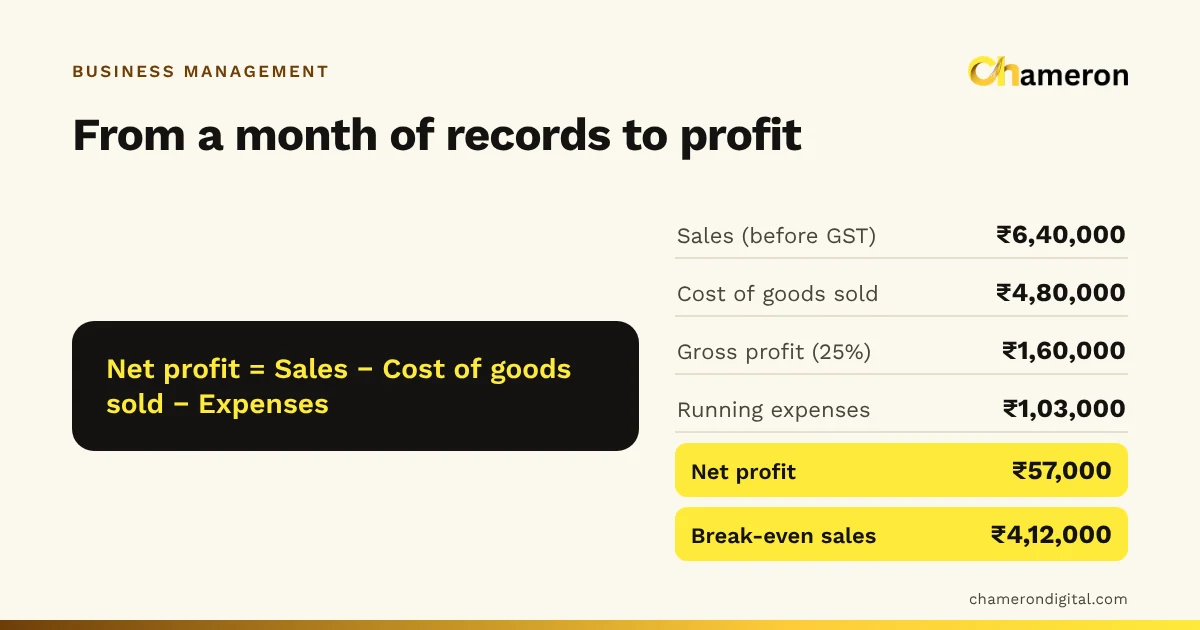
| Sales (before GST): cash ₹2,10,000, UPI ₹3,90,000, card ₹40,000 | ₹6,40,000 |
| Cost of goods sold | −₹4,80,000 |
| Gross profit (25% of sales) | ₹1,60,000 |
| Rent | −₹35,000 |
| Salaries | −₹48,000 |
| Electricity | −₹6,500 |
| Phone and internet | −₹1,500 |
| Packaging | −₹4,000 |
| Transport | −₹5,000 |
| Other | −₹3,000 |
| Total expenses | −₹1,03,000 |
| Net profit | ₹57,000 |
The difference between the two profit lines is explained on our page about gross profit vs net profit, and the full method is in how to calculate business profit.
Use the same numbers for break-even
With a 25% gross margin and ₹1,03,000 of monthly expenses, the store needs sales of ₹1,03,000 ÷ 0.25 = ₹4,12,000 a month just to cover its costs. Anything above that is profit. Try your own figures in the break-even calculator, or read how to calculate break-even point.
If your prices include GST, take the GST out before adding up sales; the GST calculator does this for any rate.
Common mistakes
- Counting stock purchases as expenses. It makes stocking-up months look like losses and the following months look too good.
- Mixing drawings with expenses. Household money taken from the till is not a business cost.
- Recording UPI by memory. Mark the payment method on each bill when it is made, not at night.
- Leaving small expenses out. Tea, porters and courier charges look trivial daily but add up to thousands a month.
- Including GST in sales. It inflates sales and margin; GST collected belongs to the government.
- Only looking at profit once a year. A monthly figure lets you correct course while it still matters.
Tracking sales and expenses in software
Billing software makes Steps 1 and 2 almost automatic: the bill made at the counter is the sales record, already split by payment method, and the expected cash is worked out for you. In BILL OS, for example, the cash drawer opens with a float, pay-ins and pay-outs are recorded with a reason, and expected cash at closing is worked out from the float, cash payments, expenses and pay-ins and pay-outs, as described under cash drawer and staff. The monthly bank match and profit review still need a person who looks at the figures.
The bottom line
Tracking sales and expenses comes down to five habits: one record per sale with its payment method, a daily cash close, expenses noted the day they happen, a regular bank match for UPI and card, and a monthly profit summary. Keep purchases and drawings out of expenses, work in amounts before GST, and the monthly figure will tell you what the business really earned. For the measures worth watching once these records are in place, see 10 business numbers every owner should track.
Questions people ask
Should I record sales with or without GST?
For understanding profit, use sales before GST, because the GST you collect is owed to the government. Keep the GST amounts as well for your returns. Check how your records should be kept for GST with your accountant or the official GST portal.
Is money I take out of the business for home an expense?
No. It is a drawing, not a business expense. Record it separately so it does not reduce your profit figure, and so you can see how much you are taking out against how much the business is earning.
Are stock purchases expenses?
Not in the monthly profit calculation. Stock bought becomes a cost only when it is sold, as cost of goods sold. Recording purchases as expenses makes a month when you stock up for a festival look like a loss and the next month look unusually profitable.
How often should I check sales and expenses?
Close the cash and look at the day's sales by payment method every day, review expenses weekly, and work out profit monthly. Small mismatches are easy to explain on the same day and almost impossible a month later.
Can I track sales and expenses in a notebook?
Yes, if the volume is small and you are disciplined about it. The same five steps apply. Software helps most with the first two, because the bill made at the counter becomes the sales record and the expected cash is worked out for you.