The short answer
Coaching centre administration is the office work around the teaching: turning enquiries into admissions, planning batches, keeping attendance, collecting fees, running tests and keeping parents informed. It stays manageable when each job has one record, one person responsible and a fixed routine: daily, weekly, monthly and for admission season. Most office trouble in a coaching centre comes from a job that belongs to everyone and therefore to no one.
The six records the office runs on
Everything the office does touches one of six records. Decide where each one lives and who keeps it.
| Record | What it holds | Owner | Updated |
|---|---|---|---|
| Enquiries | Name, course, phone, source, follow-up date, outcome | Front desk or counsellor | Every enquiry |
| Students | ID, student and parent details, course, batch, fee plan | Front desk | At admission and on changes |
| Batches | Timing, room, teacher, capacity, students | Academic coordinator | Before each intake |
| Attendance | Present or absent by batch and date | Teachers | Every class |
| Fees | Schedules, payments, receipts, balances | Accounts | Every payment |
| Tests | Marks by test and student | Academic coordinator | After each test |
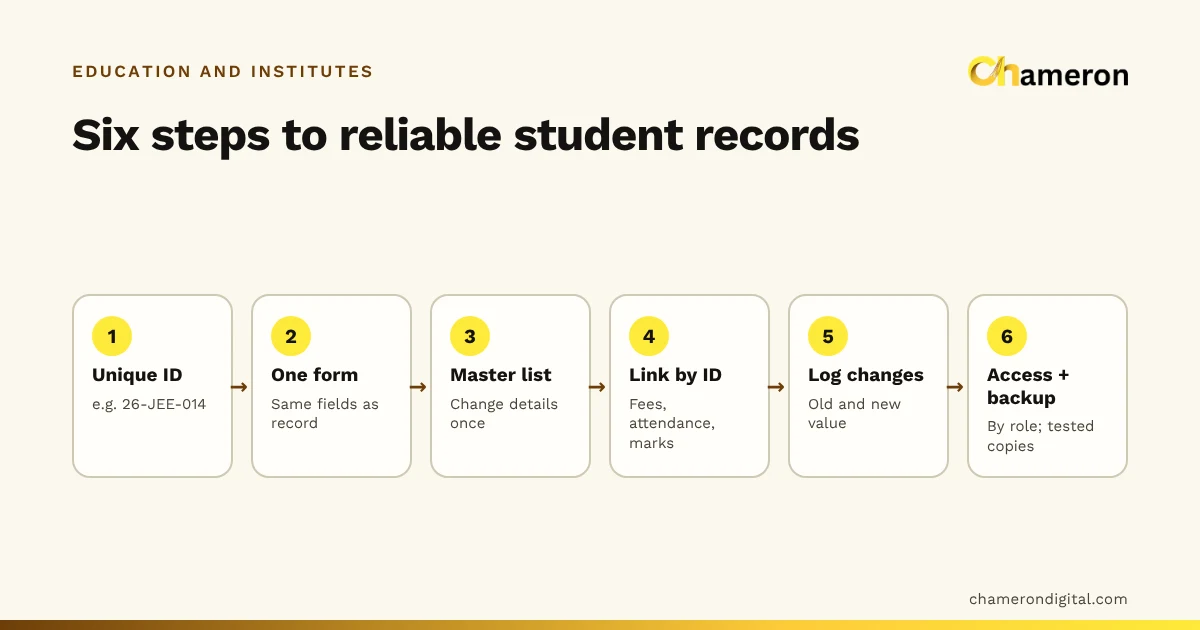
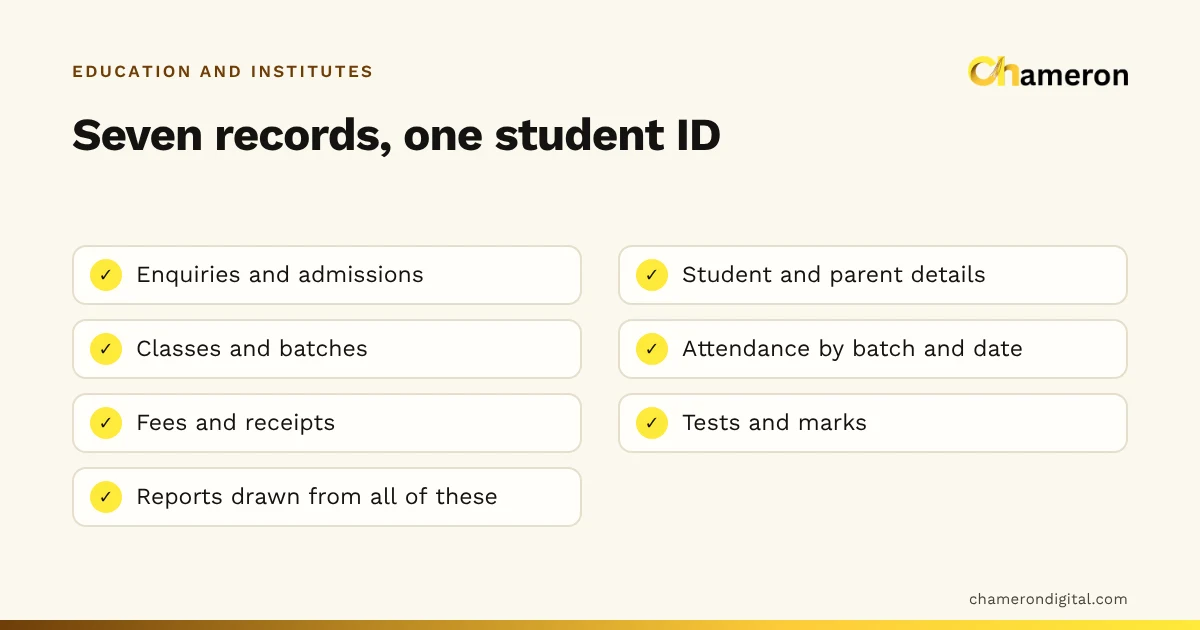
The student record is the centre of the others. Give each student a unique ID at admission and use it in every other record; our guide on managing student records explains how.
Enquiries to admissions
Each enquiry is a family deciding where to spend a large sum on their child's education. Treat the enquiry register as a follow-up list, not a visitors' book.
For every enquiry, record:
- the student's name, class and course of interest;
- a parent's phone number;
- the source: walk-in, referral, school visit, a leaflet or online;
- the next follow-up date and what was promised, such as a demo class or a fee plan;
- the outcome: admitted, joined elsewhere, postponed or not interested.
At the end of each month, count enquiries and admissions. If 60 enquiries in July led to 18 admissions, your conversion rate is 18 ÷ 60 = 30%. The number on its own means little, but a fall from one month to the next, or a source that never converts, tells you where to look. Every enquiry without a follow-up date is a family nobody will call back.
Planning batches
Batch planning decides how full your rooms are and how stretched your teachers are. Before each intake, lay out every batch with its capacity and current strength:
| Batch | Timing | Capacity | Enrolled | Seats left | Fill |
|---|---|---|---|---|---|
| JEE morning | 7–9 am | 30 | 27 | 3 | 90% |
| JEE evening | 5–7 pm | 30 | 30 | 0 | 100% |
| NEET morning | 7–9 am | 25 | 16 | 9 | 64% |
| Foundation evening | 4–6 pm | 35 | 21 | 14 | 60% |
| Total | 120 | 94 | 26 | 78% |
This table answers the counsellor's daily question, "Which batch can I offer?", and the owner's planning question. The JEE evening batch is full, so new JEE students should be offered the morning batch or a waiting list. The NEET and foundation batches have room; perhaps those need more effort at the enquiry stage.
Before announcing timings, check for clashes: the same teacher in two batches at once, or two batches in one room. Changing a batch's timing mid-term affects every family in it, so make it a decision that needs the owner's approval and a notice to parents.
Attendance and absentee follow-up
Attendance is only useful if someone acts on it. Mark it at the start of every class, by student ID or name against the batch list, and set a simple rule for follow-up. For example: the front desk calls a parent the same day after two consecutive absences.
Review each student's attendance monthly. A student who attended 17 of 22 classes has 77% attendance (17 ÷ 22 = 0.773). Falling attendance is often the first sign of a student who is struggling or about to drop out, and sometimes of a fee that is about to go unpaid. Looking at attendance and fee dues together, by student ID, often explains both.
Tests, marks and parent communication
Most coaching centres run frequent tests, and parents judge the centre partly by how clearly results are shared.
- Publish a test calendar at the start of each term, so students and parents know what is coming.
- Enter marks within two working days of each test, against the student ID, so results are ready while the test is still fresh.
- Share a short update with parents after major tests: the score, the batch average and attendance for the period.
- Hold parent meetings once a term, with one summary per student covering attendance, test results and fee status.
Parents mostly want answers to three questions: is my child attending, are they improving, and is anything due? If the office can answer all three from one place, there are far fewer phone calls.
Staff roles and handovers
Small offices work because people cover for each other. They break down when nobody knows who does what. Write down the roles, even if one person holds several:
- Front desk or counsellor: enquiries, admissions, student details, absentee calls.
- Accounts: fee schedules, receipts, daily reconciliation, dues follow-up. Our guide to managing coaching centre fees sets out this routine.
- Academic coordinator: batches, timetable, test calendar, marks.
- Owner or director: discounts and scholarships, refunds, batch changes, monthly review.
Give each person their own login or their own register section, and never share passwords. Keep a one-page handover note for each role covering where the records are, what is done daily and who to call, so the office keeps running when someone is on leave.
The office calendar
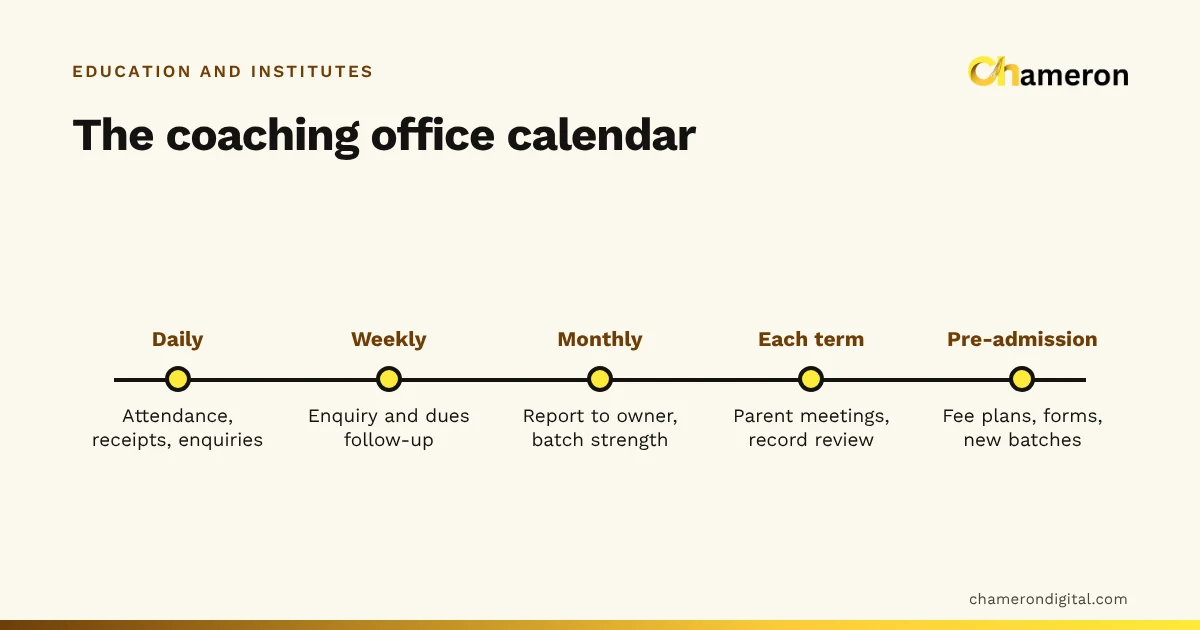
A fixed calendar means important jobs happen because it is the day for them, not because someone remembered.
Daily
- Mark attendance in every batch.
- Record enquiries with a follow-up date.
- Issue receipts and reconcile the day's collection.
- Call parents of repeatedly absent students.
Weekly
- Follow up open enquiries.
- Follow up overdue fees by phone.
- Check that marks from the week's tests are entered.
Monthly
- Report enquiries, admissions, collections and attendance to the owner.
- Review batch strength and seats left.
- Check fee totals against the dues list.
Each term
- Parent meetings with a summary per student.
- Review and update student records.
- Plan the next term's batches and test calendar.
Before admission season
- Print fee plans and admission forms.
- Set up the new intake's batches and ID series.
- Brief the front desk on courses, fees and batch availability.
Admission season is when everything happens at once. Doing the preparation a few weeks early is what keeps it calm. For a broader view of the numbers worth watching, see business numbers to track.
Student data and documents
The office holds personal details about children and parents. Collect only what you need, keep paper files in a locked cupboard, give access by role and keep backups of any digital records. Rules on personal data can change, so check current requirements for your centre with a professional.
Common mistakes
- Enquiries without follow-up dates. They are forgotten within a week.
- Overfilling popular batches. Adding "just two more" to a full batch affects every student in it.
- Attendance nobody reads. Marking attendance without a follow-up rule is wasted effort.
- Teachers collecting fees informally. All payments go through the fee window, with a receipt.
- Shared logins and no handover notes. The office stops when one person is away.
Tools for the office
Registers and spreadsheets can run all of this, and a fee collection tracker is a good place to start for fees. When several people need the same records at once, institute management software brings them under one student ID. Chameron Digital's EDU OS is intended for admissions, attendance, fees and exams in a school or coaching office. It is not yet generally available; ask about availability on its page or visit our schools and coaching institutes page.
The bottom line
A coaching centre office runs smoothly when six records each have an owner, enquiries always have a next step, batches are planned against capacity, and a calendar decides what happens each day, week, month and term. None of this needs complicated tools. It needs clear ownership and the discipline to follow the same routine in admission season as in a quiet week.
Questions people ask
How many staff does a coaching centre office need?
It depends on the number of students and batches, not on a fixed ratio. Many small centres run with one front-desk person and the owner handling accounts. What matters is that every record has a named owner and someone else knows how to cover it.
What is a good enquiry-to-admission rate?
There is no standard figure; it varies with the course, the season and where enquiries come from. Track your own rate month by month and by source, and look into it when it drops.
How often should we update parents?
A short update after every major test and a fuller meeting once a term works for many centres, along with same-day calls for repeated absence. Keep the rhythm consistent so parents know when to expect news.
Should teachers handle fee questions?
Usually not. Send fee questions to the person who keeps the fee records, so answers are consistent and teachers can stay focused on teaching.