The short answer
A coaching centre manages fees well when four things are in place: a written fee plan, a dated instalment schedule for every student, a numbered receipt for every payment, and a daily reconciliation of receipts against cash and bank. Add a fixed calendar for following up dues, starting a week before each due date, and most fee disputes and surprises disappear. The rest of this guide shows how to set each part up, with worked examples in rupees.
Write the fee plan before admissions open
Fee confusion usually begins at the admission desk, when a counsellor agrees something verbally that nobody writes down. Prevent it with a fee plan for each course, printed and handed to every parent.
A good fee plan states:
- the course fee and exactly what it covers, such as study material or test series;
- the payment options, for example full payment or instalments;
- the instalment amounts and due dates;
- discounts and scholarships, and who can approve them;
- the refund or withdrawal policy;
- any late fee, and when it applies.
Here is an example for a one-year Class 11 JEE foundation course:
| Option | At admission (June) | 10 Aug | 10 Oct | 10 Dec | Total |
|---|---|---|---|---|---|
| Full payment | ₹46,000 | – | – | – | ₹46,000 |
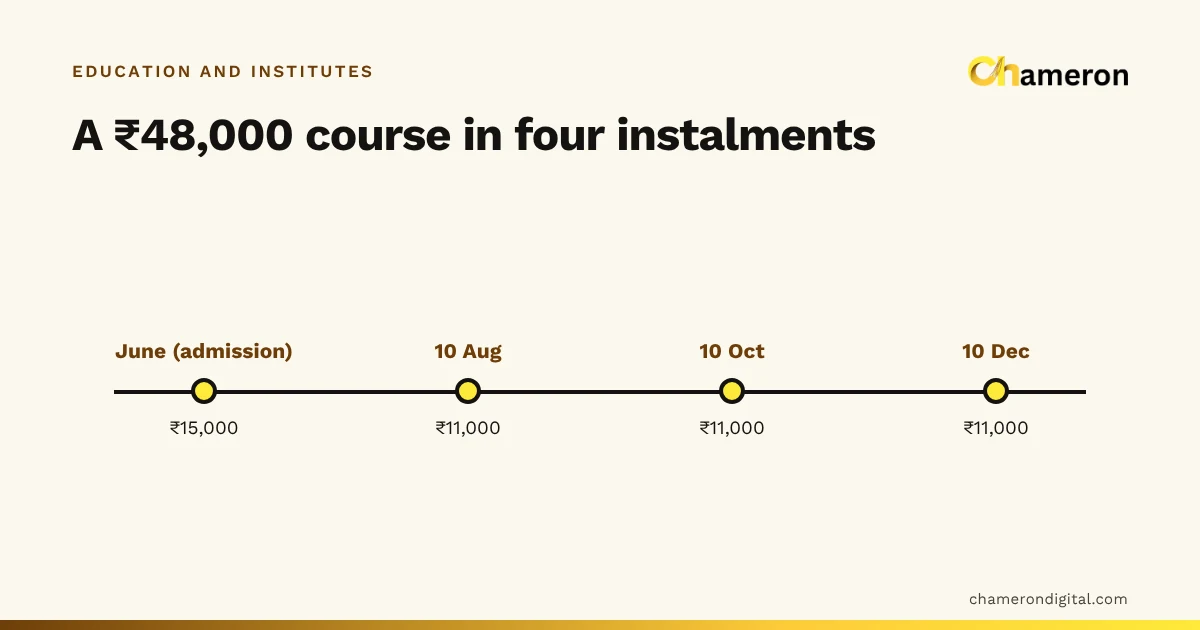
| Four instalments | ₹15,000 | ₹11,000 | ₹11,000 | ₹11,000 | ₹48,000 |
The full-payment option includes a ₹2,000 discount (₹48,000 − ₹2,000 = ₹46,000). The instalments add up to ₹15,000 + 3 × ₹11,000 = ₹48,000. Fixed dates such as the 10th of the month are easier for parents to remember than "60 days after admission".
Turn each admission into a schedule
When a student is admitted, write out their own schedule from the plan. Each row is one instalment, and every payment is recorded against a row.
Suppose a student on the instalment plan has a 10% merit scholarship, worth ₹4,800 on ₹48,000. Record it as a separate line, taken off the final instalment, rather than quietly changing the course fee:
| Instalment | Due date | Amount | Paid | Receipt | Balance |
|---|---|---|---|---|---|
| 1 (admission) | 12 Jun | ₹15,000 | ₹15,000 | 0218 | ₹0 |
| 2 | 10 Aug | ₹11,000 | ₹11,000 | 0402 | ₹0 |
| 3 | 10 Oct | ₹11,000 | – | – | ₹11,000 |
| 4 | 10 Dec | ₹11,000 | – | – | ₹11,000 |
| Scholarship (10%) | 10 Dec | −₹4,800 | – | – | −₹4,800 |
| Total | ₹43,200 | ₹26,000 | ₹17,200 |
The student pays ₹43,200 in all, and the final instalment becomes ₹11,000 − ₹4,800 = ₹6,200. Anyone looking at the schedule can see the full fee, the scholarship and who it was approved for. The balance check: ₹43,200 − ₹26,000 = ₹17,200.
A spreadsheet such as the fee collection tracker holds these schedules for every student, one row per fee period.
Receipts: one for every payment
The receipt is the link between money received and the fee record. Every payment gets one, however small, and it carries:
- a receipt number from a single running series;
- the date;
- the student ID and name, and the batch;
- the instalment the payment is for;
- the amount and mode: cash, UPI, cheque or bank transfer;
- the UPI reference or cheque number and bank, where relevant;
- the balance still due on that instalment, and when;
- the name or signature of the person who received it.
If a receipt is wrong, cancel it: mark it cancelled, write the reason and keep the copy. Then issue a fresh one. A missing number in the series should always have an explanation.
When a parent pays part of an instalment, the receipt shows the amount received and the balance still due, and the instalment stays open until it is paid in full. The partial payments page gives a worked example.
Whether your fees attract GST depends on the service and current rules. Ask your accountant, and make sure receipts or invoices show tax correctly if it applies.
Follow up dues on a calendar
Chasing fees feels awkward, so it tends to be put off until the amounts are large. A fixed calendar makes it routine and polite:
| When | Action | Who |
|---|---|---|
| 7 days before the due date | A friendly reminder to parents with the amount and date | Front desk |
| Due date | Fee window open; list students not yet paid | Accounts |
| 7 days after | A phone call to each parent who has not paid | Front desk |
| 15 days after | A meeting or call with the counsellor to agree a date | Counsellor |
| 30 days after | The owner decides the next step under the written policy | Owner |
Keep a short log of each call: date, who was spoken to and the promised date. When a parent promises to pay on the 20th, the next call happens on the 21st, not whenever someone remembers.
Talk to parents, not students. Reading out defaulters' names in class embarrasses children and rarely speeds up payment.
Reconcile every day and every month
The daily check
At closing time, total the day's receipts by payment mode and match each total to where the money actually is.
If the cash box holds ₹20,000 instead of ₹20,500, look for the missing ₹500 that evening, while everyone still remembers the day. Check UPI payments against the statement yourself; a screenshot shown by a parent is not proof that the money arrived. For the same routine at a shop counter, see how to track sales and expenses.
The monthly check
At the end of each month, compare what was due with what came in:
| Amount | |
|---|---|
| Total due in October (all students) | ₹4,40,000 |
| Collected against October dues | ₹3,92,000 |
| Outstanding | ₹48,000 |
That is a collection rate of about 89% (₹3,92,000 ÷ ₹4,40,000). The ₹48,000 should equal the sum of the balances on the dues list. If it does not, a payment has been recorded in one place and not the other. Tracking the same few numbers each month is covered in our guide to business numbers to track.
Withdrawals, refunds and batch changes
- Withdrawals and refunds: follow the written policy, record the refund as its own entry with its own reference, and never reduce an old receipt.
- Batch changes: move the student's schedule to the new batch; payments already made stay where they are.
- Fee changes: apply new fees to new admissions. Existing students keep the plan they signed unless they agree in writing.
Common mistakes
- Verbal discounts. A concession promised at the desk and never recorded turns into a dispute months later.
- Editing the fee to match the payment. If a parent pays ₹9,000 of ₹11,000, the fee is still ₹11,000 and ₹2,000 is due.
- One receipt for several payments. Each payment, on each date, gets its own receipt.
- Reconciling weekly. A difference found a week later is much harder to explain.
- Starting follow-up after the due date. A reminder before the date is friendlier and more effective.
Register, spreadsheet or software
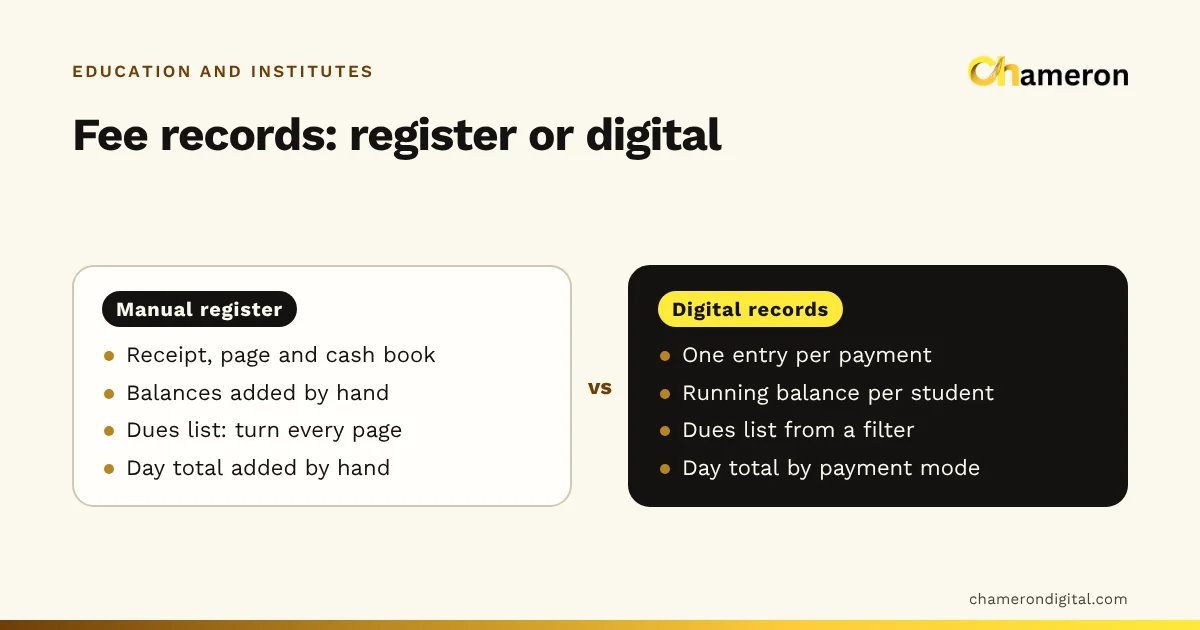
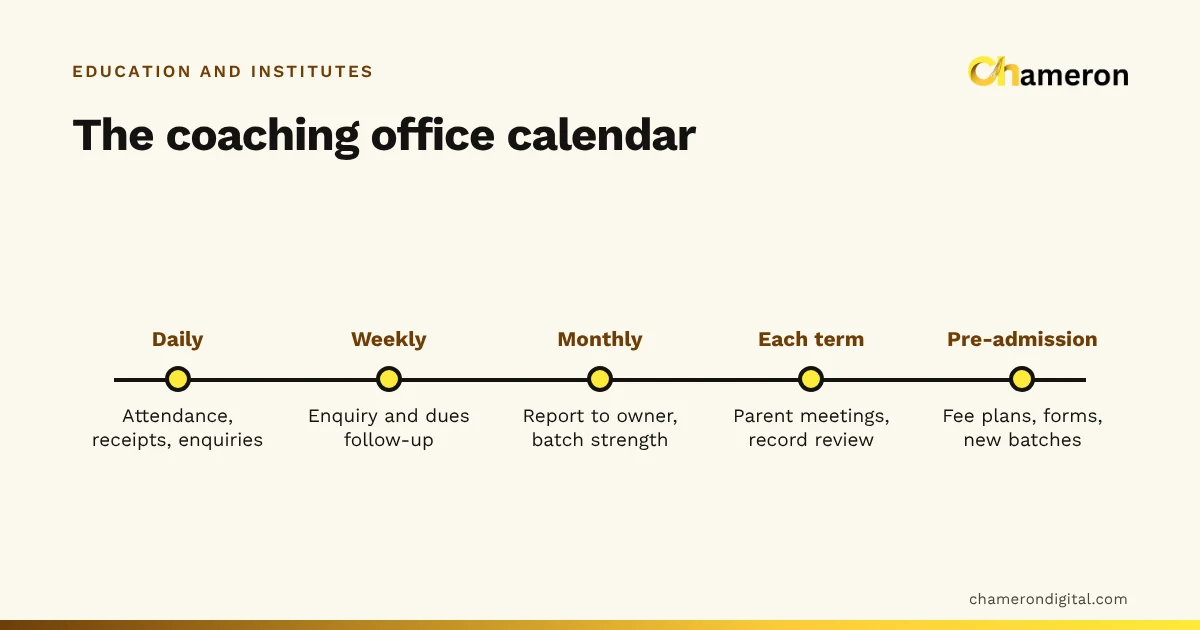
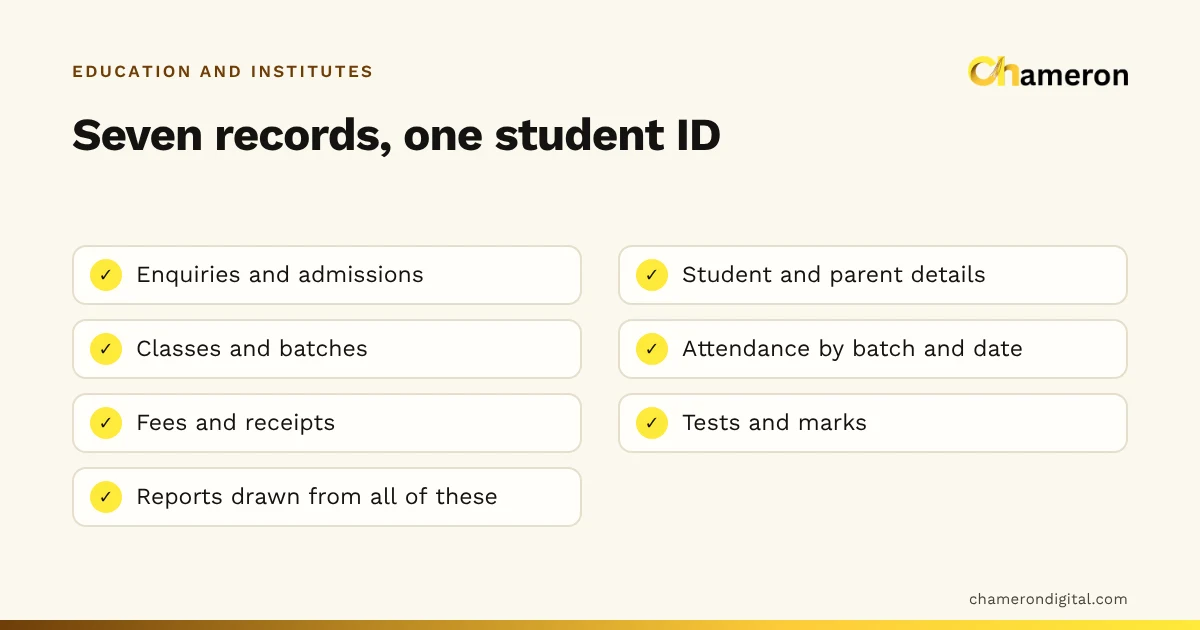
All of this works with a register and receipt book, a spreadsheet or institute software. The method matters more than the tool. Our comparison of manual registers and digital fee records helps you decide when to move from one to the next. For the rest of the office routine, including enquiries, batches and attendance, see coaching centre administration.
Chameron Digital's EDU OS is intended for admissions, attendance, fees and exams in a school or coaching office. It is not yet generally available; you can ask about availability on its page, or read more on our schools and coaching institutes page.
The bottom line
Good fee management in a coaching centre is mostly about writing things down at the right moment: the plan before admissions, the schedule at admission, the receipt at payment and the totals at closing time. Add a follow-up calendar that starts before each due date, and fees stop being a monthly scramble and become a routine the whole office understands.
Questions people ask
Should a coaching centre charge the full fee upfront or in instalments?
Many centres offer both: a small discount for paying in full and a fixed instalment plan for everyone else. What matters is that the options, amounts and dates are written down and the same for every student on that plan.
How do we record a parent who pays only part of an instalment?
Issue a receipt for the amount received, record it against the same instalment and show the remaining balance and its new due date. Our page on recording partial fee payments walks through an example.
Do coaching centres have to charge GST on fees?
It depends on the kind of course, your registration and the current rules, so check with your accountant. If GST does apply, your receipts or invoices need to show it correctly, and the GST calculator can help you check the arithmetic.
Should we charge a late fee?
That is a policy decision. If you do, state the amount and when it applies in the written fee plan, and apply it consistently. A late fee that is waived for some parents and not others causes more trouble than it solves.
How often should we reconcile fee collections?
Every day for the day's receipts against cash, UPI and cheques, and every month for the total due, collected and outstanding.