The short answer
Gym attendance tracking means recording each member’s check-in against their record, then using those records to spot members who are drifting away, plan staff for busy hours and confirm that everyone training has an active plan. The recording must be quick enough not to cause a queue at the desk. The value comes from a few simple numbers reviewed every week, especially the list of active members who have not visited for two weeks.
Why check-ins matter
A membership is paid for up front, so it is tempting to treat attendance as a formality. It is the opposite: attendance is the clearest sign of whether a member is getting value from their plan, and therefore whether they will renew.
Check-ins answer three practical questions:
- Who is drifting away? A member who came four times a week and now comes once is at risk, even with two months left on their plan.
- When is the gym busiest? Staffing, trainer schedules and cleaning rounds should follow the hours members actually come.
- Is this person an active member? A check-in against the member’s record confirms the plan has not ended and flags any balance due.
How to record check-ins without a queue
The front desk is busiest when the doors open and in the evening rush. Whatever method you choose, a check-in should take a few seconds.
| Method | Speed at the desk | Easy to use later? | Notes |
|---|---|---|---|
| Paper register signed by member | Fast | Hard: pages of handwriting to read | Fine for counting, poor for finding absent members |
| Staff tick a printed member list | Medium | Medium | Needs a fresh list as members join and leave |
| Look-up by member number or mobile | Fast once practised | Easy: each visit is on the record | Shows end date and dues at the same moment |
| Membership card with a number or code | Fast | Easy, if linked to the member record | Members forget cards; keep look-up by mobile as a fallback |
The method matters less than one principle: each check-in should be stored against a member, not just as a line in a book. That is what lets you ask “who has not been in for two weeks?” later.
The four attendance numbers worth watching
You do not need a dashboard. Four numbers, reviewed weekly or monthly, cover most decisions.
1. Visits per member
A gym with 240 active members recorded 3,360 check-ins in the last four weeks. That is 3,360 ÷ 240 = 14 visits per member in four weeks, or 3.5 a week. On its own the figure means little; watch whether it rises or falls month to month.
2. Days since last visit
Sort active members by how long it has been since their last check-in.
| Days since last visit | Members | Share of 240 |
|---|---|---|
| 0–7 days | 172 | 71.7% |
| 8–14 days | 38 | 15.8% |
| 15–30 days | 21 | 8.8% |
| More than 30 days | 9 | 3.8% |
The 30 members in the last two rows (21 + 9) are your priority list this week. They are still paying members, but most of them will not renew unless something changes.
3. Share of members who came this week
Weekly active share = members with at least one check-in this week ÷ active members. If 190 of 240 members came in at least once, that is 79.2%. A falling share is an early sign of rising churn, before it shows up in renewals.
4. Check-ins by hour
Count check-ins in each hour for a typical week. A gym might see 34 in the 6–7 am hour, 41 in the 7–8 am hour, 38 in the 6–7 pm hour and 46 in the 7–8 pm hour, with the afternoon much quieter. That tells you when the desk needs two people, when trainers should be on the floor, and when to schedule cleaning and maintenance.
Using attendance to keep members
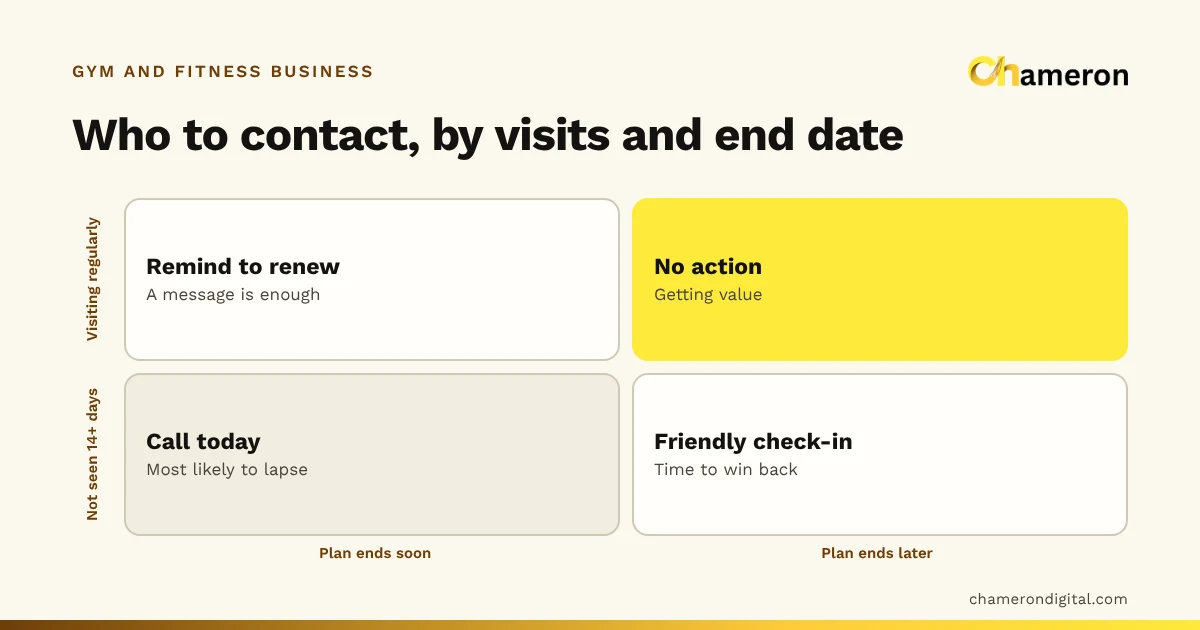
Attendance becomes most useful when combined with the plan end date. Together they sort members into four groups, each needing a different action.
| Plan ends within 30 days | Plan ends later | |
|---|---|---|
| Visiting regularly | Renewal reminder; a message is usually enough | No action needed |
| Not seen for 14+ days | Call today: the most likely to lapse | A friendly check-in: ask if anything is wrong |
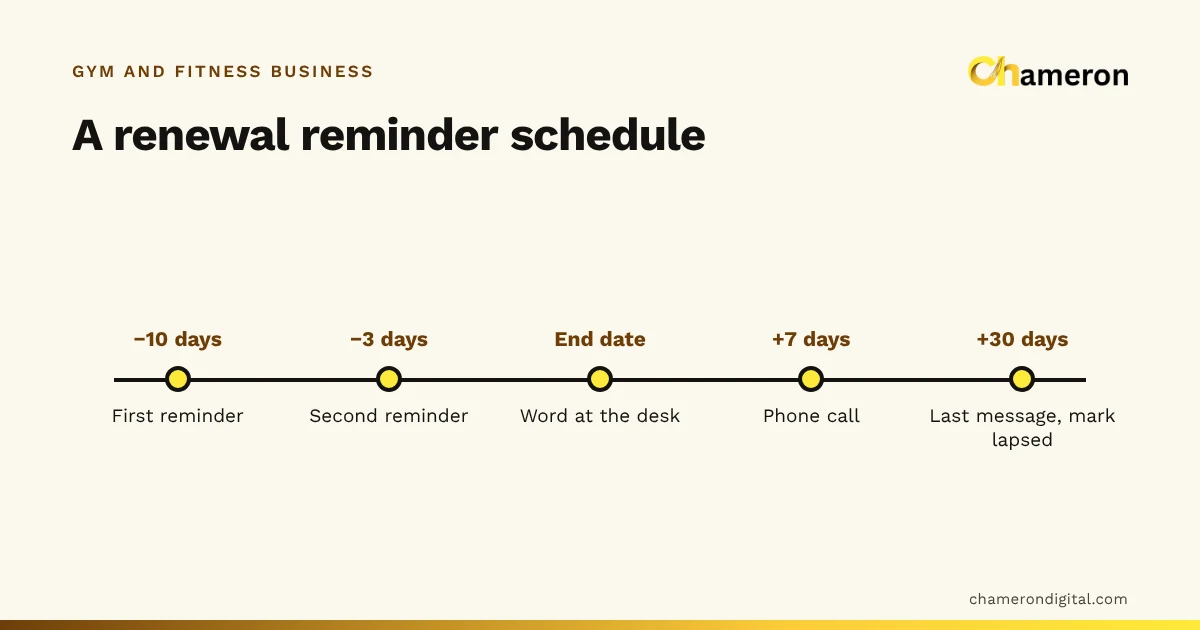
The bottom row is where attendance tracking earns its keep. A member who stopped coming because of timings, an injury or a busy month at work can often be helped: a different batch, a freeze instead of a lapse, or a short session with a trainer to restart. Our guide to tracking renewals sets out the reminder schedule for the top-left group.
Each month, compare how many members from the “not seen” list came back after a call. It is a simple way to judge whether the calls are worth the time, and it feeds directly into your churn rate. Lower churn is worth real money; the gym membership revenue calculator shows how much.
Using attendance for staffing and trainers
Hourly check-ins are the basis for practical decisions:
- Front desk: two people during the morning and evening peaks, one in quiet hours.
- Trainers on the floor: schedule general-floor trainers for the busiest hours, and offer personal training slots in quieter ones.
- Cleaning and maintenance: plan them for the quietest hour, not the most convenient one for staff.
- Plan design: if afternoons are consistently quiet, an off-peak plan might fill them, but only if the desk can enforce the timing.
Respect privacy
Attendance shows when a person is and is not at a particular place, so treat it as personal data.
- Record only what you use: date and time of check-in is usually enough.
- Limit access: front desk and managers, and trainers only for their own clients.
- Tell members what you record and why, for example at joining.
- Keep records secure and backed up, and follow the data protection law that applies to your business; ask your adviser if you are unsure. Our backup checklist applies to gym records too.
Common mistakes
- Recording check-ins but never reading them. The value is in the weekly “not seen” list, not the register.
- Counting visits, not members. A busy gym can hide many absent members behind a few very regular ones.
- Calling only after the plan ends. By then the member has usually decided. Call while there is time left on the plan.
- Letting the evening shift skip check-ins. Incomplete records make the “not seen” list wrong, and staff will stop trusting it.
- Collecting more than you need. Extra personal details add risk without helping any decision.
Doing it in software
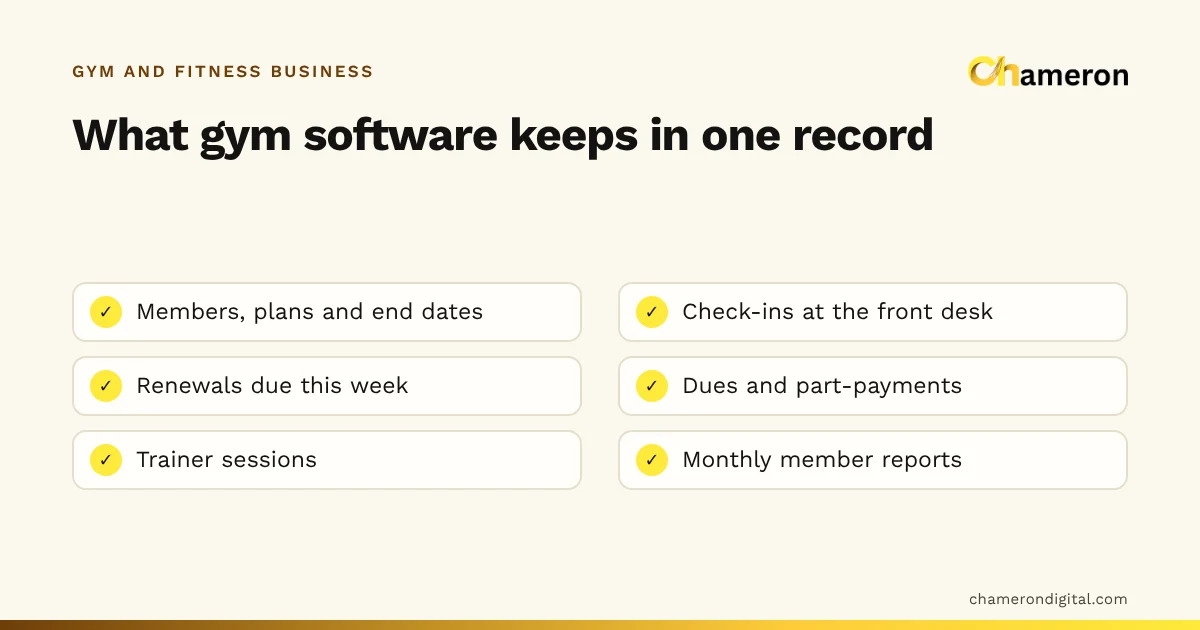
A register or spreadsheet can record attendance; the hard part is turning it into weekly lists. Software that stores each check-in against the member record can produce the “not seen for 14 days” list and hourly counts without anyone reading through pages. Our explainer on gym management software covers what to look for. GYM OS, Chameron Digital’s product for check-ins, memberships, renewals and dues at the gym front desk, is not yet generally available; you can ask about availability on its page.
The bottom line
Attendance tracking is not about policing members; it is about noticing them. Keep check-ins quick and tied to each member’s record, watch four simple numbers, and act every week on the list of members who have stopped coming while there is still time on their plan. That one habit does more for renewals than almost anything else the front desk can do. For the wider picture of running a gym front desk, see our page for gyms and fitness centres.
Questions people ask
Why should a gym track attendance if members have already paid?
Because members who stop coming rarely renew. Attendance shows who is drifting away while there is still time on their plan, and it confirms that the person training is an active member. It also shows your busiest hours for staffing.
How many days without a visit should trigger a call?
Fourteen days is a sensible starting point for members who usually come several times a week. Adjust it for your gym: a member on a three-days-a-week routine who misses a week is already worth a friendly message.
Is a paper register good enough?
For recording who came in, often yes. The problem is using it afterwards: finding everyone who has not visited for two weeks means reading pages of handwriting. If you keep a register, copy the totals into a sheet each week, or move to a system that keeps check-ins against each member’s record.
Should trainers see attendance data?
Trainers can usefully see attendance for their own personal training clients and for members they look after. Keep wider access to the people who need it, such as the manager and front desk.