The short answer
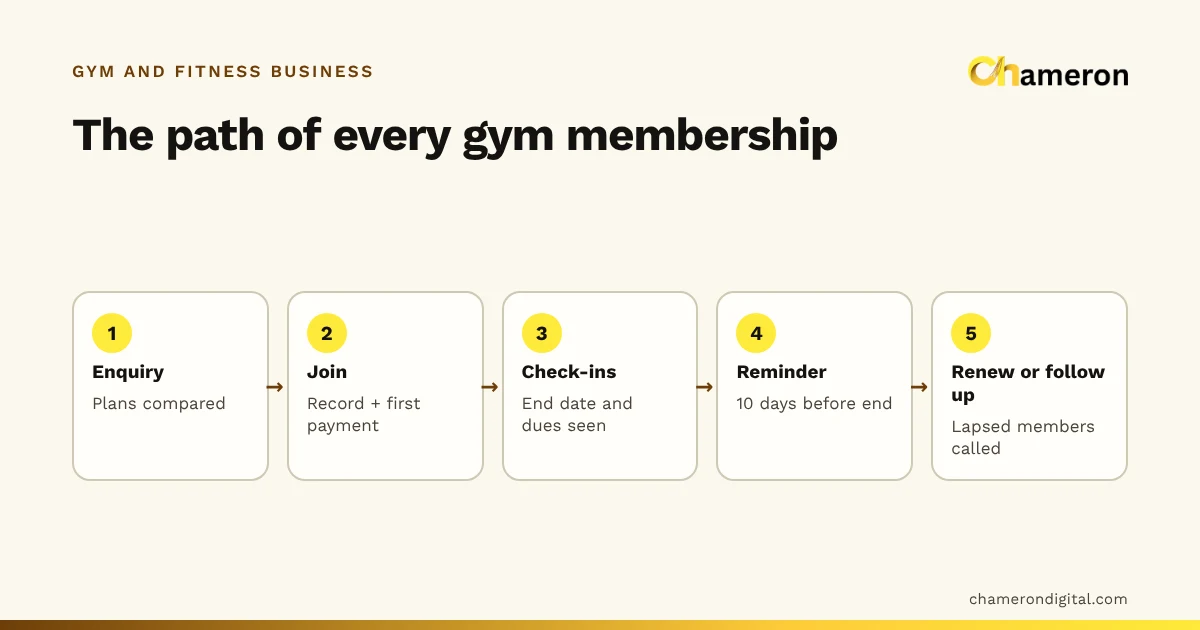
To track gym membership renewals, keep every member’s plan end date in one sortable list, check it every week for plans ending in the next ten days, and follow a fixed reminder schedule for each one. Combine the list with attendance and dues, so members who have stopped coming or owe money get a personal call. Then measure one number each month, the renewal rate, and record why people did not renew.
Build one renewal list
Every renewal starts with an end date. If end dates live on joining forms, membership cards or a trainer’s notebook, they will be found too late. Put them in one list that can be sorted by date.
| Column | Example | Why it is there |
|---|---|---|
| Member | Priya S., 98XXXXXX21 | To find and contact them |
| Plan | Quarterly | Tells you the renewal amount |
| End date | 18 Oct 2026 | Sorts the list |
| Balance due | ₹0 or ₹1,500 | Settle dues before or with the renewal |
| Last check-in | 15 Oct 2026 | Shows whether they are still coming |
| Reminder stage | 10-day sent | Stops two staff calling the same person |
| Outcome | Renewed / Lapsed / Frozen | Feeds the monthly count |
| Reason (if lapsed) | Moved city | Tells you what to fix |
The membership renewal tracker template has these columns ready. If you already keep member records properly, as described in how to manage gym memberships, this list is simply a filtered view of them.
Follow a fixed reminder schedule
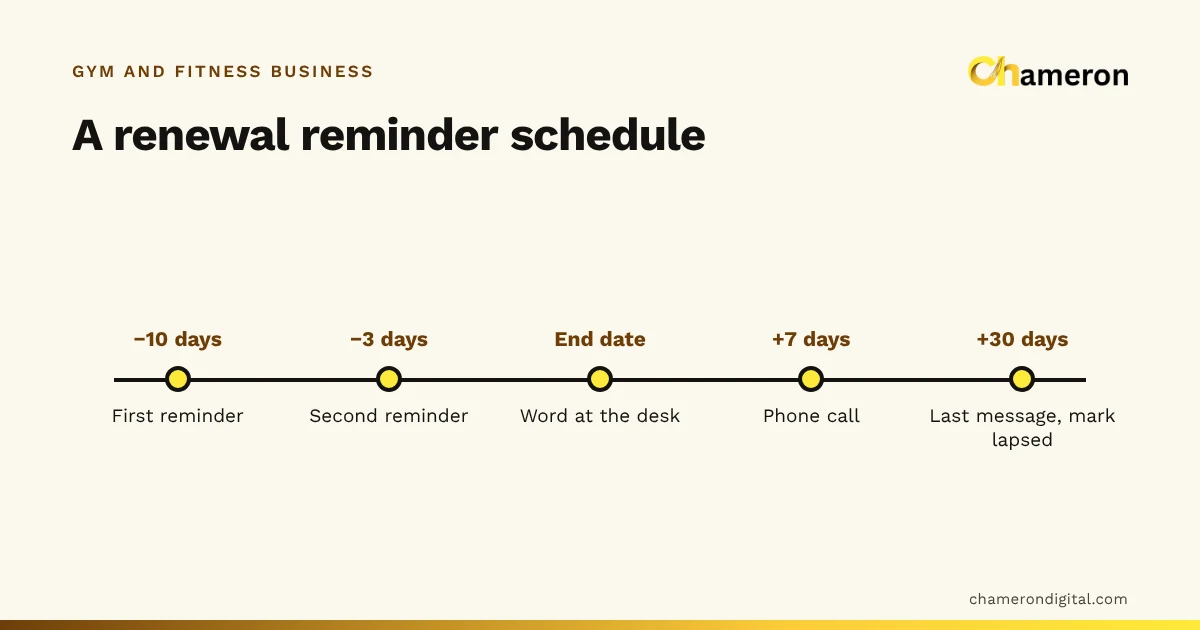
Reminders work best when they are routine rather than personal judgement. Apply the same schedule to every member, so nobody is forgotten and nobody is chased twice in a day.
| When | What | Who |
|---|---|---|
| 10 days before end date | Short message: plan ends on [date], renewal amount, how to pay | Front desk |
| 3 days before | Second message, or a word at the desk if they visit | Front desk |
| On the end date | Mention at check-in; offer to renew there and then | Front desk |
| 7 days after | A phone call: ask if anything is stopping them | Manager or trainer |
| 30 days after | One last friendly message; then mark as lapsed | Front desk |
Ten days gives members time to plan the payment, especially for a quarterly or annual plan. Stopping after thirty days keeps the gym respectful, and lapsed members who were treated well are the easiest to welcome back later.
Combine end dates with attendance and dues
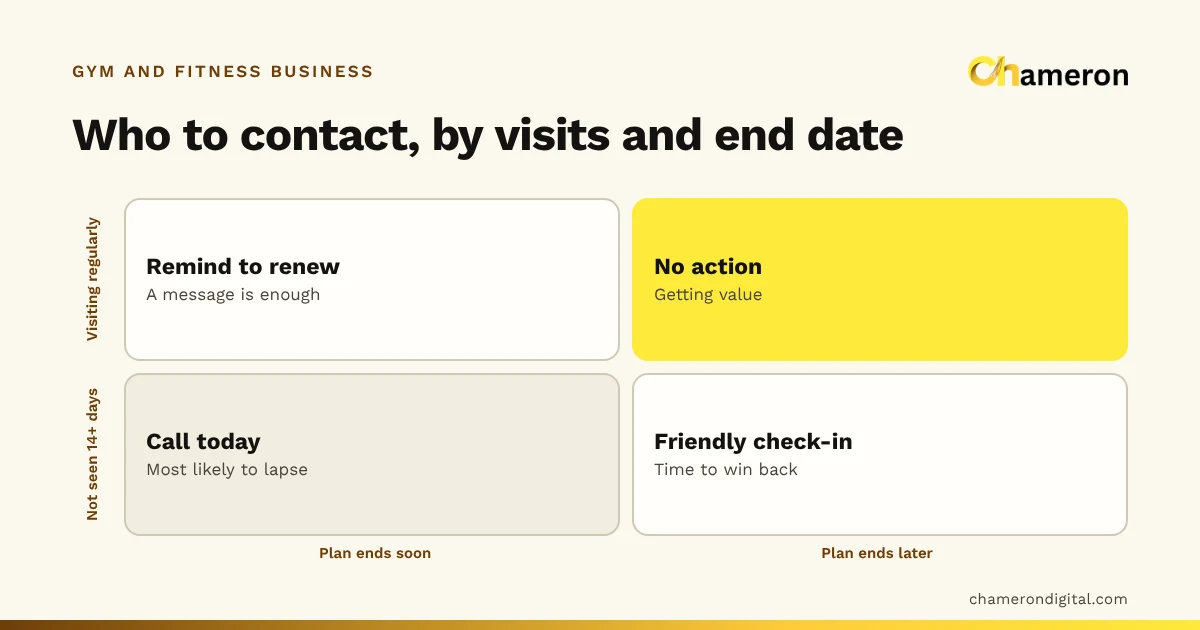
An end date tells you when to remind someone. Attendance and dues tell you how.
- Regular visitor, nothing owed: a message is usually enough. They intend to renew.
- Regular visitor, balance due: settle the balance with the renewal, at the desk, in person.
- Stopped visiting: a message alone rarely works. Call before the plan ends, not after; the reason they stopped is the reason they will not renew.
- Stopped visiting and owes money: the most likely to lapse. A call from the manager or their trainer is worth it.
Members who stop coming rarely renew, so the weekly list of absent members described in our guide to gym attendance tracking is effectively an early renewal list. A member who has not checked in for two weeks with a month left on their plan still has time to be won back.
Measure your renewal rate each month
One number tells you whether the system is working.
Track the on-time and late renewals separately. If many renew only after the 7-day call, your earlier reminders are not landing; try a different time of day or a different message.
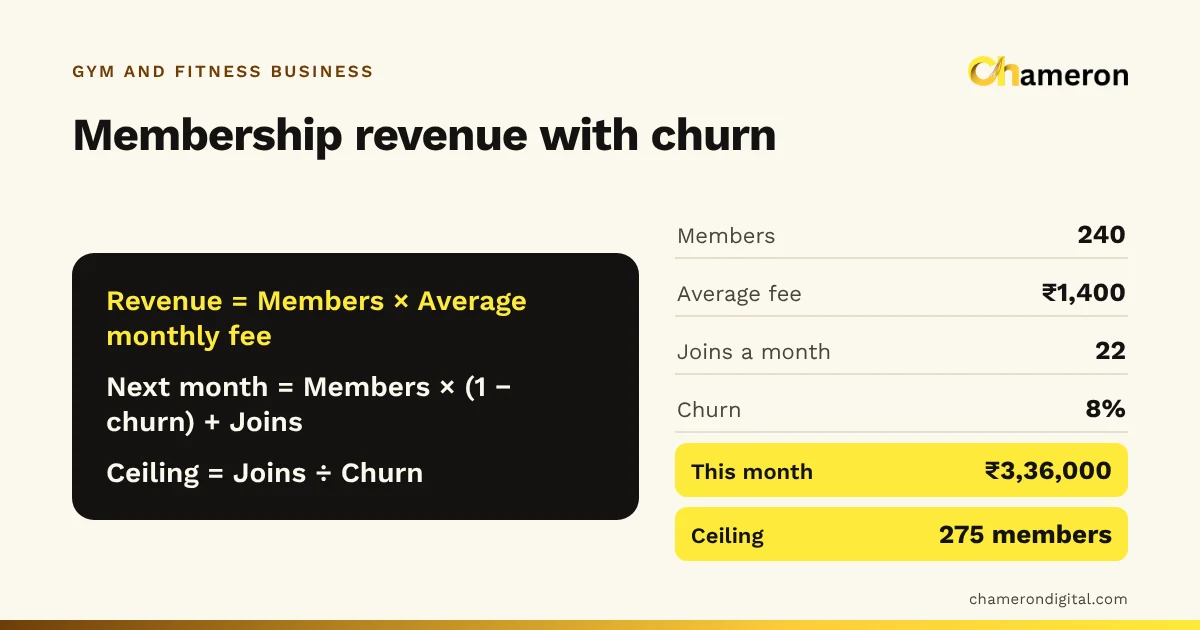
Renewal rate is closely related to churn rate, but not the same: churn compares leavers with your whole membership. Both feed into what the gym earns, and the gym membership revenue calculator shows how even a small change in the share of members leaving each month changes a year’s revenue. Our guide on calculating membership revenue works through an example.
Record why members do not renew
The “reason” column is the most useful part of the list after a few months. Keep the reasons short and from a fixed set, so they can be counted:
| Reason | What it might tell you |
|---|---|
| Moved away or changed job | Nothing to fix; keep in touch |
| Timings do not suit | Consider batch or off-peak options |
| Too crowded at peak hours | Look at evening equipment and staffing |
| Price | Check whether a longer plan’s monthly price would help |
| Lost motivation | Trainer check-ins in the first months may help |
| Health or injury | Offer a freeze next time rather than a lapse |
If one reason dominates over a quarter, it is worth acting on. If the reasons are scattered, focus on the reminder schedule instead.
Common mistakes
- Looking at end dates only on the day. By then the member has already decided. Start ten days ahead.
- Several staff chasing the same member. Record the reminder stage so everyone knows what has been sent.
- Counting frozen members as lapsed. They are paused. Keep them out of both the plans due and the renewals.
- Renewing without settling dues. A balance carried over a renewal is rarely collected later.
- Chasing for months. Two messages, a call and a final note are enough. Beyond that, it damages goodwill.
- Not recording reasons. Without them, you only know how many left, not why.
Doing it in software
A spreadsheet handles this well for a small gym if one person owns it. Once several staff take payments and check members in, a system that builds the “ending soon”, “owing money” and “not seen lately” lists from the same member records saves time and avoids double calls; our explainer on gym management software describes the category. GYM OS is Chameron Digital’s product for memberships, renewals, check-ins and dues at the gym front desk. It is not yet generally available, so ask about availability on its page.
The bottom line
Renewals are not won on the end date; they are won in the ten days before it and lost in the weeks of absence that come earlier. Keep one end-date list, apply the same reminder schedule to everyone, use attendance and dues to decide who needs a call, and measure your renewal rate every month. For more on running the front desk, see our page for gyms and fitness centres.
Questions people ask
When should a gym send a renewal reminder?
About ten days before the end date works for most members, because it gives them time to plan the payment. Follow up three days before, mention it at the desk on the last visit, and make one call a week after the plan ends. A final friendly message a month later is enough; more starts to feel like pressure.
What is the difference between renewal rate and churn rate?
Renewal rate looks only at plans that ended in a month and asks what share renewed. Churn rate looks at all members at the start of the month and asks what share left. A gym with many annual members can have a low churn rate and still a poor renewal rate on the few plans that ended. See what churn rate means for a gym.
Should a renewal start from the old end date or the payment date?
Either can work if it is applied consistently. Starting from the old end date keeps the calendar tidy and does not reward late payment. Starting from the payment date is kinder to members who were away. Write the rule down so every staff member applies it the same way.
How should a gym contact members about renewals?
Use whatever the member prefers: a call, a text message or a word at the desk. Ask at joining how they would like to be contacted and note it on their record. Keep reminders short and polite, send them from the gym’s own number, and stop if a member asks you to.