The short answer
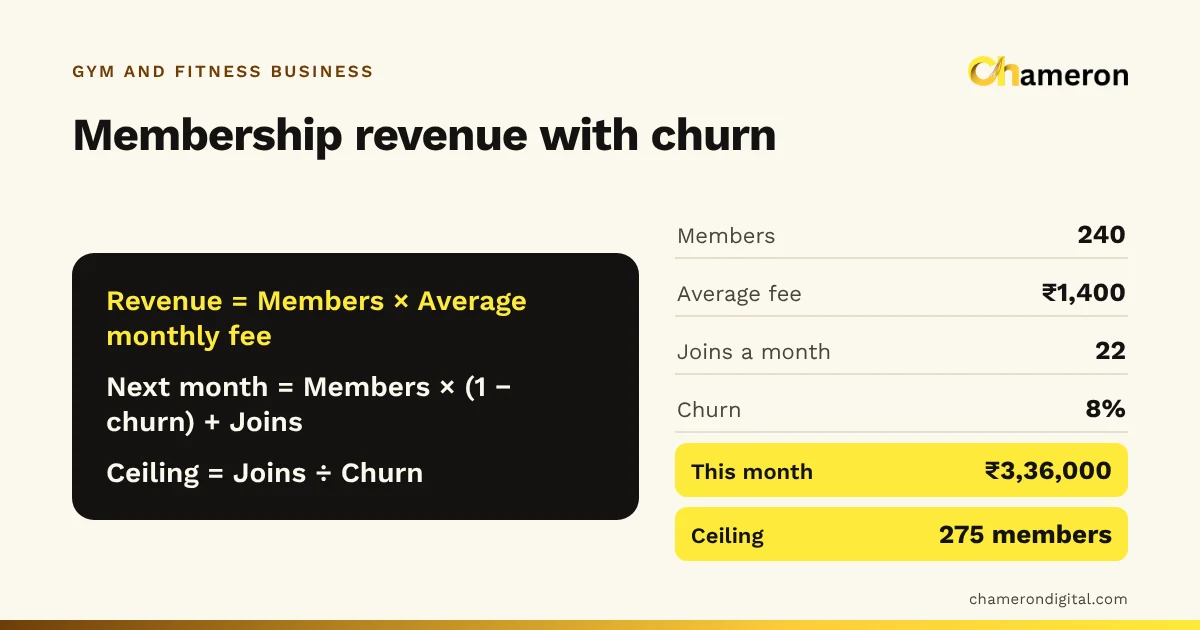
Gym membership revenue for a month is the number of active members multiplied by the average monthly fee. Because members join and leave every month, project it forward with one more step: next month’s members = this month’s members × (1 − churn rate) + new joins. Membership stops growing at joins ÷ churn rate, so your churn sets the ceiling on what the gym can earn.
The core formulas
Three formulas cover almost everything you need.
Churn rate is the share of members at the start of a month whose membership ends without renewal during that month. If 240 members start the month and 19 leave, churn is 19 ÷ 240 = 7.9%. Our short page on gym churn rate covers how to count it, and the glossary entry on churn gives the general definition.
Step 1: Find your average monthly fee
Most gyms sell monthly, quarterly and annual plans at different prices. To get one average, convert each plan to a monthly figure first.
| Plan | Price | Monthly equivalent | Members | Monthly revenue |
|---|---|---|---|---|
| Monthly | ₹1,600 | ₹1,600 | 120 | ₹1,92,000 |
| Quarterly | ₹4,200 | ₹1,400 | 60 | ₹84,000 |
| Annual | ₹12,000 | ₹1,000 | 60 | ₹60,000 |
| Total | 240 | ₹3,36,000 |
Average monthly fee = ₹3,36,000 ÷ 240 = ₹1,400. That ₹3,36,000 is the gym’s membership revenue for the month.
Use the prices members actually paid. If a third of your quarterly members joined during an offer at ₹3,600, their monthly equivalent is ₹1,200, not ₹1,400, and the average falls.
Step 2: Separate cash from revenue
This is where many gym owners misread a good or bad month. When a member pays ₹12,000 for an annual plan, the cash arrives in one day, but the gym earns it over twelve months.
| Month | Cash received from this member | Revenue earned |
|---|---|---|
| October (pays annual plan) | ₹12,000 | ₹1,000 |
| November to September | ₹0 each month | ₹1,000 each month |
| Year | ₹12,000 | ₹12,000 |
A month with many annual renewals looks wonderful in the cash book and may hide a shrinking membership. A month with few looks poor even if membership is growing. Track both: cash for paying rent and salaries, revenue for understanding whether the gym is healthier than last month. Our guide on tracking sales and expenses covers the habit of keeping the two apart.
Step 3: Project the year with joins and churn
Now add movement. Suppose the gym above gets 22 new members a month and 8% of members leave each month.
| Month | Calculation | Members | Membership revenue |
|---|---|---|---|
| 1 | Starting point | 240.0 | ₹3,36,000 |
| 2 | 240 × 0.92 + 22 | 242.8 | ₹3,39,920 |
| 3 | 242.8 × 0.92 + 22 | 245.4 | ₹3,43,526 |
| 12 | (repeated each month) | 261.0 | ₹3,65,418 |
Over twelve months, membership revenue totals about ₹42,32,696. Growth is slowing every month: 2.8 members added in month 2, about 1.2 by month 12. The member counts are averages, so decimals are fine; you cannot have 0.8 of a member, but you can project one.
Why growth slows: the ceiling
Each month, 8% of a bigger base leaves. At some point the leavers equal the joiners, and membership stops growing.
At ₹1,400 a member, that ceiling is ₹3,85,000 a month. However hard the gym advertises, with these numbers it cannot go far past that point without changing joins or churn.
Step 4: See what lower churn is worth
Run the same gym with churn cut from 8% to 6%, perhaps through better renewal tracking and follow-up of members who stop visiting.
| 8% churn | 6% churn | Difference | |
|---|---|---|---|
| Members after 12 months | 261.0 | 302.5 | +41.5 |
| Revenue in month 12 | ₹3,65,418 | ₹4,23,550 | +₹58,132 |
| Revenue over 12 months | ₹42,32,696 | ₹46,11,053 | +₹3,78,357 |
| Ceiling (22 ÷ churn) | 275 | 366.7 | +91.7 |
Same joins, same fees, about ₹3.78 lakh more over the year. This is why renewals usually matter more to a gym’s income than a short burst of new joins. You can try your own figures in the gym membership revenue calculator, which runs exactly this month-by-month projection.
A quick sense of member value
A rough rule: the average membership lasts about 1 ÷ churn rate months. At 8% that is 12.5 months, worth about ₹17,500 at ₹1,400 a month. At 6% it is about 16.7 months, worth about ₹23,333. Treat this as a rule of thumb, not a precise figure, but it helps when deciding how much a joining offer can sensibly cost.
Step 5: Add other income separately
Membership is only part of a gym’s income. Keep the other streams as separate lines so each can be judged on its own.
| Income line | Example this month | Amount |
|---|---|---|
| Membership revenue | 240 members × ₹1,400 | ₹3,36,000 |
| Personal training | 18 clients × ₹6,000 package | ₹1,08,000 |
| Joining fees | 22 joins × ₹1,000 | ₹22,000 |
| Total | ₹4,66,000 |
Joining fees rise and fall with new members, so do not mix them into the average monthly fee. Personal training depends on trainers’ time and their share, so judge it on what is left after paying trainers. If you want to know whether the whole operation covers rent, salaries and equipment, the guide to calculating the break-even point shows how.
Common mistakes
- Counting annual plans as revenue in the month paid. It flatters that month and hides the trend.
- Using list prices. Discounts, offers and free months lower the real average fee.
- Counting frozen members as leavers. They will return; counting them inflates churn. Count them as neither active nor lapsed while paused.
- Measuring churn against the end-of-month count. Divide by members at the start of the month, before new joins are added.
- Mixing personal training and joining fees into membership revenue. You lose sight of which part is growing.
- Planning on joins alone. As the ceiling formula shows, extra joins without lower churn only raise the ceiling slowly.
The bottom line
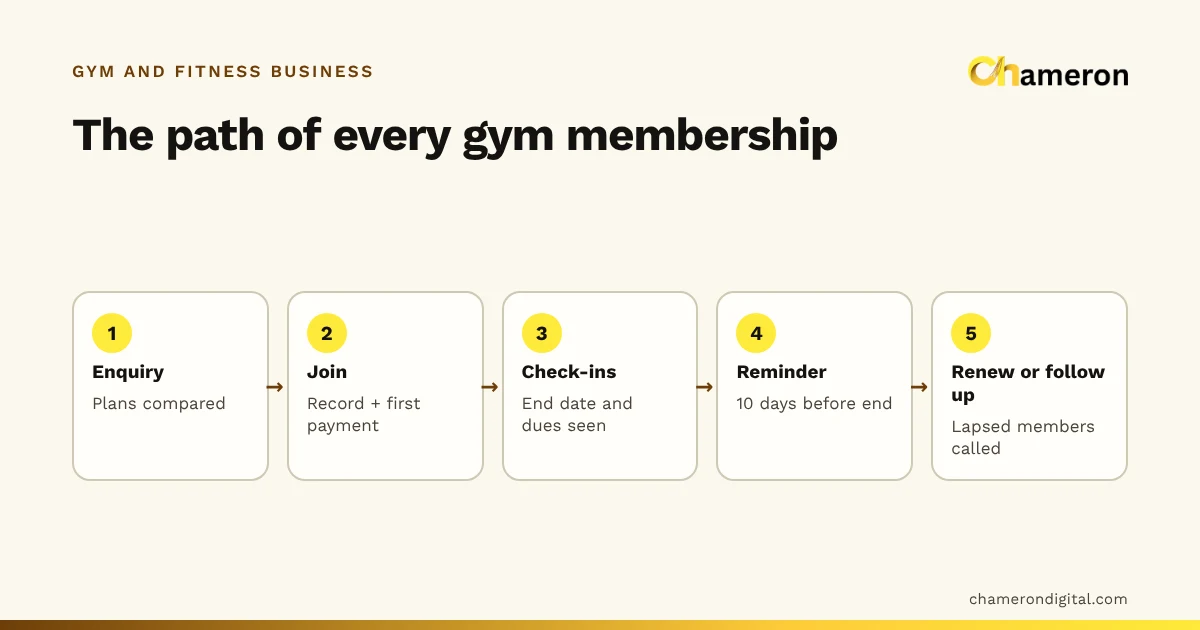
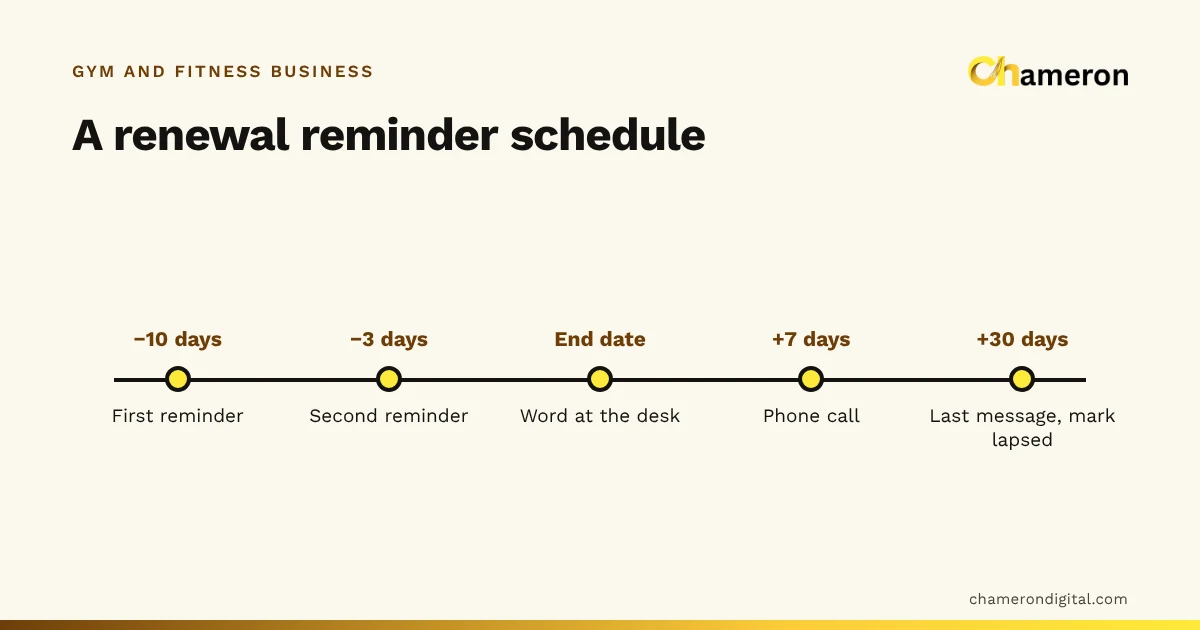
Membership revenue is simple multiplication; the skill is in getting the inputs right and watching how they move. Convert every plan to a monthly figure, keep cash and revenue apart, and project forward with joins and churn. The ceiling, joins ÷ churn, tells you how far the current numbers can take the gym, and why keeping members is usually the cheapest way to grow. For the routines that keep churn down, see how to manage gym memberships. GYM OS, our product for gym memberships, renewals and dues, is not yet generally available; you can ask about availability.
Questions people ask
What is a good churn rate for a gym?
There is no single right figure; it depends on your plans, location and members. What matters is your own trend and the ceiling it implies. Divide your monthly joins by your churn rate: if that ceiling is below your current members, the gym is shrinking even if it feels busy.
Should annual plans be counted as revenue in the month they are paid?
For understanding how the gym is doing, no. Spread the plan across its months: a ₹12,000 annual plan is ₹1,000 a month. Track the cash separately, because it arrives up front. For tax and accounts, follow your accountant’s advice on how to record advance payments.
Why does the member count stop growing even with steady joins?
Because leavers are a percentage of a growing base. With 22 joins a month and 8% churn, the number of people leaving rises as membership grows, until about 275 members, where 22 leave each month and 22 join. To go higher you must either raise joins or reduce churn.
How do I find my average monthly fee?
Convert every active plan to its monthly price (plan price ÷ months), add them up and divide by the number of active members. Use the price members actually paid after discounts, not the list price.
Can I use this to set a monthly target?
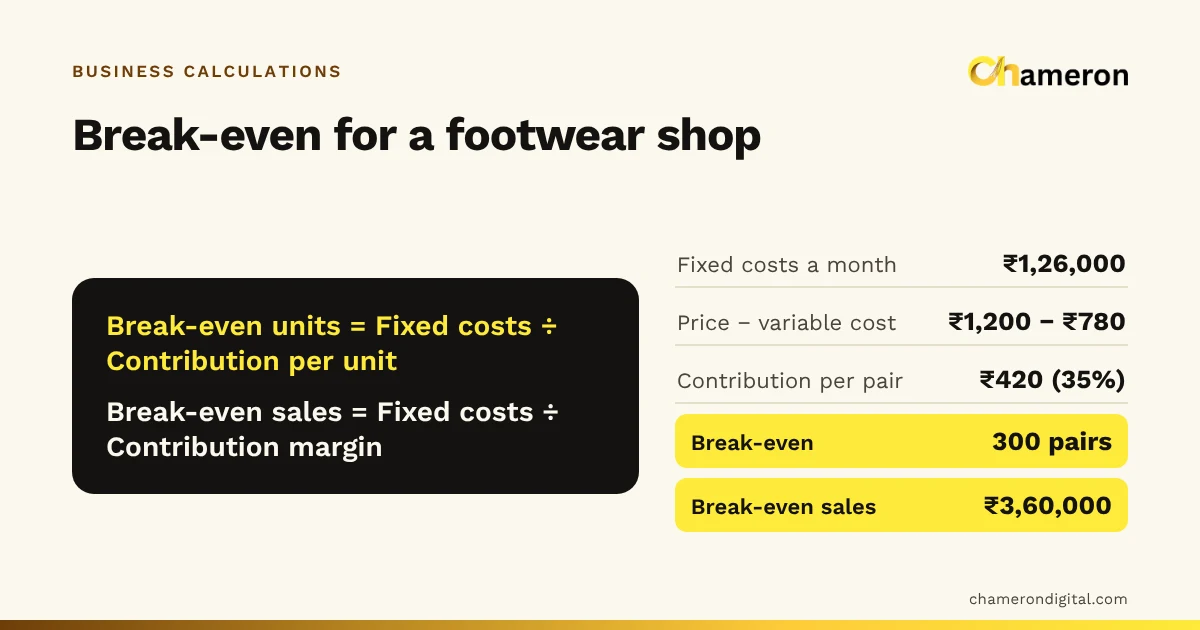
Yes. Once you know your fixed costs, the break-even calculator shows how many members you need, and the sales target calculator turns a revenue goal into a monthly figure.