The short answer
SKU management is the practice of giving every distinct item you sell its own code and record, and then managing those records for as long as the item exists. That means creating each SKU with complete data, tracking stock and sales against it, reviewing how it performs and retiring it cleanly when it stops earning its place. Choosing a good code pattern is only the first step, covered in our SKU naming guide. This guide covers everything that happens after.
What counts as one SKU
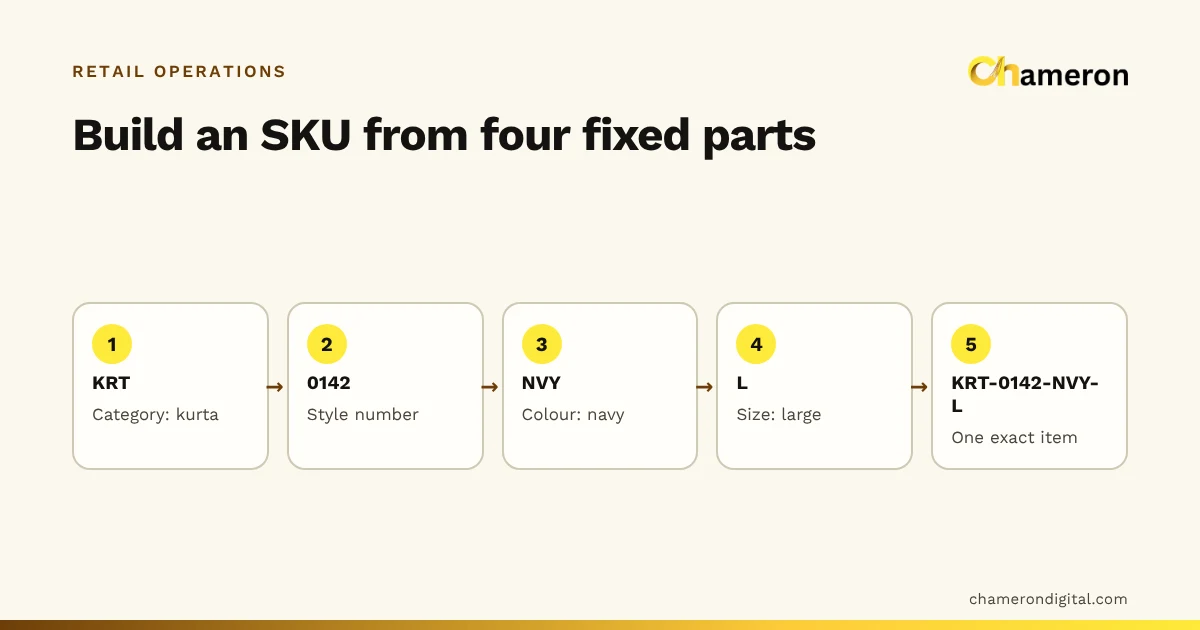
SKU stands for stock keeping unit: the smallest unit you stock, count and reorder as one thing. The test is simple. If a customer would care about the difference, or you would reorder it separately, it is a separate SKU.
| Situation | Separate SKUs? | Why |
|---|---|---|
| A shirt in sizes M and L | Yes | Customers choose a size; each size runs out separately |
| A shampoo in 180 ml and 340 ml bottles | Yes | Different price, different shelf, different reorder |
| A pack of 6 sold alongside single pieces | Yes | Sold and counted as a different unit |
| The same notebook bought from two distributors | Usually no | Same item to the customer; record the supplier on the purchase |
| A gift-wrapped version of the same item | Usually no | Wrapping is a service, unless you stock pre-wrapped items |
Variants multiply quickly. A footwear shop that stocks one running shoe style in 3 colours and 6 sizes holds 3 × 6 = 18 SKUs. Ten such styles is 180 SKUs, each with its own stock level. That is not a problem in itself, but it is why SKU management needs a method. Our guide to size and colour variants goes deeper into setting them up.
SKU, barcode, HSN and item name
These four are often confused because they all identify a product in some way.
| Identifier | Who sets it | What it is for |
|---|---|---|
| SKU | You | Your internal code for one stockable item |
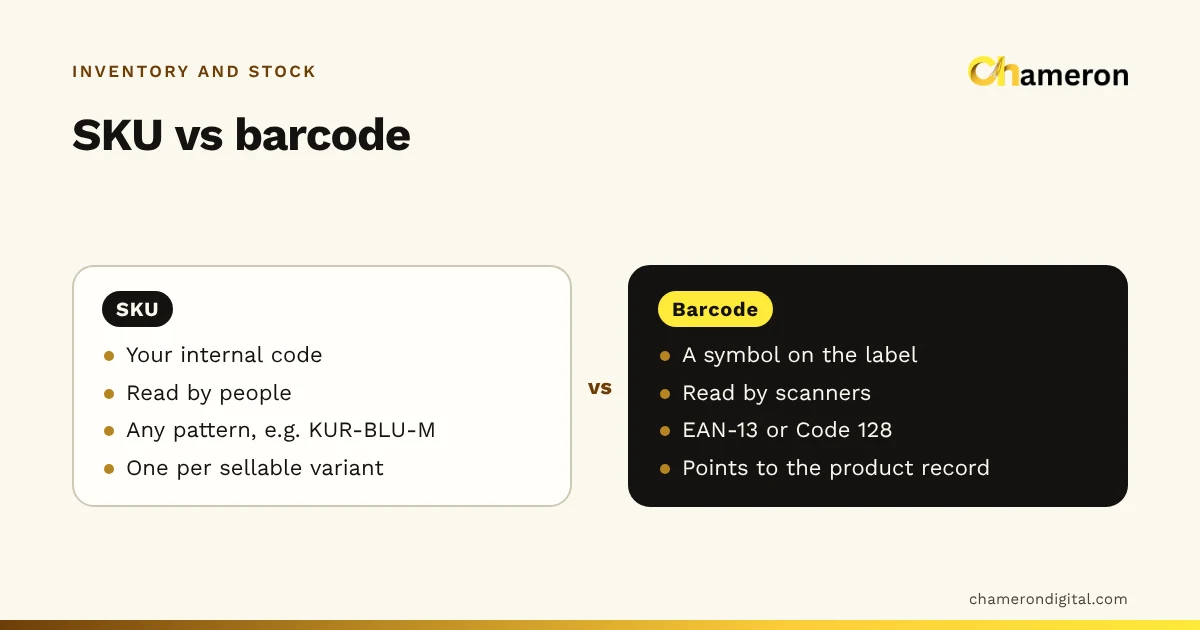
| Barcode | The manufacturer, or you | Lets a scanner find the SKU at the counter |
| HSN code | The tax classification system | Classifies goods for GST; many SKUs share one HSN |
| Item name | You | What staff and customers read on the bill |
A useful way to think about it: the SKU is the record, the barcode is the fast way to reach it, the HSN code is for tax reporting and the name is for people. Check the correct HSN code and GST rate for your goods with your accountant or the official GST portal.
The SKU lifecycle
1. Create it with complete data
Most SKU problems start when an item is created in a hurry at the counter. Decide in advance what every new SKU must have:
- SKU code and item name
- Category, plus size and colour where they apply
- Unit of sale (piece, pack, box, kg) and pack size from the supplier
- Cost price and selling price, both before GST
- HSN code and GST rate, as confirmed with your accountant
- Main supplier
- Reorder level for items you never want to run out of
A SKU planning worksheet helps when you add a new range at once.
2. Label and shelve it
Give every unit a scannable label before it reaches the shelf, and give the SKU one home location. An SKU that lives in three places gets counted in two.
3. Track stock and sales against it
From now on, every sale, return, delivery and adjustment is recorded against the SKU, never against a similar item "because it is the same price". Substituting codes makes two records wrong at once.
4. Review it
Look at each SKU's sales, margin and stock regularly (see the next section).
5. Retire it
When you stop stocking an item, sell or return the remaining units, mark the SKU inactive and keep its history. Never reuse the code for a new product.
Reviewing SKU performance
A review answers one question per SKU: does this item deserve its shelf space and the money tied up in it? Two measures do most of the work: how fast it sells and how much margin it earns.
Here is a 90-day review for four SKUs in the footwear shop. For this shop, "fast" means more than 30 pairs in 90 days and "high margin" means 30% or more.
| SKU | Pairs sold (90 days) | Margin | Stock on hand | Days of cover | Action |
|---|---|---|---|---|---|
| RUN-BLK-08 | 54 | 38% | 12 | 20 | Protect |
| RUN-BLU-11 | 4 | 40% | 9 | 203 | Promote |
| SLP-GRY-07 | 61 | 14% | 30 | 44 | Reprice |
| FRM-BRN-10 | 2 | 15% | 14 | 630 | Clear |
For example, RUN-BLK-08 sells 54 ÷ 90 = 0.6 pairs a day, so 12 pairs last 12 ÷ 0.6 = 20 days. FRM-BRN-10 sells 2 pairs in 90 days, so its 14 pairs would take about 630 days to sell. That is money that will sit on the shelf for nearly two years.
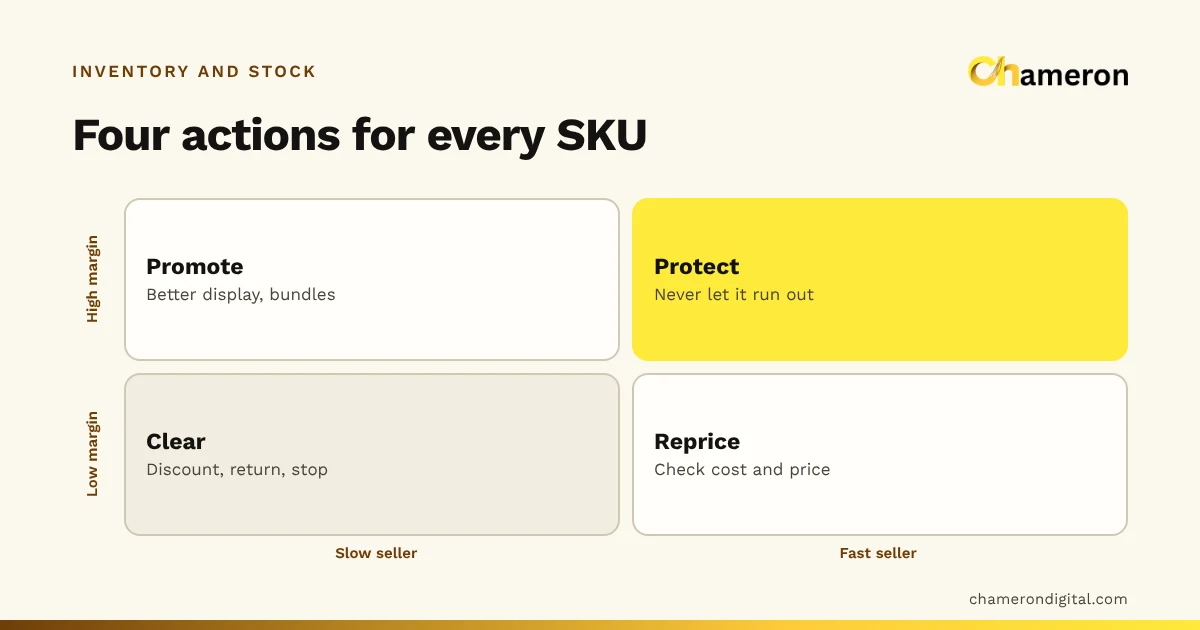
The four actions come from a simple grid:
| Slow seller | Fast seller | |
|---|---|---|
| High margin | Promote: better display, bundle, staff push | Protect: never let it run out |
| Low margin | Clear: discount, return or stop buying | Reprice: check cost, price or supplier |
Work out margins on prices before GST; the margin and markup calculator helps if you are unsure which percentage you are looking at. For the shop as a whole, the inventory turnover calculator shows how fast stock moves overall.
How many SKUs should a shop carry?
Every SKU has a cost even before it sells:
- Shelf space that another item could use
- Money tied up in its opening stock, often a full minimum order
- Counting time at every stock count
- Risk of becoming dead stock
That does not mean fewer is always better. A shop known for range needs depth. But each SKU should have a reason to exist. Two habits help:
- Create only the variants you will stock. If you never sell a women's style in size 12, do not create that SKU just because the size chart has it.
- One in, one out for crowded categories. When a new item joins a full shelf, the slowest SKU in that category is reviewed for clearance.
Keeping SKU data clean
SKU data decays unless someone looks after it. The most common problems are:
- Duplicates: the same item created twice with different codes, so stock is split between them.
- Mixed units: one delivery entered as boxes and the next as pieces.
- Missing cost prices: margin reports become meaningless.
- Shared barcodes: one code on two products, so the scanner finds the wrong one.
Fix duplicates by moving stock and history onto one SKU and retiring the other. Check a sample of SKUs at every stock count, not only the quantity on the shelf.
Software helps by refusing the worst errors. In BILL OS, SKUs are created automatically and never repeated within a business, each size and colour variant gets its own SKU, barcode and price, and a scan of a code used on two products asks you to fix it rather than guessing. The details are on the SKUs, barcodes and labels page.
Common mistakes
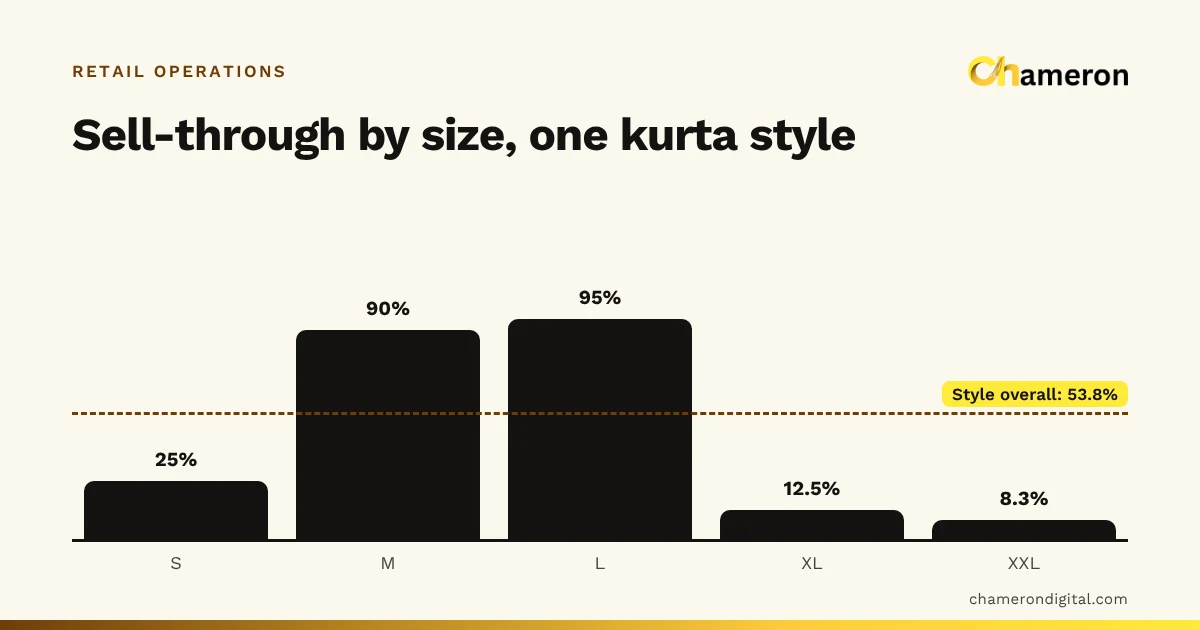
- One SKU for several sizes. Stock looks fine in total while the popular size has sold out.
- Creating SKUs at the counter. Items made in a rush lack cost, category and tax details.
- Reusing old codes. History from two products gets mixed in every report.
- Never retiring anything. Inactive SKUs clutter searches, counts and reorder lists.
- Reviewing totals instead of SKUs. A category can look healthy while half its SKUs have not sold in months.
The bottom line
SKU management turns a product list into something you can run a shop with. Decide what counts as one SKU, create each with complete data, record every movement against it, review it by speed and margin, and retire it cleanly. Start by naming codes well with the SKU naming guide, then put the 90-day review on your calendar.
Questions people ask
Is an SKU the same as a barcode?
No. The SKU is your internal code for an item; the barcode is a machine-readable label that a scanner reads. One SKU usually has one barcode, which may be the manufacturer's code or one you print in the shop. The barcode inventory guide explains how they work together.
Should I use the manufacturer's product code as my SKU?
You can keep the manufacturer's barcode for scanning, but give the item your own SKU as well. Your SKU stays consistent across suppliers and can carry information that suits your shop, such as category, colour and size.
How many SKUs is too many?
There is no fixed number. You have too many when slow SKUs crowd the shelves, counts take longer than you can manage, and money is tied up in items that rarely sell. A quarterly review that clears the slowest SKUs keeps the range in check.
If I open a second store, do I need new SKUs?
No. The same item should keep the same SKU in every store, with stock recorded per store. That way you can compare stores and transfer stock without confusion.
Can I reuse the SKU of a discontinued item?
No. Old bills, returns and reports still refer to that code. Reusing it mixes the history of two different products. Mark the SKU inactive and create a new one.