The short answer
To improve restaurant operational efficiency, measure a few numbers first, find the single step that slows every service, and fix that before anything else. Track how long tickets take, how many times tables turn, sales per labour hour, food cost and waste. Then work through five areas in order: the menu, prep, kitchen flow, tables and front of house, and staffing. Efficiency is not about rushing guests or cutting people; it is about removing the waiting, rework and waste that nobody enjoys.
Measure first: five numbers
Without numbers, every fix is a guess. These five cover most of what matters, and each can be worked out on paper or from software reports.
| Number | How to work it out | What it shows |
|---|---|---|
| Ticket time | Time from order to "ready" at the pass | Kitchen speed, by station and dish |
| Table turns | Parties seated ÷ number of tables, per service | How well the dining room is used |
| Sales per labour hour | Service sales ÷ total staff hours worked | Whether staffing matches demand |
| Food cost % | Ingredients used ÷ food sales × 100 | Purchasing, portioning and waste together |
| Waste value | Total of the waste log at cost | Overproduction, spoilage and returns |
Measure for two weeks before changing anything, and keep lunch and dinner separate. Averages across the whole day hide the rush, which is where most problems live. For the wider set of business figures worth watching, see business numbers to track.
Worked example: a 15-table restaurant
| Measure | Lunch | Dinner |
|---|---|---|
| Sales | ₹18,000 | ₹48,000 |
| Staff on shift × hours | 8 × 4 = 32 | 8 × 5 = 40 |
| Sales per labour hour | ₹562.50 | ₹1,200 |
| Parties seated | 24 | 36 |
| Table turns (15 tables) | 1.6 | 2.4 |
The same team is on both services, but lunch earns less than half as much per hour worked. That does not mean lunch is bad; it means lunch is staffed for a dinner it is not getting. We come back to this in the staffing section.
Find the bottleneck
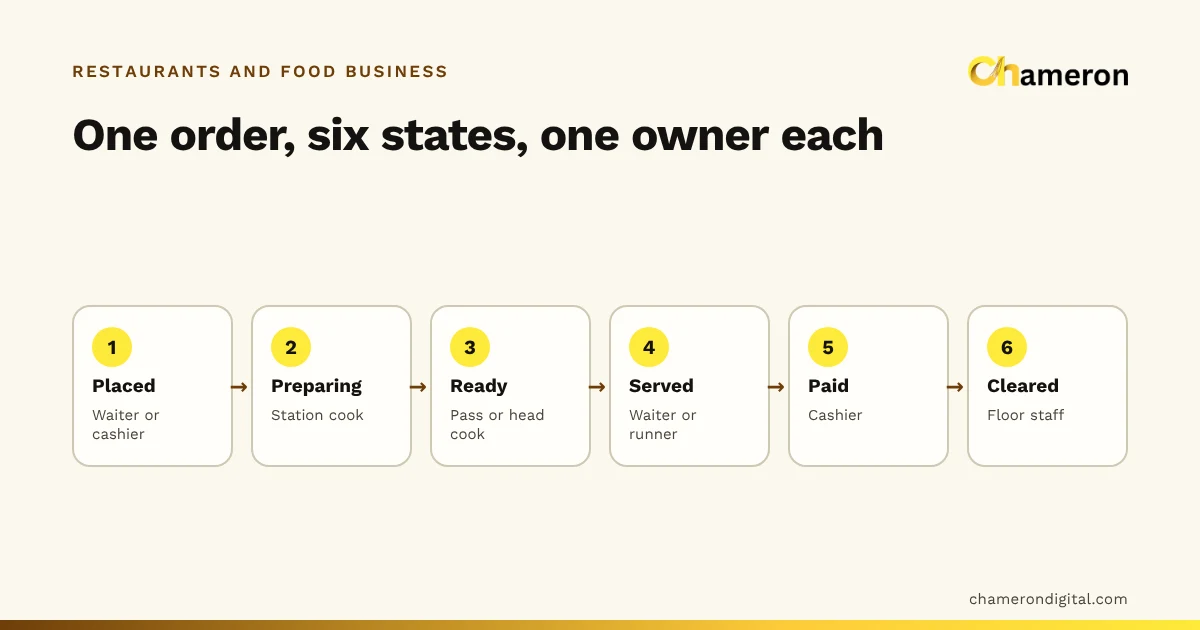
A restaurant service is a chain: seat, order, cook, serve, pay, clear, reset. The slowest link sets the pace for everything. Speeding up any other link just makes the queue in front of the slow one longer.
Common bottlenecks:
- One overloaded station. The tandoor or grill handles most of the menu while the curry station waits.
- The pass. Plates are ready but nobody is free to run them.
- Billing. Guests wait to ask for the bill, then wait again for change or for a payment to go through.
- Table reset. A table is empty but not cleared, so the next party waits at the door.
- Prep running into service. Onions are still being cut at 1 pm.
To find yours, watch one busy service with a notepad and a clock. Note where people stand waiting, which tickets run late and which tables sit empty but uncleared. Ticket times by station usually point straight at the kitchen bottleneck.
1. Simplify the menu
The menu decides how much stock you hold, how much prep you do and how many stations are busy. A long menu is the most common hidden cause of a slow kitchen.
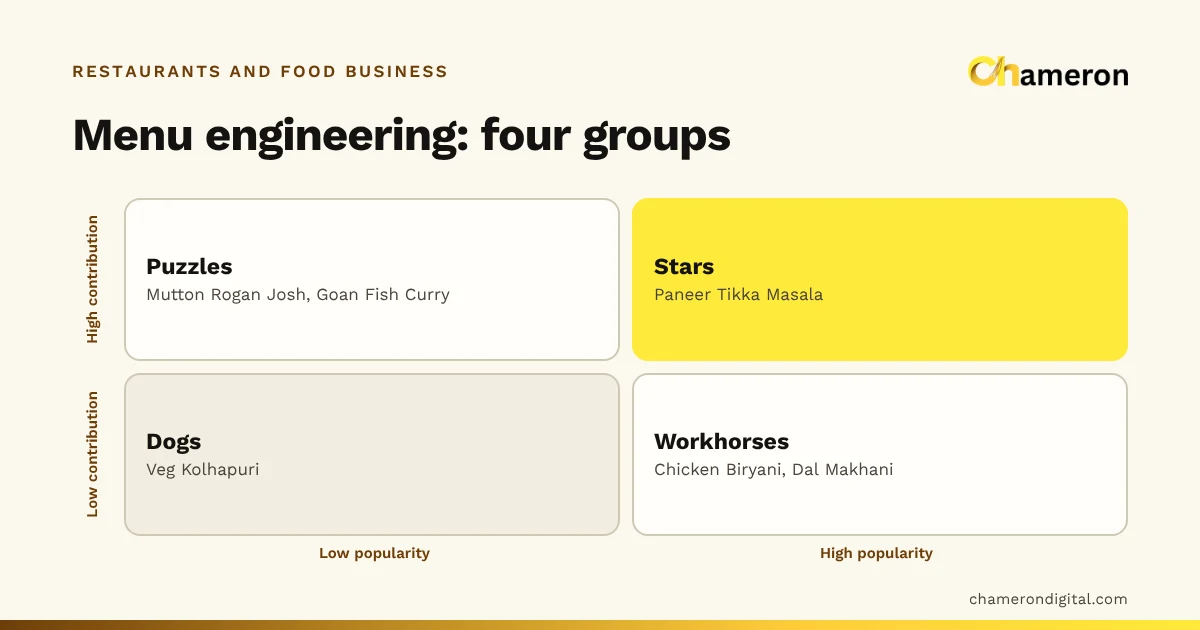
- Cut or rework dishes that sell little and earn little per plate. Our guide to menu profitability shows how to rank dishes on both.
- Share prep across dishes. One base gravy, one marinade or one dough that serves several items cuts prep time and waste.
- Balance the stations. If most bestsellers come off one station, move a dish or two to another method, or add a second set of hands there at peak.
- Price from cost, not habit. Rising costs can quietly turn a bestseller into a poor earner.
The menu price calculator does this for any dish, including the rounding.
2. Plan prep from forecasts, not habit
Prep is where efficiency is won or lost before the first guest arrives. Too little and the kitchen cuts onions during the rush; too much and the surplus goes in the bin.
Example. On Saturdays the restaurant expects about 180 covers, and roughly one cover in six orders dal makhani: 180 ÷ 6 = 30 portions. At 250 g a portion that is 7.5 kg. With 2 kg left from Friday, prep 5.5 kg.
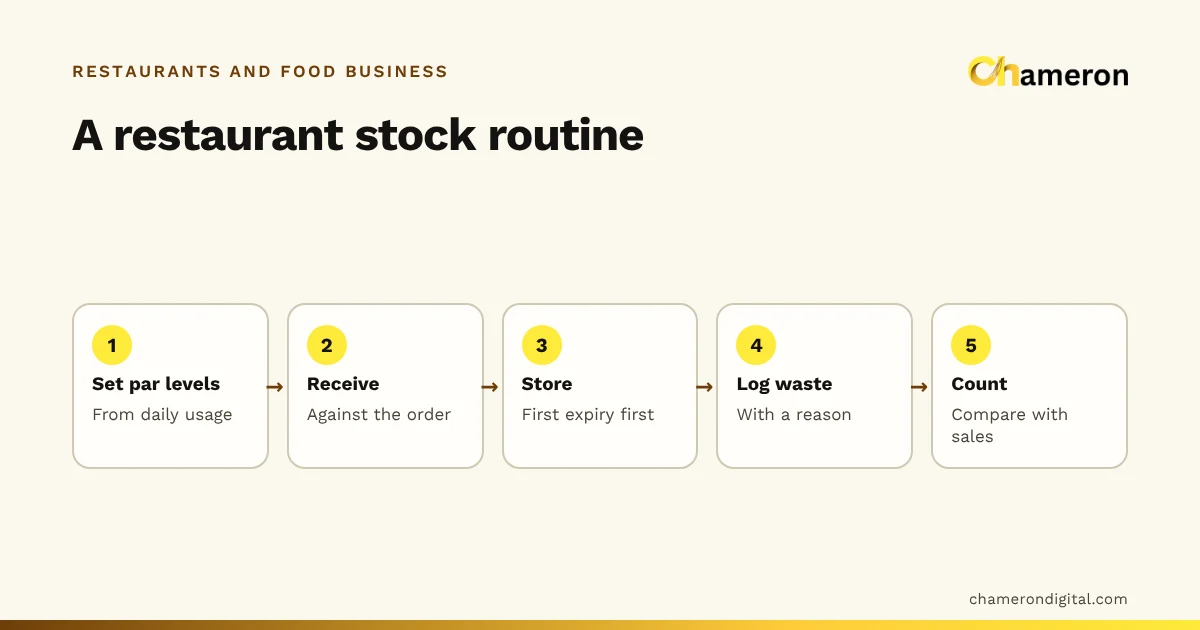
Write a prep list for each station every day, with quantities, and tick it off. Over time, compare prep with what sold and with the waste log, and adjust the shares. The restaurant inventory management guide covers par levels and waste logging, which feed directly into prep lists.
3. Make the kitchen flow
Once the menu and prep are right, look at how orders move through the kitchen.
- One path for orders. Every order on a KOT or kitchen screen ticket; nothing cooked from a shouted request.
- Route tickets by station, so each cook sees only their own work and nothing waits for someone to read it out.
- Watch the clock on every ticket. Agree target times for starters and mains, and look at the tickets that miss them, not just the average.
- Mark dishes ready at the pass, so servers know what to collect without asking.
- Fix the layout. Keep what each station needs within reach, and keep runners' paths clear of cooks' paths.
The restaurant order workflow guide covers order states and station routing in depth, and the printer guide covers KOT printers for kitchens that prefer paper.
4. Tighten the table cycle
In a busy dining room, the minutes that matter are often not the meal itself but the gaps around it: waiting to order, waiting for the bill, and the empty table nobody has cleared.
- Greet and take drinks quickly, so the order is in sooner.
- Bring the bill when it is asked for, and be ready for split payments and UPI so paying does not take ten minutes.
- Reset tables straight away. Make "cleaning" a recognised status, so a table is not offered to the next party half-cleared, and not left empty either.
- Seat to the rhythm of the kitchen. Seating five tables at once sends five orders to the kitchen at once. Spreading arrivals smooths the load.
If the same 15 tables seated three more parties a night at an average bill of ₹1,100, that is ₹3,300 more in sales, without adding a table. The question page on table turnover rate explains how to measure it.
5. Staff to the sales pattern
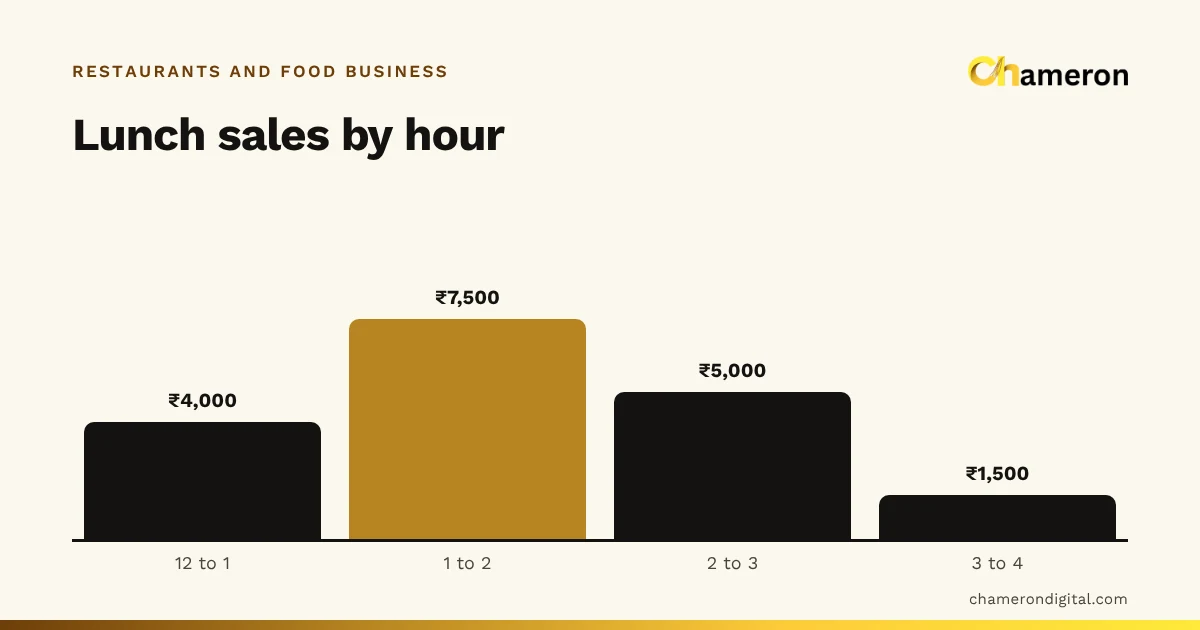
A fixed roster pays people to wait during quiet hours and leaves the team short at peak. Hourly sales show the real pattern.
| Lunch hour | Sales |
|---|---|
| 12 to 1 | ₹4,000 |
| 1 to 2 | ₹7,500 |
| 2 to 3 | ₹5,000 |
| 3 to 4 | ₹1,500 |
| Total | ₹18,000 |
Most of the lunch takings come between 1 and 3. If two of the eight staff start at 1 pm instead of noon and the same two finish at 3, lunch uses 6 × 4 + 2 × 2 = 28 labour hours instead of 32, and sales per labour hour rise from ₹562.50 to about ₹643. The quiet hour is a good time for prep, deep cleaning and receiving deliveries.
Cross-train where you can. A server who can help on the pass, or a cook who can run the tandoor at peak, absorbs the unexpected without calling in extra people.
Common mistakes
- Speeding up the wrong step. A faster till does nothing if the bottleneck is one tandoor.
- Cutting staff instead of moving them. Shift timings first; headcount later, if at all.
- Rushing guests. Efficiency comes from removing waits guests did not want, not from hurrying the meal they came for.
- Changing five things at once. You will not know which change worked. Change one thing, measure for a week, then the next.
- Measuring the whole day as one. Lunch and dinner behave differently; so do weekdays and weekends.
- Ignoring fixed costs. More covers only help if each one earns more than it costs. The break-even calculator shows how many sales cover your fixed costs.
Using software to see and keep the gains
Most of these numbers can be collected by hand for a fortnight, but software makes them available every day. In DINE OS, kitchen tickets are filtered by station with a timer on each, the kitchen marks orders ready for the counter, tables move to "cleaning" after payment, and reports show sales by day, channel and item; see kitchen display and KOTs. Those are the inputs for ticket times, station load, table turns and menu reviews. The decisions still come from you and your team.
The bottom line
Restaurant efficiency comes from a short loop repeated often: measure, find the slowest step, fix it, measure again. Start with two weeks of ticket times, table turns and sales per labour hour, split by service. Then simplify the menu, plan prep from forecasts, route orders by station, tighten the table cycle and staff to the hourly pattern. Small, steady changes in each area add up to a calmer kitchen and a healthier bottom line.
Questions people ask
What does operational efficiency mean for a restaurant?
Serving the same or better food and service with less wasted time, food and effort. In practice it shows up as shorter ticket times, more table turns in busy hours, lower waste, and sales per labour hour that rise without guests feeling rushed.
What is a good table turnover rate?
It depends on the format. A fine-dining room expects long meals; a busy lunch place expects several turns. Measure your own rate for each service and work on the parts of the table cycle you control, such as seating, ordering, bill delivery and reset. See what is table turnover rate.
How do I work out sales per labour hour?
Divide the sales for a service by the total hours worked by all staff in that service. ₹48,000 of dinner sales with 8 staff working 5 hours each is ₹48,000 ÷ 40 = ₹1,200 per labour hour.
Will cutting the menu reduce sales?
Not necessarily. Dishes that rarely sell still need stock, prep and space. Review sales by item and gross profit per plate; remove or rework dishes that are low on both, and keep the ones guests come back for.
Does restaurant software make a kitchen faster?
It removes some delays, such as unreadable KOTs, orders sent to the wrong station and time spent adding up bills, and it gives you the timing and sales data to find bottlenecks. The kitchen still needs good prep, layout and staffing.