The short answer
Retail stock management is the set of routines that keep your shelves full of what sells and your records equal to the shelves. Every unit enters the shop, moves around it and leaves it, and each of those movements needs a habit and a record. Shops that manage stock well do the same few things on the same days: receive before shelving, refill the floor from the back, take returns against the bill, count a little every week and reorder from numbers.
This guide is for a shop that is already running. If you are setting up from scratch, start with inventory management basics for a small shop.
Follow one unit through the shop
Before building routines, list the ways stock can move. Each one either changes the quantity you own or only changes where it sits.
| Movement | Quantity in your records | What to record |
|---|---|---|
| Delivery received | Goes up | Supplier’s bill, quantity, cost, batch and expiry |
| Backroom to shelf | No change | Nothing, if you track one quantity per item |
| Transfer to another shop or godown | Down here, up there | A transfer note at both ends |
| Sold | Goes down | The bill |
| Customer return, resaleable | Goes up | Return against the original bill |
| Damaged or expired | Goes down | Reason and date |
| Returned to the supplier | Goes down | A debit note |
| Count difference | Up or down | Approved adjustment with a reason |
If a movement in your shop is not on this list, or happens without its record, that is where your stock figures will drift.
Receiving: the first routine of the day
Fix a receiving window, for example before 11 am, so deliveries are checked calmly instead of during the rush. Then follow the same order every time:
- Count the goods against the supplier’s bill, not against what the delivery person says.
- Check cost prices against what you agreed.
- Note batch numbers and expiry dates for items that have them.
- Set damaged units aside.
- Label anything without a usable code, then shelve.
The price check matters more than it seems. Suppose you agreed ₹180 a unit for a tiffin box and the bill says ₹195 for 40 units. That is ₹15 × 40 = ₹600 paid in excess, and every later margin report on that item will be wrong if nobody notices.
Shelves and display: keeping the floor full
A shop can have stock and still lose the sale if it is in a carton at the back. Start each day with a gap walk: go along every aisle, note empty or thin facings, and refill them from the backroom before customers arrive.
- Rotate as you refill. Older stock goes to the front so it sells first; for anything with a date, the earliest expiry goes first. The glossary explains FIFO and FEFO.
- Display pieces are still stock. A mannequin’s outfit or a demo unit is counted like anything else. When it becomes soiled or worn, mark it down and record the change.
- Keep a minimum on the floor for your fast sellers, for example three facings, and refill whenever it drops below that.
Transfers between shops or a godown
Transfers cause more mystery differences than almost anything else, because they are often recorded at only one end. A sound transfer has three steps: the sender records the items leaving, the receiver counts what actually arrives, and any difference is raised the same day.
For example, a shop sends 20 kurtas to its second branch and the branch counts 19. If the transfer is recorded at both ends, the missing kurta is visible at once and can be traced to the packing, the vehicle or the counting. If it is recorded only at the sending end, it surfaces months later as an unexplained shortage.
Shops with several branches can keep stock per store and transfer it between them in BILL OS; see the notes on multi-store retail.
Customer returns and exchanges
Take every return against the original bill, so the right item, size and price come back. Then sort it:
- Resaleable: back into stock and back on the shelf.
- Damaged or used: into a damaged area, out of saleable stock.
An exchange is two movements, one in and one out, and both must be recorded. A size swap done "informally" at the counter leaves the system thinking you still have the large and have sold the medium. On GST bills, a return is normally handled with a credit note; check the correct treatment with your accountant.
Damage, expiry and supplier returns
Keep one marked box or shelf for damaged goods and empty it every week:
- Return what the supplier will take back, recorded as a debit note that reduces what you owe.
- Mark down what can still be sold as seconds.
- Write off the rest, with a reason.
Once a month, list items expiring in the next 30 to 60 days and decide what to do with each while there is still time to sell it.
Shrinkage: measure it before you fight it
Shrinkage is stock you have lost without selling it. Measure it at cost price, and compare it with sales for the same period so that different months and sections can be compared.
Invented example: a stationery section’s records show ₹2,40,000 of stock at cost, and a quarterly count finds ₹2,34,600. Shrinkage is ₹5,400. The section sold ₹3,60,000 in the quarter, so shrinkage is ₹5,400 ÷ ₹3,60,000 × 100 = 1.5%.
Then split the ₹5,400 by the reasons recorded at the count. Some will be paperwork: a delivery never received in the system, or an exchange done off the bill. What remains unexplained is where to look at theft, damage and supplier short deliveries.
Counting: a little every week
Full counts are slow and tiring, so mistakes creep in. Rotating counts are easier to sustain:
| Group | Examples | Count |
|---|---|---|
| Fast sellers and high-value items | Phones, branded jeans, top-selling packs | Every week or two |
| Everyday stock | Most of the shop | One section a week, in rotation |
| Slow movers | Seasonal items, spare sizes | Monthly or quarterly |
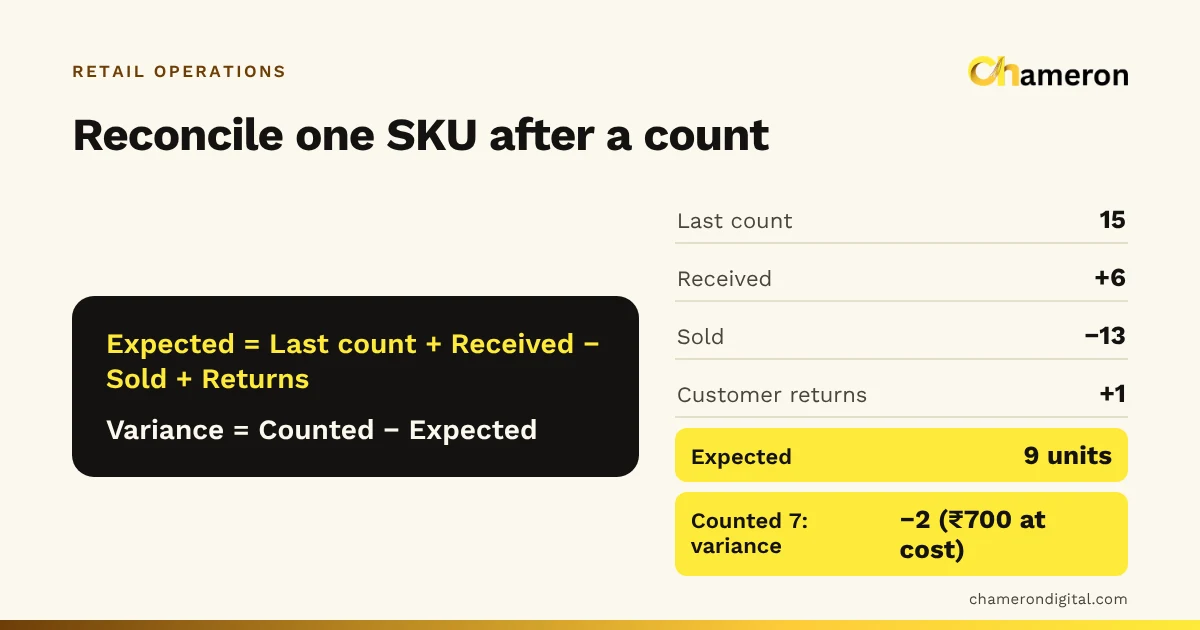
Count blind, without looking at the system figure, recount differences, and approve adjustments with a reason. The full method is in stock counts and reconciliation.
Reordering from numbers
A reorder point is the stock level at which you place the next order, so it arrives before you run out.
A notebook sells 8 a day, the supplier takes 4 days to deliver, and you keep 12 as a buffer: 8 × 4 + 12 = 44. When stock falls to 44, order. To cover two weeks of sales, order 8 × 14 = 112, rounded up to a carton of 120. The reorder point calculator does this for any item. Recalculate after festivals and season changes, when daily sales shift.
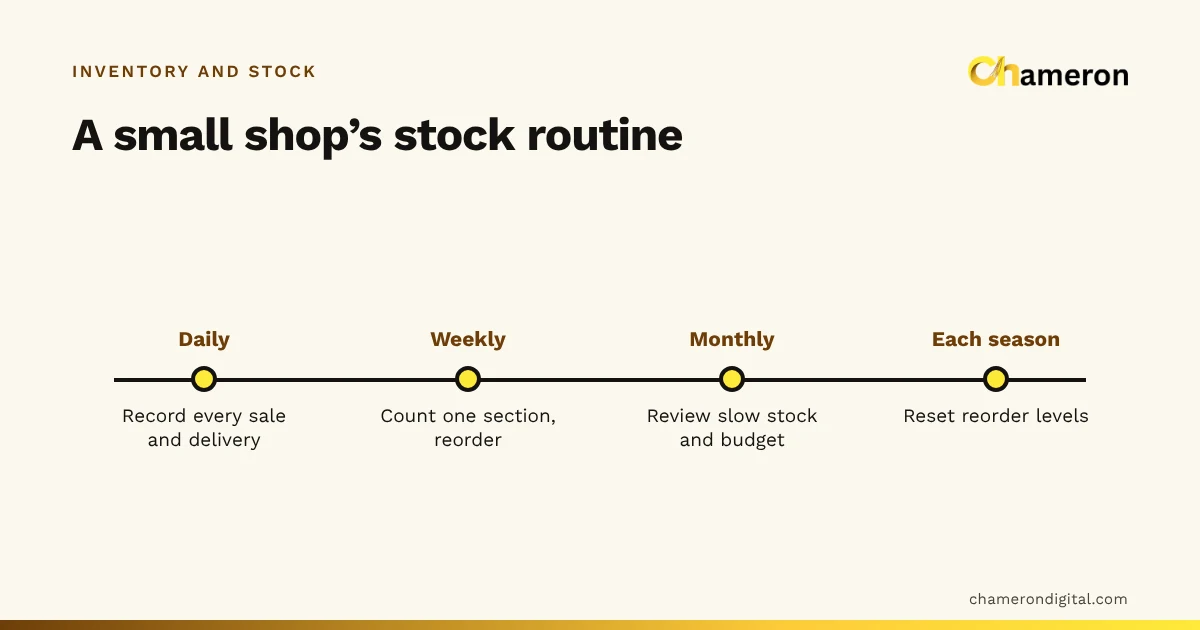
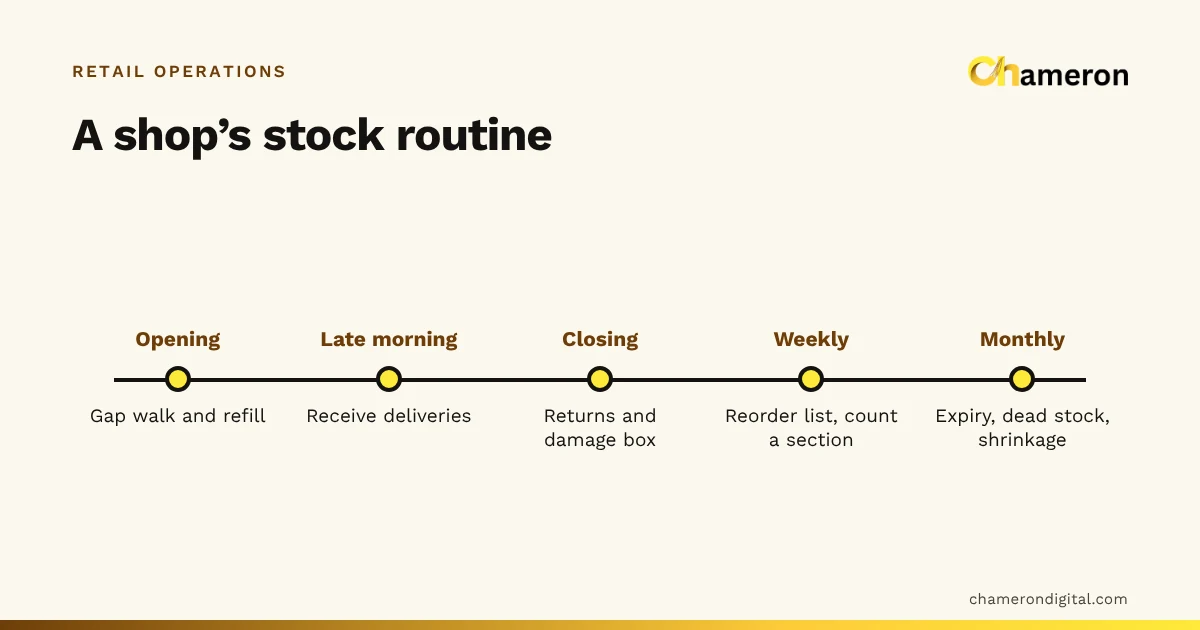
A simple stock calendar
| When | Routine |
|---|---|
| Every morning | Gap walk and refill from the backroom |
| Every day, fixed window | Receive deliveries against the bill |
| Every evening | Put away returns; move damaged items to the damage box |
| Weekly | Reorder list; count one section; clear the damage box |
| Monthly | Expiry list, dead stock review, shrinkage by section |
| Quarterly | Wider count of slow movers; review reorder points |
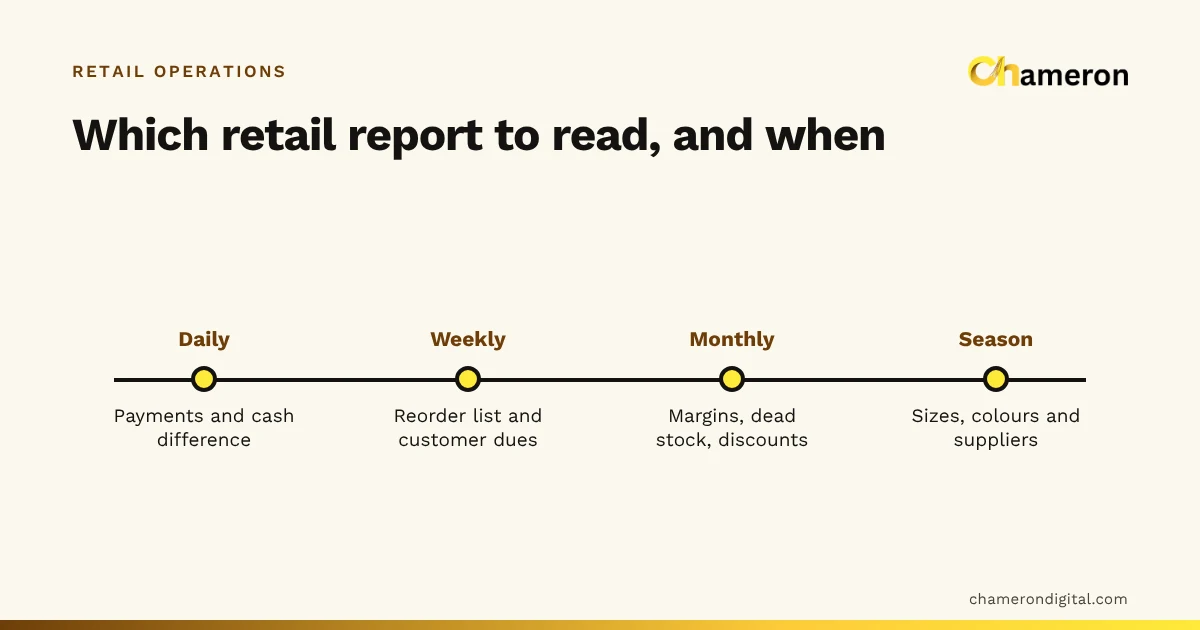
Pair the calendar with the reports that matter: sales and payments daily, reorder and dead stock lists weekly or monthly.
Common mistakes
- Treating backroom stock as "not in stock". The system is right; the shelf is empty. A gap walk fixes it.
- Recording transfers at one end only. Every transfer needs a sender’s record and a receiver’s count.
- Never updating reorder points. A level set in a quiet month is too low for the festive season.
- Counting only when something looks wrong. By then the trail has gone cold.
For more habits that quietly damage stock records, see inventory mistakes to avoid.
The bottom line
Retail stock management is not a project you finish; it is a routine you keep. Record every change in quantity with a reason, receive before shelving, refill from the back each morning, count a section each week and reorder at a calculated level. Done consistently, these habits keep the shelf, the records and the cash tied up in stock in step with each other.
Questions people ask
How often should a retail shop count its stock?
Count your fastest-selling and most valuable items every week or two, everything else in rotation over a month or a quarter, and do a full count when your accountant needs a year-end figure. Small, frequent counts find problems while they can still be traced.
What is a normal level of shrinkage?
There is no single right number; it depends on what you sell and how. Measure your own shrinkage the same way each quarter, by section, and investigate any section where it rises.
Should backroom stock be recorded separately from shelf stock?
Most small shops record one quantity per item and use a daily gap walk to move stock from the back to the floor. Separate locations are worth recording when you have a godown or a second shop, where stock is genuinely in another place.
What should I do with a returned item that is damaged?
Accept the return against the original bill if your policy allows it, but put the item in a damaged area, not back on sale. Then return it to the supplier, mark it down, or write it off with a reason.
How much stock should a shop keep?
Enough to cover sales until the next delivery arrives, plus a buffer for busy days. See how much stock should a shop keep for a simple way to work it out.